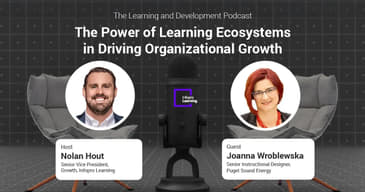
Discover how learning ecosystems drive organizational growth by connecting people, technology, skills, and learning strategies to improve performance and business outcomes. Also Listen - The Power of Learning Ecosystems in Driving Organizational Growth
Podcast Takeaways
Technology should align with organizational goals, not just trends.
Learning ecosystems thrive on collaboration between leadership, L&D, and learners.
AI adoption is growing rapidly, but strategy matters more than tools.
Structured chaos can be a valid AI strategy: experiment, learn, and iterate.
Trainers’ roles are enhanced, not replaced, by technology.
AI tools like Gamma and Notebook LM can amplify creativity and efficiency in facilitation.
Learning culture starts at the organizational level and drives engagement.
Evaluation models like Kirkpatrick still matter; execution is key.
The ultimate L&D goal is to connect learning, performance, and technology into a unified strategy.
[00:00:08] - [Speaker 0]
To the Learning and Development Podcast sponsored by InfoPro Learning. As always, I'm your host, Nolan Hout. Joining me today, we have Joanna Brobleska, who has over fifteen years of experience designing corporate learning experiences, instructional design, LMS, all types of experiences, working with some of the world's largest Bristol Myers Squibb, Microsoft, Google, etcetera, etcetera. Today, we're going to be talking with Joana about her journey through L and D, some of the things that she's learned along the way, and specifically talk a little bit about how we can use technology to elevate learning, really, regardless of what your role is in the L and D function, whether you're at the org role, trainer facilitator, individual learner. But with that, we're not going to learn from me today.
[00:00:52] - [Speaker 0]
Let's learn from our guest, Joana. Welcome to the podcast. Pleasure to have you on.
[00:00:57] - [Speaker 1]
Thank you. Thank you for inviting me. It's pleasure to be here. Maybe I will start a little bit telling a little bit about myself. I like, like you mentioned, I have a nice experience working with L and D or maybe training in general.
[00:01:20] - [Speaker 1]
Right?
[00:01:21] - [Speaker 0]
Yeah.
[00:01:21] - [Speaker 1]
And mentoring people. Currently I'm a mentor at ATD, Puget Sound ATD. I am supporting some individual on their journey, which is exciting. And I also have a mentor because in being in a learning industry, I think the growth never ends.
[00:01:47] - [Speaker 0]
Yeah, it doesn't. I mean, you're in the learning industry or not, let's hope the growth never ends.
[00:01:53] - [Speaker 1]
Exactly. Exactly. Exactly. So, I graduated with a master's degree. And one month later, I landed in The US, where I started, you know, my journey at colleges and universities here as well.
[00:02:18] - [Speaker 1]
So having all this kind of knowledge and experiences in being as a student, I started my career. And I started my career from teaching, from teaching in college. That was a fantastic experience. And I, I always will remember this as, as, as a perfect, perfect experience for their first job. Right.
[00:02:55] - [Speaker 1]
And then I connected to learners immediately. I, I tried to understood what, what they want to achieve, how they are, you know, understanding the material and how we can prepare better material for them. And that was the first my first first experience. And this experience stayed with me. Now I am senior instructional designer at Pure Sunfarms Energy.
[00:03:35] - [Speaker 1]
And I love it. And I totally love what I'm doing. And during those times of my journey, during my journey, I definitely get kind of insights how we as people can elevate our experience in L and D. And not only in L and D, in organization. And I don't want to put any organization on the spot, but in general, what I can say that we have like three levels of focus.
[00:04:30] - [Speaker 1]
One is leadership on executive level. The other is L and D trainers, instructional designers, program managers, and, of course, learners. Right? And I sometimes I'm using a kind of terminology or metaphor that we live in ecosystem, learning ecosystem, and we need to function together and we need to create our, our connection and our vibe in order to achieve company goals. And this is very, very important for this connection is very important.
[00:05:29] - [Speaker 1]
And now technology. How technology can help us to achieve those goals. How technology can elevate even better experience. And I worked your podcasts many times, and I see, first of all, you have fantastic guests. Thank you for sharing people and and, you know Yeah.
[00:06:02] - [Speaker 1]
The
[00:06:02] - [Speaker 0]
thanks goes to them for joining this schlub on the on his podcast.
[00:06:07] - [Speaker 1]
Yeah, it's it's it's really it's really it's really fascinating to to listen and and and and hear, you know, different reflections and different perspectives on learning and development on our work. What I want to see, and you probably agree that we live in a technology time, right? That everything is so focused on this tool and that tool and this platform and that platform. We have AI and how we can use AI in L and D. And this is fantastic.
[00:06:50] - [Speaker 1]
And I, and I love it. And I am the, the person who usually, you know, sends email to my manager, Hey, we have update to this software. Can we have this newest version?
[00:07:02] - [Speaker 0]
Right. Yeah. This new thing.
[00:07:03] - [Speaker 1]
Yeah. This is the new thing. But, you know, I also recognize over the time that even with those amazing tools which we have, we need to focus more and align more our efforts with organization level.
[00:07:25] - [Speaker 0]
Yeah. Yeah. I mean, I think we, you know, I, speaking of that, it's interesting that you bring that up. I was talking about just last week I was at a conference, the Training Industry Strategy Conference, and I was speaking there about how to leverage AI strategy. And it was really interesting because a lot of what I traditionally, you know, talk about and do webinars and, you know, videos on is, is the hands on use of AI.
[00:07:53] - [Speaker 0]
But as I was kind of preparing for this session, I actually did quite a bit of research into the strategy component of AI. And just tried to get like a little bit more experience from others outside the organization and understand what was their strategy. Cause a lot of people are doing right. They're out there doing, they're, they're getting the club, they're getting the GPTs, they're doing this. And it was, and I realized that the reason is that the amount of technology, the amount of the rate of change with AI is unparalleled.
[00:08:28] - [Speaker 0]
I mean, one of the things that I discovered is we're at 40% of adoption with AI in just two years in The United States. To give you some comparison, it took twelve years for computers to reach that level. So twelve years before computers were adopted at 40%, we're six times faster than we than that. And that generates a lot of chaos, to put it quite simply. And, and so your knee jerk reaction is go out and get things.
[00:09:00] - [Speaker 0]
It's a simple way to do it. I don't blame them, right? Go out, buy this thing, buy that, whatever thing.
[00:09:04] - [Speaker 1]
But,
[00:09:06] - [Speaker 0]
but a report by MIT Sloan's their business college And the gentleman that read it is a or who conducted this survey is the gentleman who wrote Blue Ocean Strategy, which is a very prominent business book. He was saying only 5% of AI projects achieved rapid revenue recognition, which is just amazing, right? It was just companies going out there, as you said, buying a software or doing something without the, the, how does this fit into my larger ecosystem? And so I think you're right on the spot there that, that the, the right way to look at technology is how does this play in this environment that we operate in versus just looking at it from a, what is this one specific role in the company or one specific job that AI helps me do? I would, it's interesting.
[00:10:03] - [Speaker 0]
I would, I would also maybe caution people though, because there is a point in which strategy can, can, can suffocate you, I feel like. You just get so caught up in trying to design something perfect and thinking so high level. Do you end up not doing anything? With the pace of change being so fast, if you try to wait for things to cool down before you implement your strategy, well, good luck. It's not going to happen.
[00:10:32] - [Speaker 0]
So, you know, I think there's there's like, there's better terms for it, but in my mind, what I'm thinking of is almost like structured chaos, you know, like a strategy could be. I want my team to go out there and find the best 10 tools and purchase those and acquire them and then report back on how that is. It doesn't, you know, that's a strategy. What's not a strategy is to not have a strategy. Yeah.
[00:11:00] - [Speaker 0]
Is to just let John buy this software, Jim buy this software, Sarah buy that software and do nothing to try to integrate the three, do nothing to try to learn from the lessons of the three. So again, I, while we're talking about strategy, I also want to caution people. Sometimes a strategy can be as simple as let us go out there and learn a lot and come back and share it together.
[00:11:26] - [Speaker 1]
Yeah, yeah, yeah. Yeah, I totally agree. I totally agree with that. And, and I, I also will add another piece that on executive level, company has certain goals.
[00:11:44] - [Speaker 0]
Mhmm.
[00:11:44] - [Speaker 1]
And we, as L and D, we are kind of aligning to this strategy. Right? Because we support our training's supposed to prepare Mhmm. People for for, you know, for performance, for good performance, for achieving those goals. Right?
[00:12:03] - [Speaker 1]
And we know the group of people, our target audience, and, you know, the age, the the persona, I would say.
[00:12:19] - [Speaker 0]
Mhmm.
[00:12:19] - [Speaker 1]
Right? The persona. And which kind of technology they will benefit from.
[00:12:27] - [Speaker 0]
Mhmm. Mhmm.
[00:12:30] - [Speaker 1]
Because what what what I see, like you mentioned, you went to a conference recently. I am getting at least twice a week messages through LinkedIn from people who are developers of different, you know, L and D tools. And and I think those are great tools, but I don't know if we really need those simply because because we we have what we have, and at this moment, it's good. Can we can it just be better? Can this be elevated?
[00:13:15] - [Speaker 1]
Of course, it can be. But is this really aligning with our strategy?
[00:13:20] - [Speaker 0]
Yeah. The, the the, you know, there was a lot of money made still is a lot of money being made from a lot of SaaS organizations who create pain points that, that weren't really there. You know, they solve a problem, but it's maybe not the critical problem, a really, you know, good use. So, so we do have to be careful because I think you can go into one, as you mentioned, if all, if you respond to all of those messages, if you're always looking at the next greatest tool, you'll do nothing but be in demos all day long. You just won't.
[00:13:59] - [Speaker 0]
I promise you there's enough tools out there that that's what you'll do. Then you'll be on their email list for like a decade. So good luck. But then there's also, you know, I think I'm kind of like you where I do take them every now and then though. Like, I just, I feel like it's important for me to keep my sword sharp to know.
[00:14:19] - [Speaker 0]
And what I kind of tell myself is even if I'm not trying to buy the tool, I'm going to learn something, you know, I'm going to learn the way that they're doing it or whatever they're pitching. It helps me stay fresh and helps me kind of get something new to my repertoire. Again, you know, just like anything, right? The answer is, should you take those calls? It depends.
[00:14:42] - [Speaker 0]
But, but really don't. You can definitely get, especially these times with so many AI tools, I must come across a new one every day that promises, you know, end to end AI, create a, create a course in five minutes. I'm telling you that doesn't exist. If anybody out there, please message me if I am wrong. Please do.
[00:15:04] - [Speaker 0]
I have tried Course Box. I have tried SliceKnowledge. I have tried Storyline. I have tried any of these tools. Creating something that I would say is better than just creating an AI agent to give somebody a Q and A.
[00:15:21] - [Speaker 0]
I don't think I've seen something that can do that in fifteen minutes. So, very good. You know, one of the things that you, that we wanted to really pull down on, on was this idea of, of using technology kind of across these different, you know, areas. And so we started the org level, what can an organization do? How does the org technology support learning at a trainer facilitation level, right?
[00:15:47] - [Speaker 0]
How are we using it in our presentations and then at the individual learner level as well? Let's start at the kind of the top, the org level, you know, using technology. What is really key for orgs to look at when they're looking at their tech stack of what they need to support a good learning ecosystem, training ecosystem?
[00:16:06] - [Speaker 1]
I think, I think, I mentioned previously, we need to establish what are the goals, the company goals, right?
[00:16:14] - [Speaker 0]
Is size
[00:16:17] - [Speaker 1]
of the company? How big are we? Right? If there is a couple thousand organization that the training delivery is different than for smaller organizations, right? So this is number one, because then we can think about some LMS system.
[00:16:34] - [Speaker 1]
Right? Yeah. But having LMS system, it doesn't mean that we have L and D.
[00:16:41] - [Speaker 0]
No. No. No. Not at all.
[00:16:45] - [Speaker 1]
But I came across during my career that kind of mentality.
[00:16:50] - [Speaker 0]
Yeah, no, totally exists.
[00:16:53] - [Speaker 1]
We bought that. So we are good to go. No, did first step. This is very good step. We can deliver our trainings right now.
[00:17:03] - [Speaker 1]
We can for example, Cornerstone. To Cornerstone, you can add plugins like Edcast or LinkedIn. Right? You can purchase some licenses and learners, you know, employees have plenty of opportunities to use those free trainings. Right.
[00:17:25] - [Speaker 1]
Which we, which we as LMD, we are not producing. But what I'm seeing, I'm seeing other strategy behind that. I see strategy of creating learning culture.
[00:17:42] - [Speaker 0]
Yeah. That's big.
[00:17:43] - [Speaker 1]
That's huge. And even starting from small things like having Toastmasters at the workplace. Right? Mhmm. Having leadership development, you know, promoting those, you know, Edcast or LinkedIn or whatever.
[00:18:03] - [Speaker 1]
Yeah. That is like, hey. You guys have add additional resources. Right? So that will bring the culture culture and and that that on on an an organizational level will create this kind of, okay, that's where we are.
[00:18:18] - [Speaker 0]
Yeah. I don't think we can stress enough the importance that an org drives on culture nor the importance of culture on driving learning. If that is not part of your culture, it's really hard. Everything else you spend money on, you're going to be fighting uphill because you're going to be working against the friction of the company saying, don't like training. Don't like so every time you push in so hard and then the second you stop investing, drops back down.
[00:18:47] - [Speaker 0]
So you're constantly so so absolutely agree at an org level. At the trainer facilitation level, how are you seeing companies, you know, obviously we've got platforms like this, you know, technology, but what are you seeing to help enhance kind of that, that, that experience for trainers, facilitators?
[00:19:04] - [Speaker 1]
Trainers and facilitators, I see very special role for them. In terms of, of using technology, they, they have a wonderful playground, I will say, to use those toys to enhance the training experience. They can create micro learnings, they can create blended trainings with, you know, in classroom and some parties online. They can create they can, you know, create a special labs where technology is, like right now, my, company PSC, they are opening training center in YAP in, Washington.
[00:19:59] - [Speaker 0]
Oh, wow.
[00:20:00] - [Speaker 1]
Yeah. Fantastic, fantastic facility with labs. And they had the labs have newest technology. Newest technology for people who are learning how to, you know, became electrician, etcetera, etcetera. So that kind of things helps to, you know, people to learn.
[00:20:28] - [Speaker 1]
But for trainers, if if I can finish, for trainers is nothing will the technology will not replace trainers. It will just elevate their, their, the role.
[00:20:46] - [Speaker 0]
Yeah. Yeah. I think so. Yeah, you're right. There's kind of two folds of the trainer, you know, there's the people taking it and there's, yeah, there's things like lab simulations, things like that, that are bubbling up everywhere.
[00:21:00] - [Speaker 0]
For me, how I like to, you know, if I'm a trainer facilitator, you have to realize that that role is changing.
[00:21:07] - [Speaker 1]
Oh yeah.
[00:21:07] - [Speaker 0]
You already have experienced it. I mean, you've already had to learn digital learning skills, but I think it's going to take one step further because people are going to need the human element even more so actually with AI. Going to need a connector, somebody to connect the dots, somebody to say, give me some advice or help me find this tough to find answer. You are going to be the proverbial bartender of the company who connects the person sitting at this end of the bar to that person and generate the conversation. So that's one skill.
[00:21:39] - [Speaker 0]
We talked about technology, unfortunately, it's not like a tech thing, just to put that out. But technology for me, there's, there's a couple of things in my mind. One of the things that I do is I practice and I leverage AI to create better presentations. Oh yeah. So like I'll use Claude, which is a GPT, know, Chegg GPT, that kind of tool to help me I'll turn an idea into a presentation.
[00:22:06] - [Speaker 0]
So, cause I like, I like to use that tool to then get my basis of what I'm trying to get done. And then I'll use a tool. I use gammagamma. I think it's gamma.app I think is the domain. There's a free version of it.
[00:22:22] - [Speaker 0]
Just load in my brand and I say, a presentation. Here's my outline. Now go create the presentation. I am telling you, I actually got this feedback from my designer. I sent over the doc his way and I said, Hey, I just need you to spruce up a couple of slides.
[00:22:35] - [Speaker 0]
I wasn't able to get it how I wanted. And he sends it back and he goes, My team took a crack at it, but honestly, what you've got there in Gama is better than what I did. So just go with your original version. And I have a design team like these are designers on my team and they're like, it's actually pretty dang good. Go with it.
[00:22:53] - [Speaker 0]
So you have tools like Gama that can help you create those, but then you can even go one step further and you can actually practice this presentation, right? You can either load a video in or actually just talk or load a script in into a Claude or a ChatGPT or a Gemini, whatever it is, and ask for notes the last and say, you know, how did I do? What should I stress on? The last tool I think that you can use as a facilitator is, is not actually in as session, but as a leave behind. If you take all those notes, you take all those same things, throw it into a tool, NotebookLM also free, who doesn't love free loading it and it's completely secure.
[00:23:32] - [Speaker 0]
It doesn't take your, your, it doesn't learn from your data or anything like that. Throw that into NotebookLM, press a button and it generates a podcast for you. Right? Leave this at, Hey, you know, thanks for coming as a special thank you. If you want to have a download an audio to take along with you, finer points are here.
[00:23:50] - [Speaker 0]
So lots of cool things we can do, you know, on a trainer facilitation, both to practice and kind of learn along the way. And then we have the last one, Is the individual learner. How's technology impacting them?
[00:24:03] - [Speaker 1]
Well, technology brings them, you know, learning experience. Technology helps them to have better metrics, better understandings, more resources. Mhmm. And to sometimes individual may feel kind of intimidated to ask question directly. So having like online version may be very helpful for for for him or her.
[00:24:39] - [Speaker 1]
Right? Or for them. Mhmm. To kind of, you know, go over the same material again. I truly believe that if trainers, instructional designers understand the how and use different methods to help people learn and design the training by using technology.
[00:25:14] - [Speaker 1]
Learners are quicker to adapt to company goals.
[00:25:20] - [Speaker 0]
Yeah. Yeah. And I mean, which is, you know, what's important though, that as you said at the very beginning, that you have to be attached to those goals.
[00:25:29] - [Speaker 1]
Yeah. You have to be attached.
[00:25:30] - [Speaker 0]
Was so funny. I saw this article and I've never, I never do this. I saw this article on LinkedIn and it was talking, it was actually bashing kind of their Kirkpatrick model, the Phillips model of learning evaluation and learning performance. I wrote and I said, you know, I'm sorry, but this, this is silly To say that the reason that learning isn't being able to show ROI is because there's a flaw in the model. Not a flaw in the model.
[00:25:58] - [Speaker 0]
There's a flaw in your implementation of like, like all these models, Phillips, Kirkpatrick, whatever the model is. It's your ability to execute and implement that model, right? The very first thing of that study, it was so fascinating. First and this is why I actually made a comment on LinkedIn. I don't know if I got taken down or not.
[00:26:18] - [Speaker 0]
Because I but I said, listen, your first reason about why Kirkpatrick isn't a good model is because they found that 50% of the time people stop at level two
[00:26:28] - [Speaker 1]
evaluation. Well, what's the
[00:26:31] - [Speaker 0]
problem here? Is the problem with the model? No, the problem is that we aren't even getting to level three and level four, which is measuring business metrics anyways. So yes. Is there a problem with the model?
[00:26:42] - [Speaker 0]
Well, specifically, maybe because it's hard to implement, right? Like maybe for your org, whatever it is, that's not the best model for you. But I do think, you know, this is a long tiring to just say that, that as long as you're designing it, whether you use ScrewPadra or you use anything else, I don't care, whatever, or not even a model. As long as you're connecting everything in this learning training ecosystem back to that business performance, as you said, yes, every, every little, every session, every thirty minutes, fifteen minutes, five minute video, all of these little things, we don't need any more studies to show us the impact on the business. We have countless studies that say, you know, the more engaged employees are, the better they perform.
[00:27:26] - [Speaker 0]
And one of the best ways to engage employees is to help them develop their careers. We know this, that's been proven so many times. So if you can connect the business to that, you've got a winning success winning outcome. But
[00:27:39] - [Speaker 1]
that's exactly, that's the key that we need to connect those three layers.
[00:27:45] - [Speaker 0]
Yes.
[00:27:46] - [Speaker 1]
We need to connect those three layers and we need to, And and technology, the best, even the best. It's just helpful tool, not not the strategy. Strategy is different. The strategy is to align all those three layers together. And during my career, honestly, I as as much I am huge fan of Kirkpatrick, but I hardly met four levels of evaluation.
[00:28:19] - [Speaker 0]
Yeah.
[00:28:20] - [Speaker 1]
And and and then I'm not criticizing anyone. It is just because we we are not doing it. We are just not not not we don't have time. We don't have energy. We don't have we have other things to do.
[00:28:34] - [Speaker 1]
We have bunch of other training. Right?
[00:28:36] - [Speaker 0]
That's the reality, I think, is that you end up you not just you, mean, you know, any, any, like if you look at other orgs, marketing is a really good example, right? Marketing is constantly what's coming out next? What's the next ad? What's the next campaign? What's the next whatever?
[00:28:55] - [Speaker 0]
But then this really big thing came about attribution, right? Like, well, are, how is this marketing coming back to dollars? And even in a field that is very digital, that is investing billions into this space, they still get it wrong a large majority of the time. Right? They have they have people's whole job is to just try to build those connections.
[00:29:19] - [Speaker 0]
And again, this is something fairly tangible, right? This is like, did the person spend money with us because of what you did or not? Now, obviously there's nuance, right? Like you, you like we went to an event last week. Maybe somebody does business with us because of that.
[00:29:33] - [Speaker 0]
We might never know. But maybe we do. So, but level four, it's really hard to get to. But I think a lot of it is just like this idea of, of where we are being pushed to just put more out, more out, more out, which if we leverage technology, at least for the little time we have right now, we're in the honeymoon period where you actually can leverage AI to do much more than your boss expects you to do.
[00:29:58] - [Speaker 1]
Oh, that's amazing.
[00:30:00] - [Speaker 0]
And you have time right now that we have a little more time because AI is allowing us to work faster. And the bar hasn't been reset to this super high level. Maybe we have a little bit more time to go back and look at these evaluations. Well, Joanna, thank you so much. This has been such a lively conversation.
[00:30:18] - [Speaker 0]
I really appreciate you sharing a lot of your wisdom over the different organizations, you know, and digging into how people can leverage technology at all the different levels and how those things need to come together to really create this ecosystem. This has been a phenomenal conversation with you. Are there, is there anything else you wanted that you wanted to share before, before we end the podcast?
[00:30:40] - [Speaker 1]
Well, just wanted to kind of leave our listeners with with the message that we need to cooperate. We need to I will kind of use another metaphor. We are kind of like a family.
[00:31:00] - [Speaker 0]
Mhmm.
[00:31:01] - [Speaker 1]
We need to we need to build our relationships and building relationships, understanding, have this constant, you know, dialogue, what do you need, how I can help you, how we can achieve the goal as as as a group together, and how we can use the resources which are available and which resources we we can use for for that reason. So thank you so Absolutely.
[00:31:34] - [Speaker 0]
Well, Jonah, thank you. We look forward to and maybe meet you sometime. You're I'm in a, you're in my old stomping grounds of Seattle. So if I'm in, I'm in the area, we'll look up. You so much.
[00:31:44] - [Speaker 0]
Have a great
[00:31:44] - [Speaker 1]
rest Thank of your you. Have a good day.