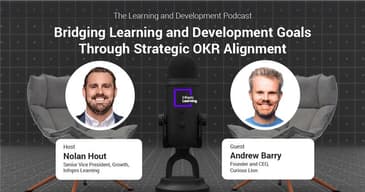
Discover how strategic OKR alignment can connect learning and development goals with business priorities, measurable outcomes, and workforce performance. Also Listen - Bridging Learning and Development Goals Through Strategic OKR Alignment
Podcast Takeaways
• How to connect L&D programs directly to company OKRs.
• The difference between KPIs and OKRs in learning measurement.
• Why developing individual contributors drives long-term value.
• Using cohort-based learning to accelerate performance and collaboration.
• Practical methods for measuring L&D impact beyond surveys.
• How to communicate ROI and outcomes to business leaders.
• Leveraging AI to link skills with organizational objectives.
• Insights from Andrew Barry’s OKR Playbook for L&D professionals.
[00:00:08] - [Speaker 0]
Welcome to the Learning and Development Podcast sponsored by InfoPro Learning. As always, I'm your host, Nolan Hout. Joining me today, we have Andrew Barry, founder and CEO of Curious Lion, whose mission is to help growing companies develop their people in unique and engaging ways. Before this, Andrew was leading content for KPMG's executive education and has held really various leadership and individual contributor roles over twenty years in the field of learning development. Today, we're going to talk with Andrew about an intersection of two acronyms very close to me, L and D, which we all know of learning development and OKRs, which are objectives and key results and we'll dig into those in just a second.
[00:00:50] - [Speaker 0]
And sorry, that's actually all I'm gonna share in the intro because I want to get into the topic. With that Andrew, welcome to the podcast.
[00:00:57] - [Speaker 1]
Yeah, Nolan. I am really excited to be here, and I was I thought a cool way to start could be the for you to share, like, what what about those two acronyms really, like
[00:01:08] - [Speaker 0]
like, jumped out at you? I've been fascinated by how much traction that post has been getting, and and I'm curious, like, what what resonated there? Well, so selfishly, Andrew, what resonated with me so InfoPro Learning, developed an OKR product. I go to a product in the market that we bundled with our learning management system in our LXP platform. I helped launch that product and get it off the ground.
[00:01:36] - [Speaker 0]
So I know the OKR realm very well, very deeply. But when we pushed it out, we we didn't really have a strong connect in L and D. Like, we we had some tangential opportunities and some things. And so when I saw these two things, I thought, wow. Like, I had had one brain on because that that product was actually ran almost as a separate business.
[00:01:58] - [Speaker 0]
So I had, my one left side of my brain is all focused on this OKR. Right side is on L and D. And now I'm seeing this post talk about both of them. And I was really happy because it it had so much engagement. I don't know how many people ended up engaging with that hundreds.
[00:02:14] - [Speaker 0]
I I think it was over a 100 comments last time I saw. Over a thousand comments. Over a thousand. So So, so good. Yeah.
[00:02:23] - [Speaker 0]
So really and it was a really happy moment for me actually because InfoPro and and myself, I've always felt that there's no point of doing a learning program unless you can measure the impact of that thing. You have to spend, you want to see the outputs of those. I always thought those two things should connect really, really closely, but I I I didn't sense a lot of, like, traction about actually trying to do that. Right? Yeah.
[00:02:52] - [Speaker 0]
Because a couple companies had tried to connect performance management to LMS, and it didn't really go well or Yeah. Too well. At least it was, like, five years ago. So that's what drew me to it.
[00:03:04] - [Speaker 1]
Yeah. I love that. I love that. I wanna maybe learn more about that product if it makes sense in the in the conversation today. But, yeah, you're you're the host.
[00:03:12] - [Speaker 1]
Where do you wanna go from here?
[00:03:13] - [Speaker 0]
Well, first, Andrew, we can't let you come on without learning more about you. I mean, you run your own business, obviously, and, but but you didn't start that. You know, you didn't just one day. You you had Yeah. Quite a bit of time at KPMG, as I mentioned, various roles.
[00:03:27] - [Speaker 0]
So help us just better understand your origin story. How did you get started? What led you on this path? Eventually, you know, ending up with kind of connecting the performance to to learning the OKRs.
[00:03:38] - [Speaker 1]
Yeah. Yeah. I mean so I'm a I'm a started back in South Africa where where I'm from as a chartered accountant. So my background is in accounting, finance, you know, business. And but I very quickly got bored over accounting and completely fell in love with the learning and development that we were going through as trainee accountants.
[00:04:05] - [Speaker 1]
So we would go to an off at least once a year, it'd be a week long event. Those are the days. And I was just like, I wanna go and do what those guys are doing, like the facilitators that we had. So I figured out I did everything I could to basically get that job at KPMG, and I got that, moved from Cape Town to Johannesburg. And I got to spend three weeks every month traveling to some part of the country teaching, right, to, like, other trainees and and then partners eventually.
[00:04:34] - [Speaker 1]
And it was awesome. I absolutely loved it. Yeah, I fell in love with the field of, you know, developing potential, right, which I think is something you you and I share in common. And so to speed up the story, I got a transfer from Johannesburg to Montvale, New Jersey, and then eventually the New York office of KPMG, and I spent about twelve years there. So working internally and then and then externally, like you mentioned, selling exec ed.
[00:05:00] - [Speaker 1]
And so I got a little, again, like, kinda back into the business side of it, trying to how do we pitch these events? How do we sell this to clients? But so and then I left KPMG. I was I always wanted to start my own thing, but I got this awesome stepping stone. Friends of mine had started a business in the hospitality industry doing high production value training for big all the big hotel brands.
[00:05:22] - [Speaker 1]
Right? So they then headquartered in Geneva, and then I helped them open a New York office and became head of learning for that company. They were they were later acquired by Ecolab. And so I got to experience this world of, like, high quality production, like, video based stuff, and I learned all about that. And throughout this process, I was just thinking, like, there's, like, a better way to teach people this stuff, especially in kinda what we would the traditional, like, approach at KPMG.
[00:05:49] - [Speaker 1]
And to me, it was some combination of these two things. And, yeah, I I set up my own my own shop in eight years ago, Curious Lion, and we just did I using the Royal Wii back in the day, I would just take on any projects I could. Eventually, I would staff up with contractors and freelancers and then slowly built a business out of that. And and, yeah, now, you know, we've we were talking offline. Like, we've we've evolved into a really specific focus, building high potential or development programs for individual contributors.
[00:06:24] - [Speaker 1]
And then this connection to the OKR thing has really become clear in the last, like, twelve, eighteen months of doing that work.
[00:06:30] - [Speaker 0]
So let's let's talk into that. That's what led us to this, the you and I connecting. And and so, you know, there's a post from Andrew Barry, and I'll just read it to you. Finally found a way to connect l and d to business results. Most l and d reporting stops at surveys in attendance.
[00:06:48] - [Speaker 0]
Useful? Sure. But disconnected from business results and invisible to the CFO. Here's the opportunity. Your company's OKRs already measure what matters most.
[00:07:00] - [Speaker 0]
What if your learning programs plugged directly into them? So that was the the post you you made and you had offered, you know, some advice and we'll get to that at the end as it could take away. But, before we get into this concept, there's a lot to unpack there. Let's just start at the highest level. Yeah.
[00:07:18] - [Speaker 0]
For those that don't have OKRs in their companies and maybe are completely, you know, never heard of that before, help us understand what are OKRs? What is their role in in measuring what matters, to steal from the founder? Start with that, and then we'll kinda dissect this bit by bit.
[00:07:36] - [Speaker 1]
Yeah. That's a really good starting point because I also actually realized in doing the post that not everyone knows what an OKR is. But everyone has the equivalent in a business, and it's essentially, I mean, OKR stands for objective and key results. So it's it's the business priorities. It's the it's the, you know, the the vision for the business, but expressed in the specific outcomes that the business is is going for.
[00:07:58] - [Speaker 1]
The the actual term OKR has kind of evolved out of Silicon Valley. John Dewar is is the creditor is kind of the main, if anybody wants to go down that rabbit hole, like, of their origin. But how I like to think about it, almost everyone in L and D is familiar with KPIs. Right? So, like, those things we mentioned, like satisfaction, like, scores.
[00:08:17] - [Speaker 1]
Right? That's an example of a KPI. KPIs are, like, vital signs. Right? So, like, you know, blood pressure, heart rates, like that kind of stuff.
[00:08:26] - [Speaker 1]
And that's an important thing to have in a business. An OKR is like your is like an exercise plan. Right? So it relies on the KPIs to know KPIs and k k and key results are kind of similar. Yeah.
[00:08:41] - [Speaker 1]
But the the the exercise plan has a future goal. Right? I wanna be I wanna be able to run a marathon or set this time in a half marathon or whatever that is. And then the key results is, like, the signals you will use to know that you've achieved that goal. Right?
[00:08:56] - [Speaker 1]
And so you can see how KPIs can kinda plug in there.
[00:08:58] - [Speaker 0]
Yeah. So so those that are not that are more familiar with KPIs. And if you go deep into this rabbit hole, you will be, you know, murdered for telling people that KPIs and OKRs have any similarities because Yeah. People really don't like to make that analogy, but end of the day so to to to simplify it, objective and key results, those are they're actually two different thing. You have an objective, which is your goal.
[00:09:22] - [Speaker 0]
Yeah. Your objective. I want to I want to run a marathon. Right. Your key results are kind of like the KPIs, if you would, that will help you determine what would you need to do to be able to hit that marathon.
[00:09:36] - [Speaker 0]
Yeah. I wanna be able to run 20 miles. I I need to, eat, you know, less junk food. You know, eat eat and and and but but the key component is, one, it's connected to this objective, and two, it has to be very measurable. Like, that is the key.
[00:09:51] - [Speaker 0]
You have to be able to measure the outcome of this thing that you're doing. And, again, it's very forward looking. Yeah. And, again, there's a there's so much nuance, but we're not gonna get into the nuance because the there's unbelievably large amounts of nuance that get done there. Let's talk about how they connect to to learning.
[00:10:12] - [Speaker 0]
Yeah. Where did you start to see this intersect? Yeah. And how is it so valuable?
[00:10:19] - [Speaker 1]
Yeah. Yeah. So if you if you just to simplify all of that, think of it as the priority business priorities. Right? Like, named business priorities.
[00:10:27] - [Speaker 1]
Yep. Yeah. And so so we so we started about eighteen months ago running these programs for ICs at the request of a client. Like like, as I'm sure you know and anyone
[00:10:36] - [Speaker 0]
And ICs is individual contributors for those that are not
[00:10:39] - [Speaker 1]
Good point. Good point. Yeah. And, actually, technically, it's experienced individual contributors. So this is, like, your four to six year tenure.
[00:10:48] - [Speaker 1]
And so this client came to us. And, again, I think this is an important point for people. Like, we didn't I didn't just come up with this as, oh, this was this like, it it was, like, the clients were looking for this. And so after having done this for a few for eighteen or so months, we kinda started realizing, oh, a lot of companies could think like this and probably will start to think like this. And we can get into that, but I think that's an important point why people should be focusing on ICs specifically because experienced ICs.
[00:11:13] - [Speaker 1]
Because of AI and things like that, they're gonna become way more valuable as we go forward. AI enables people to do way more on their own. And I think that's something to think about when you start to realize people can do become huge contributors and and and impact the business in ways that they don't need to manage people. Right? So but, anyway, we can come back to that that idea.
[00:11:34] - [Speaker 1]
But we were building these programs for ICs, and it was focused on the challenges they were they were going through. And it was all really framed around driving more impact on their own. So there was things like they were like, decision making was slow. They were having meetings about meetings, and, like, a lot of it came down to, like, cross functional collaboration, communication, being able to influence with high authority, like, those kind of skills, which, again, because I believe ISCs are gonna become more valuable and more irreplaceable, are skills that I think companies should be prioritizing. So that was the genesis of it.
[00:12:10] - [Speaker 1]
Right? Then we started to think and and these were all cross functional. So we had people from products, from marketing, from customer success, from sales, like all across the business, legal, finance. And I started to notice in our breakout room. So we teach them, like, we teach, like, how to ask better questions is one of the modules.
[00:12:29] - [Speaker 1]
Right? So, like, helping people understand customers, each other, that sort of thing. And so they go into these breakout rooms and they start talking to each other and they come out and there'd be comments like from like someone in customer success and be like, I now finally get why legal is such a jerk sometimes. Like, you know, like, I I understand now. I see their perspective.
[00:12:50] - [Speaker 1]
And I was like, I started to realize that we were not only getting delivering value by teaching them these skills, but we were actually delivering value by building a network. And people were, like, getting an understanding of different functions and understanding of each other. And then I realized that these people work on the same projects, you know, and a lot of those projects are framed as priorities or OKRs. And so these skills were helping them directly influence the outcomes of those projects and those OKRs. So, yeah, basically then started to pitch that idea with our clients and they were really interested in it.
[00:13:28] - [Speaker 1]
And I'll end this by saying the idea is incredibly nuanced, as you've said, and there's a lot of edge cases and, like, you know, it doesn't always work in practice as simply as that. Like, pick an OKR, run the thing. Right? There's, like, different so it's it's a lot more layered, but you can legitimately show business impact or contribution as an L and D person if you follow this approach to to to to tying your programs to OKRs.
[00:13:57] - [Speaker 0]
Yeah. And and kind of what I tell people is is an interesting concept depending on and and and what makes it nuances, the way that orgs implement OKRs is different in every org. But if you so if you almost just remove that the acronym and you look at it more in a simple term and you say, we have highly influential projects that have measurable outcomes attached to them. If we're able to fundamentally show how we can develop the skills of a person and those skills that they developed had a positive impact on that project, you have now connected those two things. In some ways, one of the big things is how are we going to show value?
[00:14:41] - [Speaker 0]
How are we going to show value? Well, we already have If you have an OKR tool, something similar, they've already the business has told you what they find value in. They've already defined it. All you got to do now is connect to it. Say, hey, I'm going to hop on this train.
[00:14:56] - [Speaker 0]
I understand that we're trying to launch a new cloud product in the next three months. And my job in marketing is to, you know, I don't know, generate a customer list and develop a ICP and develop all these different things. Okay. Well, how can L and D support the development of this person to go do those things? As a group, once that job is done, L and D can say, Yeah, here was our role.
[00:15:23] - [Speaker 0]
It really is a way. It's an interesting way to say, What is the person already being measured on today? Let us understand the influence on that versus saying, What is the L and D program we want? Let us measure the input, then let us create our own measurement criteria to to pull just for the sake of L and D versus saying, I'm just gonna attach what the business has. The business have found value in it.
[00:15:50] - [Speaker 0]
That's it's really like a really monumental kind of shift in the way that you measure performance.
[00:15:57] - [Speaker 1]
I mean, you get it, man. Like, that was a perfect description of it. Yeah. That is exactly it. It's just reframing what you already do.
[00:16:05] - [Speaker 1]
You know? So instead of yeah, I talk about in in the playbook we've created, instead of thinking, like, periodically, you think continuously. So instead of, like, oh, we need to run a program to develop this skill because we had engagement surveys that show whatever, and then you do that, and then you've got the skill improvement, and you've got, you know, good satisfaction results, whatever, and then you try and show causation to some business projects. Right? That's typically how it's done.
[00:16:28] - [Speaker 1]
Whereas this is a way more continuous thing where you're saying you know what already matters. And, you know, the example you just brought out was awesome. And do you wanna, like, play out that example for people listening to see, like, exactly how this works in practice?
[00:16:41] - [Speaker 0]
Yeah. So if one thing I'm thinking of, Andrew, and you've you you know, I've never I've we've never attempted this, so and it's new for you, so you might not have the answer, but how do you do this at a scale? I'm kind of like I can see at an individual level almost, and when we implemented it, we had a we had a concept that we took to market and we got some legs, but it didn't quite get there. I'd love to hear how mean, you mentioned and maybe you're not doing it at scale. Maybe that's the point.
[00:17:15] - [Speaker 0]
Maybe the role is to make learning in L and D much more micro. But are so, like, how are you doing this at these large you know, you mentioned earlier the names of these companies. These are household companies. How are you doing it with such big companies?
[00:17:29] - [Speaker 1]
Yeah. Well, I mean, I I think maybe you missed my question there. Like, I I thought Oh, sorry. Yeah. Yeah.
[00:17:35] - [Speaker 1]
No. But that I wanna answer this question, I think, with with this example first. Because you you shared an example about building, like, a I forget exactly what you said, but you had, like you know, there was the marketing team had to build a Through a
[00:17:48] - [Speaker 0]
new cloud product. Yeah. More teams got created for this and ICP.
[00:17:51] - [Speaker 1]
Yeah. And then ICP and stuff. So so, like, let's just play that out, and then we can talk about the scale thing of it because I think that's a really good framing or of an example. So if that's the case, what what I'm advocating for is saying, okay. So they gotta go out and develop this I ICP, and then, you know, that we're gonna know whether it's successful or not if we find the right people that are actually, like, interested and actually end up buying this new thing.
[00:18:14] - [Speaker 1]
Right? So so then you you basically you basically gonna you go into performance consulting mode. Right? And you figure out, like, so what are they going to need to do well to develop an ICP? Well, there's probably some, like, interviews that they're gonna need to run.
[00:18:27] - [Speaker 1]
Mhmm. K? So, like, the what I shared that comes comes up a lot, asking better questions. Right? Like, to the getting so we teach this talk with narrative dialogue.
[00:18:35] - [Speaker 1]
Right? So, like so you get you give them a framework and a skill set for that component of it. Then they go and connect all these interviews. They're gonna need to, like, make sense of that. Right?
[00:18:44] - [Speaker 1]
They're gonna need to develop a point of view. So we go and teach them, like, consulting, topics like MECE and pyramid principle. And so they they now have this way to structure their thinking. And then they're gonna need to go pitch this internally first. Right?
[00:18:58] - [Speaker 1]
We talk about, like, influencing that authority. Authority. Yeah. Yeah. So let's teach them some skills of of how to adapt your communication to an executive audience, to, like, your cross functional peers, whatever the case is.
[00:19:09] - [Speaker 1]
So, you know, so you see what I mean? You kinda, like, break it down into these, like Yeah. Behaviors and then teach those.
[00:19:14] - [Speaker 0]
Well and it fits really well into the, you know, need of the hour, which is this idea of a job based organization and a role based organization. Yeah. And and that's a big advocate of what o OKRs is really they were very, very early on in this idea that what matters is the skill. It doesn't matter the job. It's like the collection of these skills will help you reach these things because a lot of OKRs are cross cross functional.
[00:19:37] - [Speaker 0]
And so it's interesting you say that because what what we tried to do, and and we have a new launch coming out that might be able to do it, is we were we were not really able at scale to say, okay. We're launching this product. Nolan needs to create an ideal customer profile. That's what ICP stands for. And and, you know, you mentioned you broke it into, well, the job is creating the ideal customer profile.
[00:20:01] - [Speaker 0]
The skill needed is market research or good asking good questions, you know. But that's the skill is is communication or asking good questions.
[00:20:08] - [Speaker 1]
Right.
[00:20:11] - [Speaker 0]
So how but but then how does Nolan Nolan might not recognize that, right? Nolan just sees the job. Nolan doesn't see the skill. And so where we try to, or where in this, in the latest launch where we're trying to push this is, can AI interpret what the OKR is and translate that to a nearest skill of somebody. And then Yeah.
[00:20:34] - [Speaker 0]
Offer them up. Okay. Here's I see one of the one of the OKRs is to do, you know, create an ICP, which, oh, okay. We know based off of, you know, the structure that that's gonna require asking good communication skills. Okay.
[00:20:51] - [Speaker 0]
Let's do two things. One, let's first measure how good Nolan has done at this job before. Maybe he's already maybe he's a 10 out of 10. That skill is already high, high, high. So I don't actually need to give him that.
[00:21:08] - [Speaker 0]
But if it's not, if it's a zero for well, Nolan does a lot of things really well that he's gonna need to do this. Of the skills that he needs to do this job this time, one we wanna press is this other is is just this one. So that's how we were trying to do it. Again, the it first iteration was a a very heavy manual input. First, have Nolan have the self realization to the, you know, go choose his own skills that are needed.
[00:21:33] - [Speaker 0]
Then the second was have the manager do it. But where we're landing on now is the AI recommend, but human has to verify. So some platforms, I think I think like Eightfold is really focused heavily into the AI, take the wheel. I think Glow and the Covers are kind going that way, but we and maybe that's what ends up working, but for us, we feel at this point in time, the best way to do it is to have AI give you that recommendation, but then have the human, Nolan's manager or whoever, Nolan himself maybe even say, okay, I can sign off that this is a skill Nolan needs. Because I just Yeah.
[00:22:13] - [Speaker 0]
I don't know unless you have this platform, how are you able to you know, so we talked about Nolan. Right? So Nolan is one one person in the function, but now there's ten, twelve other people in the function attached to this one job that, you know, launching this new cloud product. Are you in practice? Are you seeing like one L and D person is a kind of attached to this OKR?
[00:22:41] - [Speaker 0]
Like as a, as a, as you said, as a performance consultant and actually working with everybody. So we talked to marketing or maybe they're working with finance. Maybe they're working with whoever else. Is that how you're seeing it play out, or have we not have you not gone to that next level?
[00:22:57] - [Speaker 1]
Are you saying, like, the the NND person I I think I understand your question. It it the experiences we've had with it is that the L and D people, the L and D teams we work with tend to prioritize manager development. So they're kind of overly focused on that. And then and so this was, I think, with especially with this one client, like, a very forward thinking client saying, we also need to think about this IC population. And so can you come in and kind of run that for us?
[00:23:30] - [Speaker 1]
And so what they've done is just pulled. They've been the selection mechanism for, like, the 25 people that go through our calls. We've done, like, five of them now. So they're identifying the 25 people each time to go through. Does that does that answer that question?
[00:23:45] - [Speaker 0]
It does. So so so at that 25, so let's assume, you know, you're you're now trying to do this for a 125. Yeah. What would the structure if I'm an l and d person right now, I'm nodding my head. I'm saying, is super smart.
[00:24:00] - [Speaker 0]
I'm tracking. I wanna do this, but I wanna do it across, you know, a 125 people. Yeah. Is it like a you know, how do you structure yourself in a way to do this?
[00:24:14] - [Speaker 1]
Yeah. Yeah. So this gets to the scale question that you so I guess so this is great because I and I think now that people have got a picture of what this looks like. So you've, you know, you've identified these three things, and and this is so we're gonna get these 25 people skilled up in this, those three skills, and they're gonna be working on that OKR. My argument, first of all, is thinking about scale first is one part of the equation, but it's often the only thing people think about.
[00:24:43] - [Speaker 1]
So I have this concept where like, right? There's like there's a floor that you need to raise when when you're running an LND function, and then there's a ceiling. Okay? So there's floor raising stuff is super important, Jacques. Onboarding is a great example of floor raising.
[00:24:57] - [Speaker 1]
Everyone needs a certain level of understanding to be able to ramp. And and so this good floor relate like, manager development as well can also be like some floor raising stuff. Like, okay. We need them to get better feedback. Right?
[00:25:10] - [Speaker 1]
But, like Mhmm. To really move the needle, even in that feedback example, to raise the ceiling, in other words, for people, you can't give them generic training. You can't solve a thousand people's problems. You've gotta solve to raise the ceiling, you gotta solve individual people's problems. And the best way we found to do that is through cohorts.
[00:25:30] - [Speaker 1]
Because of going back to that example as well you shared. So Nolan might be really good at asking questions. Okay. So, yeah, like, I I like the idea actually of using AI as like a as like a selection part of the selection criteria.
[00:25:41] - [Speaker 0]
Yeah. Part of it.
[00:25:42] - [Speaker 1]
Yeah. But I think another thing is like what we found is that it's having Nolan in a cohort of people that are threes and fours out of 10 on Yeah. On that can actually be like, it can actually be a really it's a really good learning experience for those threes and fours, obviously. Can actually be a really good learning experience for Nolan, who's a 10 out of 10 already, because he becomes, like, a mentor, basically, for people in the cohort. Right?
[00:26:06] - [Speaker 1]
He so I'm a huge believer in just cohort learning aspect of it, and you are always learning. Even if you are one step above someone on the ladder, when they're asking you questions from that one step below, you become de facto the best teacher they could have, right? Way better than someone who's like all the way at the very top. And so because you know what their context is. You know what they've been through.
[00:26:27] - [Speaker 1]
And the process of teaching is one of the best ways to learn. Right? So that's also an argument to say, like, just bring people in of varying skill sets and have them all learning together. And over time so now getting to the sales of scale question, over time and so focus on these 25 person sprints at at a given time. Pick an OKR, two or three OKRs maybe, build that cohort, run a six these are typically six to eight weeks.
[00:26:53] - [Speaker 1]
You can I mentioned three topics? You could do them in six weeks, two weeks each, and then we sometimes add on a seventh and eighth week as like a onboarding and graduation. Okay? So that's six to eight weeks. You run the sprint, you get people kind of screwed up in this thing.
[00:27:09] - [Speaker 1]
Now you can run that same sprint over and over again. It's awesome. Or it's very easy to like plug and play that format and just start to change the skills out. Right? So then maybe it's not like asking good questions.
[00:27:19] - [Speaker 1]
Maybe it's I don't know. Maybe it just needs to focus on communication. So, you know, you you kinda just tweak it based on that. And what you'll find again is, like, people start to go through these things. You can get, you know, you typically run them like four times a year, maybe more.
[00:27:38] - [Speaker 1]
That's a 100 people a year. And you start to build up a community of alumni now as well. And so you can leverage them in that. So kinda you think micro with the sprints, but then you can also think of this as a full on program. And what do you do with these people who are now going through these sprints, learning in the flow of work?
[00:27:56] - [Speaker 1]
Right? And how are they, like, teaching each other and how are you leveraging the bright spots of the 10 out
[00:28:01] - [Speaker 0]
of tens who are really good at the different skills. And and so so when you when a company is looking to invest in this. Right? There I mentioned invest because they're spending money, especially if they're working with you. They're paying somebody outside of their company to to do this for them.
[00:28:17] - [Speaker 0]
How are you are you so the key result, which again is is similar to a KPI, some of those are probably not financial. Right? It's not always when a $5,000,000 contract or whatever. Right? It's, hey, I I I got a 95% completion rate or whatever it should be.
[00:28:40] - [Speaker 0]
How are you showing value? Are you is it literally is it just taking the key results and saying, hey, these key results are enough? Or are you trying to say these key results have a financial value attached to them and and you're working with your clients to attach a financial value to the key results as well?
[00:29:01] - [Speaker 1]
Yeah. I that's a good question. And I think this is where people can get stuck is trying to, like, quantify
[00:29:10] - [Speaker 0]
Yeah.
[00:29:10] - [Speaker 1]
The ROI. Right? And and I think that that's kind of I call it an ROI playbook, and it's I don't truly believe you can count you you can, like, estimate, like, a a decent proxy for ROI, especially if you also Beverly even talked about, like, retention. That's a huge benefit of running programs like this as well. So that's another, like, thing you should throw in the mix.
[00:29:29] - [Speaker 1]
But I I I can share a little bit about the the measurement dashboard we recommend and see if this your question and and how yeah. And fill and pick holes in this as well. Right? Because this is I I wanna see how it how it, like, survives the light of day. My what I'm saying is if you know what the OKR is.
[00:29:45] - [Speaker 1]
You know what the key results are that the business has already said is important. So that could be customer related. It could be revenue related. It could be, like, adoption rates for a product or, you know, or, like, a new it could be an internal initiative. It's like, wanna hit a certain adoption rate for a new tool internally.
[00:30:01] - [Speaker 1]
Right? Yeah. So these are all things that will impact the business in in a positive way. There are four other things you can look at before that that then help you tell a story of contribution. And those four things are, first of all, just straight up like pre and post sort of like self assessments.
[00:30:17] - [Speaker 1]
Right? Like Yeah. What are what are people saying they are getting better at? So skill growth. Right?
[00:30:24] - [Speaker 1]
The next thing is, like, an independent third party perspective on that. So we go and interview their managers and or survey their managers. Has this person's behavior changed in these dimensions? So now you've got that perspective. The third is examples of real world application.
[00:30:41] - [Speaker 1]
So what and this is my favorite part. You interview all the participants. Like, we told you this framework for interviewing and and asking better questions. How have you used that? And then you get these stories of like, oh, was on this customer call and I, you know, I was like, how what?
[00:30:56] - [Speaker 1]
So I use how what questions and, yeah, like, it just got like a whole another perspective on our clients and it led to da da da. And you get like these really nuanced detailed stories. Right? So now, like, you've got this bulletproof business case here that you are impacting the actual project that you that you picked. The fourth thing is the network that we talked about.
[00:31:16] - [Speaker 1]
So how many of these people did you know coming into the cohorts? How many do you know now? Right? Any CEO and CFO and anybody in the c suite knows that if more of our people are interacting and understanding each other and building trust with each other, they're gonna work better together. Right?
[00:31:30] - [Speaker 1]
So now you've got this skill growth, managers confirming that, actual examples of it being applied on the project, and their their networks are expanding, the overall network's expanding. How could you not be contributing that to that OKR? Right?
[00:31:45] - [Speaker 0]
Yeah. So so that's a good I I actually really like that. I I hadn't, you know, I think I'm new to this idea that it doesn't have to be a dollar necessarily. Right? So this guy, I don't know if you know doctor Keith Keating.
[00:32:00] - [Speaker 0]
He wrote this book called Hidden Values. And I was just interviewing him, and and he had said, you know, the CFOs, believe it or not, don't just want to know money. Like, they want to know the story. They truly do. Like, they want to know because they're smart people.
[00:32:17] - [Speaker 0]
Like, they know gosh, there was this company, this startup, it was an ingenious idea. He found the correlation between when somebody leaves an organization
[00:32:29] - [Speaker 1]
Mhmm.
[00:32:29] - [Speaker 0]
What they they found that, it it can be a catalyst for many others. So what this company did this is a tangent, but what this company did is they said, if Nolan leaves, we will send a note to HR about who Nolan was closest with at the company because studies show those are the low most likely to leave. Now Yeah. If we take a look at the the inverse of that and we say, if we're tie especially if we're talking like a high performer ICE individual contributor here, there's tremendous value tied up in these people. And expanding that network of like who they know is a great, great value.
[00:33:09] - [Speaker 0]
And I think so I I I I like the idea actually. I'm I'm coming around on this idea. Now, I would say, I would prefer you know, I'm I'm I mean, just like that. I'm a pain in the ass, I guess. But, like, I would prefer to say, sure.
[00:33:25] - [Speaker 0]
Great. But what is that what value could you possibly attribute to this network of 10 people sticking along? Right? Yeah. Well, if we just take the the average attrition is 20%, if we cut that back, if we save one person's salary, we're gonna save a $100.
[00:33:44] - [Speaker 0]
Mhmm. This program cost me, whatever. You know what mean? So, like, I'm I'm tempted to want to, but the Yeah. Two things.
[00:33:51] - [Speaker 0]
One, I'm I'm starting to feel the stories are important, but two, there's also just a natural, it's like a, it can just be as simple as if it is an OKR, it is of value to the company. Yeah. If you're able to accomplish the OKR, it therefore is valuable or else it wouldn't have been an OKR in the first place.
[00:34:15] - [Speaker 1]
It's you've hit the nail on the head yet because I had the same impulse. Right? I was like, okay. I was like, we have to try and measure this. How do we measure this?
[00:34:24] - [Speaker 1]
So then we went down this rabbit hole. K? So this like, this is the kind of stuff we found out. Like, going back to this original, you know, genesis was like remember, it was about decisions slowing down, meetings about meetings, all that sort of stuff. So it was like, okay.
[00:34:36] - [Speaker 1]
So if we're giving people better tools for understanding each other, better tools for developing a point of view, and better tools for communicating, we're gonna be speeding up that process. So let's go and find like, this is how crazy we were thinking. Like, first of all, like, how long has it taken you to we actually did this with the interviews. Like, how long is it a decision previously, and how long is it taking you now? People have no idea.
[00:34:58] - [Speaker 1]
Like, how you know, how do you measure that? Right? But they know that it's improving, but it's another example, like, someone said to us, like, oh, you know, we would usually have these Slack threads of, like, 80 messages back and forth. No one was getting assigned, like, taking ownership and just kind of a setting direction. And, like, now with this, like, whole brain thinking model thing that you taught us, I'm able to, like, get that done in, you know, like, a third of the time or whatever.
[00:35:23] - [Speaker 1]
Like you know? And but so, like, okay. Cool. So now could we go and measure, like, how Slack threads how much, like, they have compressed? You know?
[00:35:31] - [Speaker 0]
You went really deep into it.
[00:35:33] - [Speaker 1]
You yeah. Like, that you're creating so much extra, like, friction and baggage for people if you try and measure that stuff. And so I was just like, do we even need to know that precisely? Like, could we not just build a a case that says all five of these things are moving in the right direction? And they're all kind of interrelated.
[00:35:51] - [Speaker 1]
Like, how could you make an argument that is not improving?
[00:35:54] - [Speaker 0]
Yeah. And and and and so therefore, at a macro level, it's what is the percentage of the key results scores before versus after? Assuming again, going back to the very beginning, if you assume that the objective is business aligned, which it has to be or else it wouldn't be an objective or else Right. That there's nobody but to blame but the person who set that objective. No one's gonna come back It's LMB.
[00:36:18] - [Speaker 0]
You wanna say that. So that didn't film thing, which happens more often than you would think, but that's okay. Yeah. So then the key results, you have these three measurements. I I really do think it's as simple to say, we influence these three things and and and the what was the, you know, what is the baseline score of a key result that's not attached?
[00:36:39] - [Speaker 0]
And the the great thing about so those that aren't really deep into OKRs, with the way a lot of org structure it at a simplificate simple a lot of way that simple OKRs are set up is if you have three different key results attached to this one thing. One big project, they got three things. You usually, and everything is a zero to 100% done. You have an aggregate score of this objective. It's not necessarily always the same, but you can say what percentage complete did they get?
[00:37:13] - [Speaker 0]
It doesn't necessarily always need to be, Oh, well, last month or last quarter I was measuring an OKR that was really focused on sales. This time it's the same people, but they're focused more on project management. It doesn't really matter because it's all focused on, well, was important and these were the metrics that were defined faster to work. So over simplification, one thing I want to pick your brain on because I thought I, like, was very adamant about this, but it took a lot of rework to do. And and so I guess the market will tell us if they like it or not.
[00:37:51] - [Speaker 0]
If you it's easy when when things are going well, it's great. Right? Winning solves everything. Right? You take show me any sports team who's winning, who doesn't have a great company, a great culture, great ticket sales, great advertising dollars, like and then also don't show me a company who never wins who's got those things as well.
[00:38:12] - [Speaker 0]
So winning solves everything, but the but a lot of times we're gonna lose. So take a look at the same example of Nolan. And I and this is where I sometimes OKRs are connect to, like, individual performance. Right? Some people believe they should.
[00:38:30] - [Speaker 0]
Some people are very adamant that they should not at all be connected to performance management, but let's assume they are. Or even they're not for that matter. A big problem of a manager is if I'm if I sit down at the end of the quarter and I'm looking at my team and I see, oh, shit. You know, Andrew really He got a, He only did 10% of his of his key results attached to this objective. Aside from saying, I wish you would have done better, I don't really know how to help Andrew except for invest a ton of my time.
[00:39:08] - [Speaker 0]
Mhmm. You know, because we know, like, that's really how we know. We can move the needle the most is if I sit down with Andrew and, like, help him do the job, work with him, mentor him, coach him. That's really the only path that I that I know. And and so my what we're going to launch is if the OKRs are below a certain percentage, that instantly triggers a manager to review.
[00:39:35] - [Speaker 0]
And when the manager comes and looks at Andrew, the manager is gonna get a report that says, okay, these are the skills that probably contributed to Andrew not doing too good. We would recommend you put him in these four programs. Do you agree or do you not agree? So it's allowed L and D to work at a very micro level to create job roles, not just based off of what Andrew thinks is important, but what his manager views is important. And you've cut back this feedback loop of Yeah.
[00:40:08] - [Speaker 0]
You know, what is the organization's top 10 metrics and what skills are we gonna push this quarter versus next quarter? What do you think of that? So, you know, again, the perform the good performance, we're all happy, we're all good. But when people don't perform, that opens up a really big avenue to coach. It get because because the the opposite of this is, well, if I don't do something and Andrew underperforms again, is that Andrew's fault?
[00:40:35] - [Speaker 0]
We've seen he can't do the job, we just keep giving him the job. If we haven't changed anything, Andrew's looking for another job. He's like, I can't do the job. They're not helping me do the job. I'm out.
[00:40:46] - [Speaker 0]
Mhmm.
[00:40:48] - [Speaker 1]
Yeah. Yeah. So I think I think what you were you getting at I mean, I two thoughts. One, it it it actually sort of helps the scale piece of this because you're you're you're pushing that decision point to the managers, and so they can help triage and sort of Hell yeah.
[00:41:07] - [Speaker 0]
You know Yeah.
[00:41:08] - [Speaker 1]
Find the right people, get them in the right programs, that kind of thing. I think another part of it is, like, I think what you're getting at is sort of there's a performance management aspect to this to say, right, like, yeah, we've we've already done the work of diagnosing kinda what the the constituent parts of this performance look like, and then we've got programs that can help die improve them. Yeah. I mean, don't know. My thought goes that you have a way to hold people accountable now.
[00:41:36] - [Speaker 1]
You know? It's like, alright. Like, you gotta go and develop this, and and you can then start to lean on some of those other things of pre and post self assessments. Are you getting better at this? What does your manager say about that?
[00:41:46] - [Speaker 1]
They become a key part of this. And so yeah. I mean, I I didn't really think about it like that, but I think that's an interesting use case for this type of approach.
[00:41:57] - [Speaker 0]
Yeah. Because I I have I've always felt that that's where I think, I mean, it's one of those interesting things where l and d has an impossible job. Be everything for everyone. Yeah. Right?
[00:42:10] - [Speaker 0]
Be the marketing consultant. Be the sales consultant. Be the project management consultant. Be the compliance consultant. And so, you know, me and L and D, I go to the head of marketing, and I tell them what skills they need.
[00:42:23] - [Speaker 0]
Yeah. Okay. They're not you know, you don't know what you're talking about here. So it was like it was actually the biggest thing was like a way to empower the person who doesn't know anything about learn like they don't know learning. Mhmm.
[00:42:37] - [Speaker 0]
We're going to simplify it and allow L and D to then take the lead once they get that input. Right now, I'm getting rich feedback of exactly what I need to deliver to my workforce, and I'm getting it at the end of every cycle. And in their and since it's attached to an objective, I know the company values it. Mhmm. Yeah.
[00:42:59] - [Speaker 0]
So anyways, seems Yeah. So so so where I I doubt, you know, I know this is a very as we started with, OKRs themselves are a very nuanced conversation. Anytime we're talking about performance and measurement with an L and D, it's there's a lot of nuance and there's no, like, exactly right way to do it. I think it was a really sound advice you said of, like, if you just look to make something perfect, you'll just never do something. Yeah.
[00:43:25] - [Speaker 0]
Sometimes progress over perfection is really what you need here. And so if if you're listening and you're thinking this just seems too complicated, I would say we're talking a lot about a lot of different edge cases. There is so much progress. Like, the the smallest progress is huge in terms of the results that it can have on performance. So don't let any of these kind of edge cases scare you away.
[00:43:47] - [Speaker 0]
Get started. Do something. You know, try to connect one, you know, attach yourself to one objective in an organization. One OKR if you have OKRs. Attach yourself.
[00:43:56] - [Speaker 0]
Talk to somebody that owns it and ask them, how can I support you with this and and see what happens? So one thing I wanna do is simplify that. But the other thing I wanna bring up, Andrew, so in your post that I referenced at the beginning, you were giving away a tool to help people. Tell us a little bit about what that is and and and where they can get that tool.
[00:44:17] - [Speaker 1]
Yeah. Yeah. So it was it was it's an it's a playbook for for this. Right? So it's like a lot it's just step by step explanation of what this is and then a bunch of examples, examples from real clients we worked on and then like a fictitious example to kinda illustrate it as we walk through it.
[00:44:35] - [Speaker 1]
But I will say as we as I as the post started to gain traction, I went and started to put a lot more effort into that playbook because I was like, oh, shit. Like, people really, really want this thing. So what started as, probably four or five pages of, like, something pretty decent to follow. I was like, I need to ramp this thing up. I sent it out to some people I trust, and they gave me some really good feedback, and I just beefed that thing up.
[00:45:02] - [Speaker 1]
So it's now, like, 14 pages, and it's really solid. And I think they've helped me improve it a lot, and I think it's now a lot more valuable. But again, it's a starting point. I think you make a good point there that when you put this playbook into into play and you and it you know, it's like a again, like you like in football or whatever. Right?
[00:45:23] - [Speaker 1]
Like, you match day, like, it's very different. Like, someone hits you in the face, and it's like you know? So that that's gonna happen, and you have to yeah. You just have to trust the process and trust that you know how to do this. You're in L and D.
[00:45:37] - [Speaker 1]
You are you know, you're in it for the right reasons, and it gets it allows you to do what you do really well, which is help people move the needle, help people reach their potential. And so I think if you focus on that, you will, you know, you you will I I we first did this with this client, we got a negative NPS on the first time we ran it. Like, I just wanna say that to people that you know and you might not get this right the first time you do it. That client trusted the process. They gave us a chance, they said, look.
[00:46:07] - [Speaker 1]
If you can turn it around in this cohort, so we had two more chances for that, you know, we'll we'll we'll keep going with this. And we did that, but, yeah, like, when it meets the light of day, you're gonna get pushback. You're gonna get and just trust the process, go back to the basics in that playbook, and and and repeat. It's a it's an iterative process, I think, is what is what I'm saying.
[00:46:27] - [Speaker 0]
Very good advice. And and where do they get the playbook again?
[00:46:30] - [Speaker 1]
Yeah. So it's currently we're we're pushing it out on on LinkedIn. So folks wanna I I think you put my my LinkedIn in the show notes or something. If folks wanna click on that there, just send me a DM, you know, tell me you want the playbook, and and we'll get it over to you.
[00:46:43] - [Speaker 0]
Wonderful. And it's, for those listening, it's Andrew Barry. Barry like the name, not the fruit, b a r r y, and Curious Lion is the company. So type in Andrew, Curious Lion. You'll find it.
[00:46:54] - [Speaker 0]
If not, we'll have it everywhere for you to click and download. Well, Andrew, thank you so much for giving us time. You know, this is Friday at 04:30PM your time. I think you're in the East Coast. So I just want I always like to let my listeners know when somebody has stayed on a Friday afternoon to talk with us.
[00:47:11] - [Speaker 0]
I feel like you should get extra bonus points for that. So thank you for joining us, and thank you for joining us on a Friday afternoon at that.
[00:47:17] - [Speaker 1]
Yeah, Ben. Thanks for having me, and and I really enjoyed this
[00:47:19] - [Speaker 0]
conversation. Thank you. Bye.