
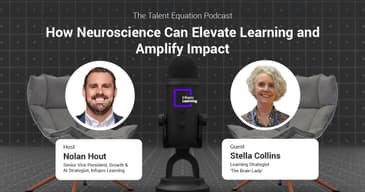
Discover how neuroscience can improve learning outcomes, strengthen knowledge retention, and help organizations amplify the impact of employee development programs. Also Listen - How Neuroscience Can Elevate Learning and Amplify Impact
Podcast Takeaways
The G.E.A.R. model (Guide, Experiment, Apply, Retain) and how it transforms learning design.
How neuroplasticity drives real skill development.
Common mistakes organizations make when designing learning programs.
How managers and culture influence real-world skill application.
Practical ways AI can enhance experimentation, application, and retention.
The evolving role of L&D professionals in an AI-powered workplace.
Why curiosity and critical thinking must remain at the core of modern learning.
Insights from Stella’s upcoming book, The Learning Organization: Using Self-Directed Learning to Drive Workforce Engagement and Performance.
[00:00:08] - [Speaker 0]
Hello, everyone, and welcome to the learning and development podcast sponsored by InfoPro Learning. As always, I'm your host, Nolan Hout. Joining me today, we have a very special guest Stella Collins known as the brain lady for her pioneering work in applying neuroscience to learning and development. This topic of neuroscience and learning is always a fascinating one for me, so I'm so excited to have Stella on. She has over twenty five years of experience in this field training professionals worldwide.
[00:00:34] - [Speaker 0]
She's the author of a a best selling book called Neuroscience for Learning and Development. She's taught over 50,000 people on LinkedIn Learning. Today, we're gonna talk with Stella a little bit about a lot of things, but it's all gonna be centered around this idea of elevating learning and amplifying impact. And to help us to amplify that impact, let's actually meet Stella. Stella, welcome to the podcast.
[00:00:59] - [Speaker 1]
Thank you very much. Lovely to meet you, Nerlyn.
[00:01:02] - [Speaker 0]
Likewise. And and thanks for joining, later in your day because, you know, we're on different, probably completely different time zones. So Stella, thanks again for joining. You know, what how we always start this, Stella, is learning a little bit more about how you got into this field in the first place. You know, you're a best selling author, You've taught 50,000 people.
[00:01:24] - [Speaker 0]
You're widely, you know, known as a subject matter expertise and and learning. But where did you start? Where did this flame that has been burning for the past twenty five years, where do where where is the kindling?
[00:01:37] - [Speaker 1]
The kindling was probably when I was a kid that my parents were teachers, and I swore I would never be a teacher. Having said that, I I worked in I started a psychology degree. I did a masters in human communication, and I became really interested in the brain. So my kind of, final project, finally a project in my degree was about the brain.
[00:02:01] - [Speaker 0]
And
[00:02:02] - [Speaker 1]
then I worked in IT for many years. So I coded and was, you know, typical IT person, And then took on a role that was IT support and training manager. And I thought, great. I can do the IT support management bit. No problem.
[00:02:16] - [Speaker 1]
Learning manager, training manager? No idea. Took on a very inspirational young woman who kept saying to me, Stella, you'd be good at this. You'd like this. It's psychology in action.
[00:02:27] - [Speaker 1]
It's psychology in motion. And that kind of inspired me. I got really interested in the brain and learning. I went to a conference. It was an HR conference.
[00:02:39] - [Speaker 1]
There were lots of people in great suits, and there was a pirate ship. I spoke to the pirate ship, and they were they were teaching finance training, but using a really different kind of methodology, really using a much more brain friendly methodology. So I kind of joined up with them. I ran, you know, ran away from home, joined a pirate ship. Well, not literally.
[00:03:00] - [Speaker 1]
And then have been in learning and development ever since and just keep on evolving, you know, my knowledge about the brain. But also it's it's very much around the practical application of, you know, what can we take from neuroscience and and psychology, so all the kind of brain sciences and make learning better. And it's a it's a it's a passion to make sure that when people are learning at work, that they're able to get impact from it. They're able to get results from it.
[00:03:30] - [Speaker 0]
Yeah. That's really interesting. The the neuroscience has always been and like the the psych psychological factor has always been really interesting to me. My my degree is in marketing, but I always found a lot of the interesting components more the psychology, like a lot of our professors actually had that background. And and helping you understand, you know, when you say this, why do people resonate with it?
[00:03:56] - [Speaker 0]
Like, what actually makes it stick to them? There's a reason that they say, you know, Miller, you got the time, we've got the beer kind of stuff. And and so I've always found fascinating that it's that same principle, you know, as I as I started in my learning career, this same kind of principle of of the more you actually understand the psychological component of why you're doing of of the way that you say it and the why that you design your instruction, has a big impact. And the more you understand the core tenants of it, the better you can do in your job. So so speaking of that, let's start with like that very conceptual idea of of how do our brains and bodies really learn?
[00:04:43] - [Speaker 1]
So it's, you know, it's all down to neuroplasticity. It's down to the fact that our brains naturally develop new connections. And I think the easiest way to describe it is if I ask you, how did you learn to ride a bike? Tell me how you learned to ride a bike.
[00:05:00] - [Speaker 0]
I think my dad pushed me, and I fell, like, four or five times. And then one time he pushed me, and I didn't fall. And that's what I did.
[00:05:10] - [Speaker 1]
So that's really how we learn most things. We warn them by, a, we want to do it. We we want to ride. Right?
[00:05:16] - [Speaker 0]
True.
[00:05:17] - [Speaker 1]
B, we get some guidance. You know, your dad pushes you or your dad helps you. You ride a small boat kind of a structured environment. You're doing it in your backyard rather than, you know, on the on the highway. And then you kind of start experimenting for yourself.
[00:05:31] - [Speaker 1]
You let, you know, let go. You fall off a few times. And then eventually, you know, you you kinda get it. And because you keep repeating it, then you learn it. You've learned to do it.
[00:05:41] - [Speaker 1]
Now you've learned to do it at a very basic level at the age of four or five, whatever it might be. Yeah. But then as you go through your life, you learn to ride, you know, bigger bikes, better bikes, faster, and different types of bikes. So you keep mastering that that skill, and that's how we learn all skills. And one of the things I've done over the one of the things I think is really useful in terms of learning is to have a process that helps people remember what are the stages of learning.
[00:06:07] - [Speaker 1]
So that's where I kind of came up with the the gear model, which very much represents that that story. It's, you know, first of get people well, first of all, think about what's the end result. The end result is you want to be riding a bike or able to code or, you know, have a have a an in-depth conversation with somebody or sell them a product, you know, all the whatever it is. Think about what's the end result. Keep people motivated because learning is quite hard work.
[00:06:35] - [Speaker 1]
It's effortful. It uses brain energy. It uses body energy. And give people some guidance at the first part. So that's the the g of gear.
[00:06:45] - [Speaker 1]
Give them some guidance. Allow them to experiment, the e. Get them to experiment. Just fall off, you know, get some feedback.
[00:06:52] - [Speaker 0]
Yeah.
[00:06:53] - [Speaker 1]
Then they need to apply it in the real world. So if you're riding a bike, you need to eventually get onto the road. If you're learning to sell a project, you need to go and try it with a client, potential client. So you need to do that application. That also requires support.
[00:07:07] - [Speaker 1]
You know? It requires certain organizational context. It needs the environment to be right. You need the opportunity to do it. And the final piece of that gear is the retention piece, which is how do you help people remember information for the long term?
[00:07:21] - [Speaker 1]
But how do you help people go from, you know, kind of small wobbly, I'm just riding my bike, or I'm selling to the client that I'm I'm following the script, to turning it into your natural dialogue, your natural way of behaving, you know, you know, turning effectively into a habit embedding it. And that involves, you know, huge amounts of practice, repetition, and just making sure that it goes from kind of being difficult to do cognitively demanding prefrontal cortex work into something that's more habitual and has kind of become, yeah, more more of a habit or a learned behavior.
[00:08:00] - [Speaker 0]
Yes. I mean, that's a really simple model. It's the, you know, the gear, g e a r model. And and so we've got g for guide, e for experiment experiment, a for apply, and then r for retain. A really simple model that you you were talking about it a lot in this context of like riding a bike.
[00:08:19] - [Speaker 0]
You mentioned, you know, programming coding. As a lot of the world is shifting more to skills and and, you know, versus the job, my job is coding versus my skill is I'm a logical thinker or whatever it is. Are you seeing a similar application being applied for how people can acquire a skill versus a specific job, and especially, like, maybe even those softer skills?
[00:08:45] - [Speaker 1]
Yeah. Absolutely. It it's how we learn pretty much everything, whether you Okay. Whether you're talking about skills or whether you're talking about the full job. You know, a job is a set of skills that you stick you know, you string together in different ways in order to be able to do your job.
[00:09:01] - [Speaker 1]
It's the skills that matter, and I think, you know, learning to do particular tasks can teach you how to do the skills. But whatever you're doing, you have to go through this process of, you know, I can't quite do it. I'm practicing doing it. I'm getting better at it. Bless you.
[00:09:20] - [Speaker 1]
And I'm now kind of mastering that ability to be able to do it and feel and feel confident in doing it. I think that's one of the other important things. That's why the motivation's important that you feel you want to do it and that you you can do it confidently and competently. And and once you can do that, you sort of lose you stop seeing it as a skill. You just see it as something you do.
[00:09:41] - [Speaker 0]
Yeah. So help me understand the I mean, this is, sounds great and good, and this is how people learn. But how do people get it wrong? Like, necessarily how do people implement the gear model wrong, but when they're designing learning programs and you do a lot of consulting work. Right?
[00:09:59] - [Speaker 0]
You've worked with really large organizations helping design fairly complex learning programs. When you're coming in and doing this work, where do you see the common missteps, in learning? Like, what what are they missing? And and if you happen to know, like, what is the science behind what they're doing that makes it not maybe the ideal situation for learning?
[00:10:19] - [Speaker 1]
Oh, that's a really interesting meta question. Where are we getting it wrong? We're not starting in the right place.
[00:10:27] - [Speaker 0]
Okay.
[00:10:27] - [Speaker 1]
We're you know, l and d are often and I'm working with the clients at the moment where l and d are very well meaning, but they're creating courses because they think people need them. They're not what does the business need. They they are moving towards that. They're starting to ask the question. What does the business need in order for people in the business to, you know, thrive in their own careers, but also to, you know, keep that business going to make it a profitable, you know, valuable, useful organization.
[00:10:56] - [Speaker 1]
Mhmm. So we don't start in the right place. We tend not to measure. We tend to measure, did people enjoy the training and, you know, did they did they turn up? Neither of which actually tell you whether they've actually applied the skills back on the work.
[00:11:12] - [Speaker 1]
Yeah. Still, organizations really focus on content. They have, you know there is so much content in the world, and that's great. We need some information to guide us. Most organizations do the guide.
[00:11:27] - [Speaker 1]
They work hard on the motivation. They quite often do the experiments. So if you're doing workshops or if you're doing AI simulations or something like that, you know, that's definitely the experiment part. But the piece where organizations struggle is the application, the helping people actually take it into the workplace. The, you know, the most the most the person who has the most impact on whether you actually apply your skills, your new wobbly skills, is your manager.
[00:11:54] - [Speaker 1]
Are managers supporting that? Do managers have time? Are managers empowered to do it? Are they trained and helped to do it? And then there's also the retention piece because often, you know, and I see it with many, many organizations, training is a one off event where you go, somebody tells you something, and you're expected to be able to not only remember it, but to actually apply that as a skill.
[00:12:18] - [Speaker 1]
So I think that's the it's the it's the taking people on the full journey is where things fall apart. Yeah.
[00:12:25] - [Speaker 0]
I like the context you applied to applying it to the business. I think a lot of times, when we and it's a component of it is the what is the, you know, what is the business metric that you're trying to do. Right? But I think you also nailed on like, well, what is the culture of learning that skill or acquiring that skill? And a lot of that drives from the manager and like, what is so understanding the business world and ecosystem you operate in is really important.
[00:12:53] - [Speaker 0]
Like, I'm like thinking that, you know, if we you stick with a bike riding analogy, if I took a pro if I took a course and maybe my dad was there the very first day and he pushed me, you know, one time. He said, hey, alright. I'm gonna guide you once, but then I've got 50 other kids. I gotta go help all these 50 other kids. Now, I will eventually learn.
[00:13:10] - [Speaker 0]
I I I would, but I would have a lot more band aids, a lot more band aids. And so I think part of of what you're, you know, recommending is that that that that if you take all these things into context, try to remove some of those band aids, try to remove some of those falls, get them on the bike, can get them on the bike a lot faster if you, you know, one of context is, yes, we need to ride the bike. So cool. We have the business, you know, reasoning, but do we understand the world that they're operating in is so important. Makes a lot of sense to me.
[00:13:43] - [Speaker 0]
I can see how that has a big impact.
[00:13:44] - [Speaker 1]
It's not just can I ride a bike? It's why am I riding a bike?
[00:13:48] - [Speaker 0]
Why am I riding a bike?
[00:13:49] - [Speaker 1]
Riding a bike because I want to go to get to school or I want to be able to cycle to work or it's it's the it's that bigger picture why. And that really helps people get their motivation. If if people come to training because they were sent and it still happens
[00:14:02] - [Speaker 0]
Mhmm.
[00:14:03] - [Speaker 1]
They're not going to learn very much. Their bodies may be there. Their minds are probably not there. They're not really taking things in, and they're certainly not gonna certainly not gonna practice afterwards where there is a risk of failure. And, you know, if failure is not tolerated within the organization, they're not going to practice because if they're seen to fail and and they get, you shouted at or punished, they're not gonna do it.
[00:14:24] - [Speaker 1]
Culture in which you're trying to learn is hugely important. And, know, organizations work very hard to build a good learning culture, but you've only got to have a pocket of, you know, one team or one manager who has a different view on it. And that can really start to sort of eat away at the the great culture you had. Suddenly, there's a, you know, a bad bit that maybe needs not cutting out, but sorting. Yeah.
[00:14:50] - [Speaker 0]
You know, it's an interesting thing. I was just talking. So doctor Carl Kopp, he, you know, has done a lot in the gamification world and he has this new book came out called Action First Learning. And I was chatting with them about it with this idea of how do you tell them why you need to know Doretta bike. Right?
[00:15:07] - [Speaker 0]
They're like he's like, you know, the the age old thing is you start with, you know, why is this important for me? And he's like, and it's right. You need to do that, but the lens in which you tell people is important. And if you can, you know, the people that don't know how to ride a bike, sure, that, you know, just telling them why is big. But the people that have been riding their bike for years, that's not gonna be doing much for them.
[00:15:28] - [Speaker 0]
It's you know, you gotta help them actually engage and uncover their why early on. I thought that was a really interesting perspective as we kind of graduate from the, you know, knowing the business context and and explaining that first.
[00:15:41] - [Speaker 1]
But I think also what's important there is understanding your the stage of learning your people are at. When people are new to something, you've never ridden a bike before, you need a lot more scaffolding, a lot more structuring.
[00:15:53] - [Speaker 0]
Yeah.
[00:15:54] - [Speaker 1]
If you're building on the skills you already have, you already have knowledge, you have experience, and that needs less structuring. Actually, it allows peep what works better there is to really expand on the kind of the experimenting bit, letting the letting them test and use their own common sense knowledge, that they've already got. So, you know, the context of the individual learner is also important. And I will I would say that even telling a new learner why you want to do it, yes, that might give them some information. But unless they can find their own why Yeah.
[00:16:27] - [Speaker 1]
It's wrong.
[00:16:28] - [Speaker 0]
Yeah. And that that that that's kind of what that that point is is is help people uncover that why Yeah. You know, with with some scaffolding. You know, one of the things that I've been wanting to talk about a big component that ties into all of this is this idea of AI. You know, you mentioned managers and not having time.
[00:16:46] - [Speaker 0]
AI obviously is a really good way on the apply phase or maybe the experiment phase actually is maybe the better one experiment is to, you know, a lot of what we're doing now is creating a customer agent that acts exactly like the customer of our people and say, you know, hey, if you wanna practice, you can go use that. It it helps take a little bit of that burden away from the manager because they don't have to be there all the time. Maybe it's not as good as, you know, the the real manager. Hopefully not. But, or maybe I don't know.
[00:17:19] - [Speaker 0]
Maybe it is. But it helps. What are some how are you seeing AI apply, amplify, support? What this gear model is is is doing?
[00:17:31] - [Speaker 1]
So I think you're really right. I think the AI can amplify. If you've got it if you've elevated the learning in the first place and you've got the right strategy going, then the AI can really amplify. So it can it can amplify across everything. So it can really help you analyze what the problems are in the first place.
[00:17:48] - [Speaker 1]
What's the biggest problem we faced around here? You know, do we need to be training people to, you know, to do leadership? Or do we need to train people to, I don't know, clean the bathroom? It could be anything. Biggest business trend.
[00:18:03] - [Speaker 1]
You can start to use AI to analyze that data that's out there. I think that's really important. Certainly, it gets used in terms of the the guide part, you know, building content and making content. Now you can build content really fast. It can be really relevant because it's so quick.
[00:18:18] - [Speaker 1]
You can adapt it to, you know, well, there's been a change in the business. We can well, there's been a change in context. We can adapt that quickly. And also, you know, as you say, you know, you've got the opportunity to have learners practice with AI. So I think that's really the experiment part.
[00:18:35] - [Speaker 1]
But that can also still feed them guided information as they're experimenting. So so long as the AI is sort of knowledgeable enough in the right area to be able to do that, then it's really helpful. I think it can also help in the application piece. There's a tool in Australia, but they it's used globally, Leave a Learning Coach M. And they use they use an AI tool to support people in the workplace, and it effectively coaches them, you know, to apply what they're what they're learning.
[00:19:08] - [Speaker 1]
Really helps if you've got a manager who's supporting as well. This is a really good addition, you know, an amplification of that. And then in terms of of repetition, you know, the the kind of the retention piece, AI, again, you can you can use it to do space learning. It can check whether you're, you know, you're genuinely learning, whether you're just making guesses. So AI can be used in so many different places.
[00:19:30] - [Speaker 1]
And and then again, measuring, evaluating, you know, you can you can collect so much more data now, and then you can use AI to help you.
[00:19:40] - [Speaker 0]
Yeah. I I I I think on that, you know, the, application retention is a huge one. I was chatting with somebody. We're we're, we have a leadership coach. So a whole series of leadership programs at info pro learning.
[00:19:58] - [Speaker 0]
But one of the big things that that we're doing is understanding how we do provide a more cost effective, like, retention and application even because, you know, when you have the classic sage on a stage learning, you come in, you bring everybody in, and you say, we're gonna teach you, communication skills. That that's maybe not the best one, but you know, it made me conflict resolution. Right? Okay. Conflict resolution, you're gonna learn how to to do that.
[00:20:29] - [Speaker 0]
Now, you can't really control what conflict comes up in the workplace and when it comes up in the workplace. And it comes a year later. Okay. Great. What percentage is this employee remembering of their conflict resolution?
[00:20:44] - [Speaker 0]
Class, you know, most zero. But if we take that program and we feed it into the agent and then the employee goes to this agent and says, hey, you know, I have conflict with this employee, I don't really know what to do. It acts almost as a application and retention. It's the a and the r because it's helping you apply it, but then it's also that it is that retention that you need to then go back and apply it. So I think there's a lot of cool things.
[00:21:12] - [Speaker 0]
Then one of the the big things that you you talked about was the, and I wanted to pick your brain a little bit bit on it is, you know, you said how these like synapses are formed. And a lot of times when we're we're developing skills for people, it's rare that everybody starts at the same level. And so you're kind of so so therefore, their synapses have been, you know, formed at different levels. And and this is where I think AI can be a little bit tricky because, it can one be really helpful because you can design many versions of a program depending on whether an expert mid tier or, you know, novice in the past to to think about creating three different programs would have been an absolute terror. But then, you know, now being able to just make some tweaks along the way is really good.
[00:22:03] - [Speaker 0]
But I I was listening to a podcast with Werner Herzog, who's a a actor, you know, famous actor, and he was saying the way that kids are using AI today, you know, he's like, when I was in school, I first had to learn the square root of 81, you know, how to do the square root of 81, and I know it's nine. I hope that's accurate for those math people, but, he's like, and then I figured out how to use my calculator. But I knew I I, you know, I knew what it was, and I knew what I was trying to do, and I knew how to do it. But then, obviously, I got a calculator now. Don't I never have to actually do it out on paper.
[00:22:46] - [Speaker 0]
And so he was, you know, kind of saying that that for the people that don't know, we're doing a big disservice by actually giving them these AI tools immediately and saying, go do this, you know, this tool will help you identify the square root of 81 where you don't even know what square root means. Right? And and so I was thinking a lot about it, especially with somebody like you who's done so much research in this this field. So I I more wanna ask the question from you for others in your field, especially those and how we're bringing up the next group of l and d, you know, professionals. What advice do you have on how they can, you know, develop their skills, but also leverage some of the power of AI?
[00:23:32] - [Speaker 0]
It's a very I know it's a very long question, So I hope you I hope I've kept you with me the whole time.
[00:23:37] - [Speaker 1]
I absolutely totally understand the question because I actually posted it on LinkedIn about it yesterday on the Oh. Because it's the question that I think everybody's asking. And I'm I'm not sure there's any clear answers yet. Because we we know already that if you make it really if you make it really easy for people to find information, they'll find it, and therefore, they won't learn it. They just find
[00:24:02] - [Speaker 0]
it. Mhmm.
[00:24:03] - [Speaker 1]
The challenge around AI is things like, you know, if it's AI is rubbish at maths. It could tell you the square root of, you know, 81 was seven. And if you have no concept of what it is Yeah. You just have to accept that AI has done that. And I I don't really know what the answer to this is.
[00:24:21] - [Speaker 1]
I think there is something around helping, you know, helping people develop critical skill thinking, critical thinking as a skill. But unless you have some information to compare against, critical thinking doesn't really work because you don't know what to compare it with. So I suspect we will work it out. I'm not sure there is an answer yet. I think, you know, apprenticeships and things like that are a really good way to learn
[00:24:55] - [Speaker 0]
to build a great point. Yeah.
[00:25:00] - [Speaker 1]
But there's many roles, you know, particularly, you know, kind of cognitive cognitive roles are the ones now that it's it's harder to build because we are just we're AI. We're giving AI. We're deputizing AI deputizing AI to do some of that work for us, which means we're not we're not building information. So the the my long answer to your long question is I'm not entirely sure. I think it's something we really need to think about addressing.
[00:25:29] - [Speaker 1]
My optimistic answer is we'll find a way, and we'll get around it, because I had exactly the same time. This thing is Werner Herzog, and I use that example quite a lot. You know? Populate. Young people never have calculators anymore, and yet they still seem to be able to manage to function in the world.
[00:25:46] - [Speaker 1]
So I think the way the world functions and what we have to do with our jobs may change so much that maybe that basic knowledge doesn't matter anymore is is my Yeah. Hope answer.
[00:26:00] - [Speaker 0]
Yeah. My brother said something to me once and he's you know, it it was just in a conversation. He said, you know, he's like, the way that my brain seems to work, and he knows nothing about the science, is he goes, if I know I can get the answer within a couple seconds on Google, I never think to remember it. Yeah. Because the ability to get to the answer was so quick that the I feel like my brain is determined, like you said, just like what you said, if you can find the answer, you don't learn if you can find it without having to apply your brain, then you're gonna do it.
[00:26:29] - [Speaker 0]
Because, I mean, humans are are, like any other species, our number one goal is to conserve energy because we wanna survive as long as we can. Right? And maybe procreate, but, that's a separate that's for a separate podcast maybe. You know, yeah. So so I well, just one one piece of advice I can give to those that are are leveraging AI.
[00:26:51] - [Speaker 0]
I I had a really interesting experience the other day trying to get AI to to build a table for me, with data. And there was one column that I wanted to change. I had gone through all the work, and then at the end I was like, oh, I made a mistake very early on. I need to just change the column. And it could not figure it out.
[00:27:14] - [Speaker 0]
It I mean, it just had a fit because it would not unlearn what I told it in that moment. And it kind of wants to update everything or nothing. And so, I ended up asking, why is it that you're making this mistake? And and I got into this whole thing. So I ended up learning a lot more about AI on the engineering side than I ever cared to know, but actually that then made me better at my job.
[00:27:42] - [Speaker 0]
So my one piece of advice to you if you're using AI and maybe you don't, maybe, you know, maybe you don't know what a square root is and you but you ask it the square root, once it gives you the answer, just ask, how did you come up with that answer?
[00:27:55] - [Speaker 1]
Yeah.
[00:27:55] - [Speaker 0]
Can you help me understand how you come up with that answer? Just that one question will help you understand. You'll it will tell you because it will give you the logic. It will say this is exactly what I did, you know, I know this is this. And and then allow yourself to just remain curious, you know.
[00:28:13] - [Speaker 0]
A couple of gentlemen, one of them was Simon Brown. I can't remember the other who's now at But they wrote this book, The Curious Advantage. I don't know if you remember the name of the book. Yeah. Oh, yeah.
[00:28:25] - [Speaker 0]
So it was just all about like, you know, the the the context was if you build a a culture of curiosity, everybody will continue to learn. So, that's just my 2¢ on that. So so Stella
[00:28:35] - [Speaker 1]
Really valuable piece of advice, and I think I think the thing you have to keep remembering is that AI might be able to explain the logic to you, but AI has, in that sense, LLMs have no logic. They are literally stringing together that seem the most likely. So Yeah. They they do not understand square roots at all. They just make sound good.
[00:29:01] - [Speaker 1]
Yeah. An important thing to remember.
[00:29:04] - [Speaker 0]
Yeah. Absolutely. So, Stella, what's what's next on you? You know, what I what I know that a lot of people that write a book tend to, like, want to write another book. I know that a lot of where you spend a lot of your time today is consulting with l and d organizations.
[00:29:19] - [Speaker 0]
Obviously, if if you're listening and you you care to to, if you're looking for some help, definitely reach out to Stella. She's on on LinkedIn. But what what's what's new for you? Are you writing anything new? Are you coming out with any new research?
[00:29:33] - [Speaker 1]
So I'm I'm definitely writing a new book. And in fact, yeah, I would I would really urge people to get in touch with me because I actually want case studies from Okay. Companies. So the the new book is, it's a bit of a sneaky it's a bit of a sneaky entrance. It's called The Learning Organization.
[00:29:50] - [Speaker 0]
Okay.
[00:29:52] - [Speaker 1]
And it's about kind of how do we create a self directed learning environment? How do we support a self environment within the workplace? Because most organizations are aware that, you know, just having kind of yeah. Well, information delivered by L and D or this kind of very patriarchal matriarchal kind of school academic form of, you
[00:30:14] - [Speaker 0]
know Yeah. Yeah.
[00:30:14] - [Speaker 1]
Yeah. L and D is nowhere near as effective as actually having people get curiosity, you know, being curious on finding out for themselves. And humans are good at that. We're naturally good at it. However, we also make a lot of mistakes, and and we we take a long time.
[00:30:31] - [Speaker 1]
Like, you talked about, you know, riding the bike. You could do it on your own, and you get there, but you'll have more mistakes, and it'll take you longer. If you understand how learning works as a learner yourself, you're more likely to get there quicker. You know? Nobody ever well, I'm sure peep I'm sure people learn to play tennis, play the guitar without ever having any lessons, but you can really accelerate the process by having somebody explain the process.
[00:30:55] - [Speaker 1]
So I think so the book I want is to the book I really wanted to write was, you know, kind of a self help learning book, but my publisher wasn't interested in that. So the book I'm writing, and I think it's almost, contradictory, is how do you create an environment in which self help learning can can happen, self directed learning can happen. So I am looking for people who've got, you know, great stories about that they can share of what they've done in their organization or maybe what they've experienced for themselves, because I want to have, you know, practical real stories and real voices in in the book as well as some neuroscience and evidence and research behind it.
[00:31:37] - [Speaker 0]
Lovely. Well, listeners reach out to Stella. She's on on LinkedIn. Again, just search for Stella Collins. You can also look for the brain lady, and, you know, she's written bestselling books.
[00:31:47] - [Speaker 0]
So you'll yeah. I'm sure you'll find find her, and we'll put some some information in the, comments so so that people can find that. Well, Stella, thank you so much for joining us. This has been a remarkable session. Again, I appreciate you staying up, you know, later hours for you.
[00:32:02] - [Speaker 1]
Not that late here.
[00:32:04] - [Speaker 0]
Okay. And where and where I think you're in where are you? I thought you were in the Germany area, but maybe I'm wrong. I'm in Belgium. Belgium.
[00:32:11] - [Speaker 0]
Okay. Belgium. Okay.
[00:32:12] - [Speaker 1]
Right. Between France and
[00:32:14] - [Speaker 0]
and travel. Yeah. Yeah. Right there. Wonderful.
[00:32:17] - [Speaker 0]
Well, thank you, Stella. I appreciate it. We look forward to maybe catching up with you again. Once that book comes out, we have to have you back on.
[00:32:23] - [Speaker 1]
Thank you very much, Nayland, and thank you for listening, everybody.
[00:32:27] - [Speaker 0]
Thanks.