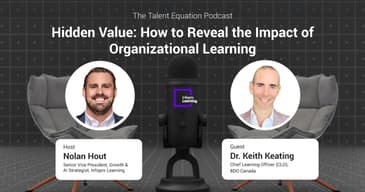
Discover how to uncover the hidden impact of organizational learning by connecting employee development to performance, productivity, engagement, and business outcomes. Also Listen - Hidden Value: How to Reveal the Impact of Organizational Learning
Podcast Takeaways
Why the future of work is shifting from a knowledge economy to a value economy.
How to build a strategic partnership between L&D and the CFO.
Applying The Value Creation Compass to demonstrate learning’s business impact.
Practical ways to measure L&D beyond ROI using stories and evidence.
How context shapes success when implementing L&D strategies.
Why marketing learning is key to engagement and long-term adoption.
The value of understanding your business as deeply as your stakeholders do.
Why L&D professionals must evolve into problem solvers and strategic business partners, not just content creators.
[00:00:08] - [Speaker 0]
And welcome to the Learning and Development Podcast sponsored by InfoPro Learning. As always, I'm your host, Nolan Hau. Today, I'm thrilled to be joined by Doctor. Keith Keating, chief learning officer at BDO Canada, lecturer at the university of Pennsylvania, and author of a groundbreaking new book, hidden values, which challenges us to look beyond the ROI metrics and uncover the deeper impact of learning and development. And Keith really has interesting perspective that he's bringing to this conversation with lots of years at the intersection of learning, finance and business strategy.
[00:00:40] - [Speaker 0]
And that's all really tied into the book and the themes. We'll kind of talk with Doctor. Keating about some of those things. Really, whether you're an L and D professional HR leader, or more in a business executive, and you're wanting to maximize your investments in human capital, this is going to be a really great conversation for you. So speaking of the conversation, let's make it two sided by bringing in our guests, Doctor.
[00:01:02] - [Speaker 0]
Keith Keating. Welcome to the podcast.
[00:01:05] - [Speaker 1]
Thank you so much for having me.
[00:01:07] - [Speaker 0]
Wonderful. Well, before we get into the, the book and some of the topics that we want to talk about, we always start with, learning a little bit more about your origin story, if you would, you know, you're an established author, a speaker. We just mentioned next week we'll be seeing you at deliver a keynote, at a conference. You're the chief learning officer, a BDO, but that wasn't your start obviously, you know, so what kind of led you down this, this path to where you are today?
[00:01:34] - [Speaker 1]
Well, it started once upon a time with being born. So when a man
[00:01:40] - [Speaker 0]
Okay. Let's flash forward maybe fifteen years forward. All
[00:01:48] - [Speaker 1]
right. So my journey would start fifteen years, actually, almost to the day with my struggle in school. So I struggled significantly, would say with learning, but I don't know that it was really learning as much as I blame the school for that. And so fun, fun fact, I mean, not really fun, but a fact is that I'm a high school dropout. So I finished maybe two months of tenth grade, but I basically have a ninth grade education and a few months in tenth grade.
[00:02:21] - [Speaker 1]
And so being a high school dropout was not just part of my story. It was my story and it was the beginning, but also the end of how I saw myself. And I was so ashamed of it for many years. I hid it. I let it define me.
[00:02:39] - [Speaker 1]
Today I've been able to transform that to the beginning of my story rather than the end. So in particular, my view on the value of learning is deeply personal because for me for a long time, didn't believe that I was capable of learning. So I struggled in school and part of that was because I had so many different schools. I grew up in Europe, in Asia, then came to The US when I was 13, 14 and my school's education just didn't line up. So one teacher would tell my parents I'm above average and I should skip a grade and the next teacher would tell them that I need to be held back because I have developmental challenges.
[00:03:23] - [Speaker 1]
So it was a deeply struggling time for me where I had to make a decision to drop out to save myself, essentially my mental health. And when I did that, I was told that the same cliche statements, you'll never amount to anything. You'll be destined for a life of fast food. First of all, as if there's something wrong with working in the fast
[00:03:48] - [Speaker 0]
food industry
[00:03:49] - [Speaker 1]
because there's not at And, and I did that. I actually went and got a job in fast food. So I had been told that I just, I wasn't smart enough that I couldn't be cut out for it. And so I just believed that. And it wasn't until adulthood that I realized the problem wasn't me.
[00:04:07] - [Speaker 1]
It was how I was being taught or not taught. And the moment that I learned how to learn, everything changed for me. It was like someone handed me the keys to my future. And from then learning just stopped being something that made me feel broken, but something that made me feel powerful and empowered. And so that, that journey has shaped everything since then.
[00:04:35] - [Speaker 1]
And what I believe about learning and development. Then when you've been the one who's been overlooked or counted out or underestimated, it changes how you see people and it makes you even more hyper aware of those hidden barriers that others might be facing. And it makes you ask questions like, who are we missing? Who aren't we developing our organization? Who's not being thought of in this learning experience?
[00:05:05] - [Speaker 1]
And so I'm constantly rooting for the underdog because I am one. And I know firsthand what it feels like when, when you get to unlock that, when, when you get to change someone's life through learning, because learning and development absolutely changed the trajectory of my life. In fact, I keep this little post it note next to my laptop all the time to remind me of what we do, what we do. Our bigger mission, our bigger purpose is we change lives through learning and development. So long story short, my journey has significantly impacted my belief in what we do.
[00:05:46] - [Speaker 1]
And if I believe anything, it's that learning is the skill, the skill that we need for today, for tomorrow and for whatever comes next. And we're the ones that get to do that. We're the ones that get to prepare people for the future. I love what we do, but it started from a very difficult place. Sorry.
[00:06:10] - [Speaker 1]
Long winded monologue there.
[00:06:11] - [Speaker 0]
No, that's phenomenal. And so it's, you know, I feel like as I've asked this question, it wasn't really the intent when I started doing these podcasts a while ago, but there's like some common themes. And I think one that is relatively common is they felt there was a better way to do it than how they experienced it. And it impacted them so strongly that they felt I have to be the one to do something about it. Like I need to be the change.
[00:06:41] - [Speaker 0]
I need to be that person to change lives and somebody else. So it's what a, I mean, yours is one of the more compelling stories you've ever heard from that perspective of, of learning really was the pivotal moment in my life. And the second that I realized that's what I needed to Excel, kind of changed my career trajectory. So, that's wonderful. So, fast forward, you know, many years later, you've just written this book on hidden values.
[00:07:12] - [Speaker 0]
Why did you write this book? What, what was the, you know, was there a similar moment in your mind or just kind of clicked and you were like, I got to put some pen to paper here. I know this is your second book. So maybe this is the, I wouldn't say leftovers of your first book, but maybe when you were writing your first book. Yeah.
[00:07:31] - [Speaker 0]
Continuation. Yeah. Like, Hey, I wanted to put more in there, but I didn't want this to be, you know, like the Bible. So, so I wanted to have two volumes, make it easier, but yeah. What led you to, to hidden values in publishing that?
[00:07:42] - [Speaker 1]
I needed a New Testament. You know, we had the Old Testament, now we needed the New Testament, New Testament, Testament, The first book is The Trusted Learning Advisor. Those of you who are watching and that is about our evolution from being order takers to being strategic business partners because our industry is largely stuck in this order taking mindset. I had played that role of an order taker for years and have been able to move out of that. And so this first book was my culmination of what did I do?
[00:08:22] - [Speaker 1]
What did my teams do? And how can we share that so that others can continue to evolve? And it focuses a lot on our foundational skills, being a trusted advisor, consulting, things like that. There wasn't a lot about the value of what we do. So when I was finished with that one, I found that there's just this gap in the industry.
[00:08:44] - [Speaker 1]
Hear a lot of negativity on LinkedIn and from others of people who are burnt out. The truth is I want them to fall in love or fall back in love with what we do because what we do is so powerful. Specifically to answer your question, I wrote this book because I care and also because the world is changing and I care deeply about this profession and the people in it. I've lived that frustration of being unseen, underestimated, unsure if the work I'm doing even matters. And I've been the learning leader that's been trying to prove value in a room where people didn't want to listen.
[00:09:26] - [Speaker 1]
And so I know firsthand what this is like, but I also know when, when we get it right, it can transform not just performance, but people's lives. And so I also, I care about where we go from here. What I mean by that is for, for years now, I've heard people say, and we live in a knowledge economy and it's all about the knowledge that we have. We're no longer in a knowledge economy because this device has more knowledge or more data than I am ever going to have. May not have as much wisdom as I have, but it has basically that knowledge.
[00:10:02] - [Speaker 1]
And I feel like because most of the world now has access to Gen AI, it's almost this democratizer where we're at this starting line together, we now have all of this knowledge. So what do we do with it? We have to create value from it. So we're moving from a knowledge economy to a value economy. Knowledge is no longer enough.
[00:10:25] - [Speaker 1]
And that differentiator for us is going to be how do we create value? How do I take my experience, my expertise, little bit of knowledge, these tools, how do I put them all together so that I can create value? I don't think that the shift is coming in the future. I think it's here now. We have a pivotal role that we can play when we talk about this idea of value.
[00:10:52] - [Speaker 1]
In summary, this book is my contribution to that future. It's a blueprint for learning talent, HR to become value creators, value seekers. How do you measure value? How do you tell the story of value? Because what we do has tremendous value.
[00:11:12] - [Speaker 1]
We just largely lack the language, the vocabulary, the skillset, the mindset, and the tools to articulate the value of what we're already doing.
[00:11:24] - [Speaker 0]
Yeah. And I have to say Keith, when I was reading it, I it's funny you, you mentioned, you know, blueprint, because I was, and we'll discuss some of the themes and, and, later on, but it did seem so, I mean, saying it sound, it seemed formulaic makes it seem like it was a dry book and it wasn't at all a dry, dry book, but it was almost so if you do this, you will get this out of it. And so it was like the perfect handbook, if you would, in my opinion, a great handbook to have with you. And there's like things in there that specifically say, Hey, if you're looking for something, if you have something great, if you don't have a way to generate value or to tie what you're doing back to value, this is a great place to start. So, I think
[00:12:12] - [Speaker 1]
I appreciate that you recognize that because I think what's important for me is I want anything I do to be practical. We have a lot of thought leaders out there. I don't ever want to be a thought leader. I want to be a practitioner who's doing the work and I want to share with others what I'm doing. Hey, this has worked for me in my context.
[00:12:36] - [Speaker 1]
If you don't have something or it's not working for you in your context, try this. And I think that, that, that practical application is hopefully what I, what comes across as, as being valuable.
[00:12:48] - [Speaker 0]
Yeah. And I want to call that out because we've seen that. So I lead a marketing organization and so I'm always tracking kind of what gets the most clicks or the views or whatever. The content that we get the most attendance for, whether it's webinars or whatever is the like, so, and one of the things that I run it is AI. And I remembered the first AI presentation I ever gave.
[00:13:14] - [Speaker 0]
I looked at the schedule of AI and everything was like strategy, strategy, strategy. And I was like, well, don't people actually want to know how to use it? Like, you know, aren't some people wanting to just try, like, you know, like open up Claude and write a prompt. And so, I, this is definitely the book for that. And I think the demand is, I mean, you've seen it, it's all over LinkedIn.
[00:13:39] - [Speaker 0]
So the demand is there. It's a great book. And I think it's really served that, that purpose. One of the things you mentioned, you know, the value and how you get value. There was one critical role and it maybe comes back to your origins, but anytime we're talking about bringing value back to the business, one of the things that I thought was interesting is usually the business is, I don't know, it's like some bean that doesn't, you know, it's like value back to the business, but something you specifically call out is the relationship of the CFO, the Chief Financial Officer with L and D.
[00:14:16] - [Speaker 0]
Talk to us a little bit about that relationship and why that was so important. Cause it's one of the first chapters in your book as well. Like why was that such a thing to stress on as an importance? Cause I also am not hearing it from others, although I agree with you that I think it is so critical.
[00:14:33] - [Speaker 1]
So interesting fact, 25% of CEOs were CFOs. So once upon a time, the CFO, if you look back in the eighties and nineties and you watch like revenge of the nerds or anything with smart, smart people, you know, you have the, the, the tape and the glasses and anybody in finance was looked down upon or they were a nerd or a geek. Fast forward to where we are today, finance are the leaders to the point now where the job trajectory for CFOs is now CEO. That's how important the CFO is. But to take a step back as to why am I advocating so much for CFOs?
[00:15:15] - [Speaker 1]
The story behind that is I was working for a fortune 500 company. We had a massive win. I think we had maybe a $3,000,000 quote ROI. That's a different discussion. And then we had about a $2,000,000 cost avoidance.
[00:15:31] - [Speaker 1]
And I was really proud of both of those. And I wanted to share the story. And my boss pulled me aside and said, we can celebrate it internally, but do not tell anybody, especially finance. If you tell finance that we have cost avoidance, they're going to reduce our budget that same amount. If you tell finance that we have an ROI result, they're going to expect us to replicate that same amount every year moving forward.
[00:15:59] - [Speaker 1]
Don't talk to finance. And so this fear had built up. And then as I thought about it more, I realized that fear has always been there because we have this saying, l and d is the first budget to get cut. Mhmm. And it permeates everywhere on social media, in books.
[00:16:17] - [Speaker 1]
I actually found it dating back to the 1960s with ATSD at the time. Way back when it was like, you know, be careful of the finance leader. So long story short, all this is happening at the same time that I was starting my doctorate. And I thought what better group of people to study to learn about CFOs. Let's find out is any of this actually real or are we creating this echo chamber of beliefs that may not actually exist?
[00:16:48] - [Speaker 1]
So I ended up researching CFOs for my doctorate. So I interviewed a Fortune 500 CFOs to understand how do they think or what do they think about organizational learning? What influences their training budget process and where might those disconnects be? And I found a lot of insightful information. So first of all, every CFO I spoke to, they believe in the power of learning.
[00:17:17] - [Speaker 1]
That's good, but they see people as strategic assets, also good. They understand that learning can drive confidence and retention and growth, but here's the most interesting part of that. They also admitted that learning is not a top priority for them. They also could not tell me how much they invested in their people each year. So I could say, hey Nolan, how much did you invest last year in IT?
[00:17:45] - [Speaker 1]
And they would say, oh, you know, 37,000,000. Yeah. How much did you invest in your people? Oh, I don't know. But people are our most important asset.
[00:17:53] - [Speaker 1]
Really? Okay. That's there seems to be a disconnect there. And so what that uncover was, it's not that they don't necessarily care about it. There's a difference between, how they find this, this concrete versus tangible impact.
[00:18:08] - [Speaker 1]
And so CFOs are wired. They're, they're held accountable to prioritize measurable, tangible outcomes, operational efficiencies, client impact, all of this stuff that really sits in this world that's abstract to us. We talk about engagement, talk about confidence, we talk about collaboration, which is all very valuable, but that's so hard to see on a financial dashboard. They're not dismissing learning, it's just they're not seeing it in the same way that we see it. At the end of the day, it's not that there's a lack of belief in what we do, it's the lack of visibility.
[00:18:48] - [Speaker 1]
And that's where we have to step up. In order for us to work with CFOs, first of we have to build a relationship with them. We have to connect human impact to their business outcomes. They largely said, don't send me an Excel spreadsheet. I don't want to see your ROI because that's not how I translate it into ROI.
[00:19:12] - [Speaker 1]
And so my next question was, well, how do you? And they're like, yes, that's the question you should be asking me. What do I want to see? Not what do you see? I don't care who Kirkpatrick is.
[00:19:22] - [Speaker 1]
Philip, I don't follow that. I don't follow Philip's ROI and that's no disservice to them at all. And in the book, I I I really try not to discredit anybody else's theories or philosophies. Those are the OGs for a purpose. What I'm trying to institute is taking their frameworks and just reframing all of it to the business and the business includes the CFO.
[00:19:51] - [Speaker 1]
The CFOs would tell me bring me the story. Don't just bring me your Excel, your data, but tell me better stories that are grounded in evidence. We don't just want data. We want the story behind it. And then go ahead.
[00:20:06] - [Speaker 0]
I was going say, yeah. And I actually found that really fascinating. I mean, I don't know if you've met, Rob Lobber.
[00:20:15] - [Speaker 1]
He was one of
[00:20:19] - [Speaker 0]
No, go ahead. Yeah. But he, he, he's always told me, you know, Nolan, the first day on the job, I would go to the CFO. Like that was my guy and our girl, you know, he's like, that's who I always wanted to have that relationship with was the CFO. And for many of those same reasons, but I never, I realized I never really peeled the onion back.
[00:20:39] - [Speaker 0]
It wasn't until I was reading your book that I really understood it from the mind of the CFO. And for me, one of the most, awe inspiring things was the, it's not just about the data. You think, you know, Oh, CFO, they're just counting beans all day and doing this out on the other. But, but then you outline the like three different parameters of which they really wanted to see, you know, economic, personal and societal. And I was just thinking, wow, I've never really, I would have assumed that all the CFO cared about was if I'm spending a million bucks on my onboarding training program, show me that it's somehow going to save me over four years, $5,000,000 or whatever it is.
[00:21:27] - [Speaker 0]
Can you talk a little, I mean, I, can we expand on that a little bit? Because at least for me that didn't like that, that didn't come naturally when I thought, oh, speak to the CFO in terms they want to hear.
[00:21:40] - [Speaker 1]
So a couple of points that are painting around. I just want make sure I don't lose them. And I'm already losing them. Give me a second. It's the really good one.
[00:21:49] - [Speaker 1]
Let me start with the, the, the not so good one. Part of it is we have to help the CFO to care. And one of the quotes that one of the CFO said to me, which has stuck with me is I have so many fires at my feet. I don't care about this. I can't care.
[00:22:09] - [Speaker 1]
This is not a priority to me. So it's our job to build that relationship to make it a priority for them. One of the things that so many people overlook with the CFOs is that the CFO's sole responsibility is to understand the value of every aspect of that organization. And so if you ask yourself, especially if you're a learning leader, has my CFO ever asked me what the value is of what we're doing? And the answer is no.
[00:22:39] - [Speaker 1]
Well, is hugely telling because then how are they calculating what value you're providing? And the answer is they're not. Right. They're not. So we have to help do that work for them by building that relationship with them so that they know what, what, what the value is.
[00:22:59] - [Speaker 0]
Yeah. And I totally agree. And I think it is an interesting thought of like the, you know, building that relationship. Feel like, I don't know, I feel like it'd be kind of a scary thing, for many, you know, new leaders, because I'm assuming you can, you know, you can speak definitely from experience. Keith, how do you, how do you even go about that introduction?
[00:23:22] - [Speaker 0]
Like we talked about practical, like, Hey, I'm Keith. I'm your new CLO. I want to have a good connection. Like what have you found to be the best strategy to get that dialogue opened when maybe in the past at the culture of your, the organization that you're in, if you went to the CFO and said, Hey, the head of learning is out here. He goes, the head of who?
[00:23:44] - [Speaker 0]
You know, like, where do you, how do you even start? You just approach a bull in a China shop barge in? What do It you find
[00:23:51] - [Speaker 1]
starts with curiosity and being truly curious about who they are as an individual and get to know them. I mean, play into their ego a little bit, ask them questions like what's, how did you get to where you are? How did you, how did you learn how to be a CFO And what was the most impactful part of that learning journey for you? Was it, your university degree? Did you take a course somewhere?
[00:24:17] - [Speaker 1]
Was there a professor that stood out to you? Oh, there was. Tell me about that professor. What did that professor do that made that professor so memorable? What was the best program that you've ever taken in any organization and what was the worst?
[00:24:32] - [Speaker 1]
And really just doing qualitative research into them to find out their experience. And that was that that's my technique because it also gives me insight as to whether or not they're going to immediately be an ally or not. If you were connecting to your CFO and they're saying, I've never had a good experience in any organizations, they have been just a waste of time. You have a lot of work to do to try and change that mindset versus somebody who can tell you who their favorite professor was, the program that made a difference to them, those, you know, that's your ally. So either way, you've got to work with them, but then digging into more about what would they like to see different in the organization?
[00:25:16] - [Speaker 1]
Or how about their own team? Every CFO has a team behind them. So, Hey CFO, is there any specific learning programs that are missing right now that might help your team might help do X, X, Y, and Z? So I would focus on those. The other questions I might focus on is understanding the budget process.
[00:25:36] - [Speaker 1]
And so I mentioned earlier that we have this echo chamber statement about how L and D is the first budget to get cut. You know, who else thinks there's the first budget to get cut Marketing. You know who else? IT. You know who else?
[00:25:51] - [Speaker 1]
HR. We think we're the first budget because that's our world. I can tell you from at least the CFOs that I interviewed, they wholeheartedly said we have never specifically cut the L and D budget. First of all, it depends on where does the budget sit. Is it centralized, decentralized, hybrid, federated?
[00:26:11] - [Speaker 1]
They would say things like, well yeah, we say take 10 across the board, but if your budget is buried in a service line then that service line is responsible for cutting your budget. But we tend to think, it's the CFO who doesn't like us or want to do this, but at least based on my research nobody is targeting specifically the L and D budget. What they're targeting is service centric type, service lines, which is what we are. We are not typically revenue generating, which side note, that should be part of your strategy. Could you be revenue generating?
[00:26:48] - [Speaker 1]
That's a different podcast for a different time. We're seen as, as cost centers for the most part. And so yes, cost centers tend to be the first budgets that are cut, but it's not at least based on the research targeted directly towards us.
[00:27:02] - [Speaker 0]
So how do we then go to, so we've got this relationship with the CFO. They're kind of telling you what they want to see And, and part of what you've talked about even on this podcast, but also in the book is this idea of going beyond just an ROI number. Tell us a little bit about how you go about going beyond ROI and how that's worked for you and your, your, your experience, and maybe outline some of the things that you present in your book as well, for those that haven't read it yet.
[00:27:34] - [Speaker 1]
So the tool that I put together that I follow is the value creation compass. This is built on the language of the business, not the language of L and D. This is one of the biggest areas that we have to evolve in because no one outside of us cares who Kirkpatrick is, who Phillips is, level three, level four. That's not only LMS, LXP, all those things. The value creation compass, the tongue twister also reframes value through the lens of how your organization typically defines success so that we can show impact in the way that your leaders already care about.
[00:28:15] - [Speaker 1]
So think about the value of learning and the compass being the directional point because you can turn in any angle with a compass and it's going to point somewhere. And so that was the intention with how I totally out the compass. So the compass, North, South, East and West, for those of you not familiar with the compass, there may be some, you know, I think the younger generation, why would they need one at this point? So I'll start with North real quick. So North is empowering people and this is our default state in talent development.
[00:28:51] - [Speaker 1]
Everything starts with our people and that's why I've captured it in the true North. It's our familiar ground. This is our skills, leadership, engagement, retention, all the thing people related. So I'm not going to dig too much into this. I want to jump to the other three.
[00:29:08] - [Speaker 1]
So we start with north focus on the people, and we move East. This is where we're driving business growth. So East is about connecting learning directly to things like revenue, innovation, market expansion. It's where we prove how L and D can fuel the business, not just support it. And so sometimes it feels like the idea of revenue could be out of reach for us, but if you take a step back and you think about programs like sales or sales enablement, or maybe you have some operational programs that have reduced the time to market or reduced the time for your new hires to be upskilled or you're supporting innovation.
[00:29:54] - [Speaker 1]
All of those are growth levers. And so this is where credibility really accelerates when leaders can see what you're doing ties to growth. So I'll give you a quick example at BDO, we have a program called the Business Growth Academy and our partners and our managers, they go through this program and it's explicitly designed to help strengthen their sales capability and revenue generation. So there's a clear link there
[00:30:22] - [Speaker 0]
to this
[00:30:22] - [Speaker 1]
curve, pipeline development, all this stuff. East, and we go south, building organizational resilience. So south is about strengthening the organization's ability to adapt, align, to endure through change. If you think about COVID, one of the positive outcomes from COVID for us from an L and D perspective is all of a sudden overnight we became important. All of a sudden it was, I don't know what Zoom is, but can you, can you see us?
[00:30:57] - [Speaker 1]
Because now everybody has to be home and how can you help? And so we rose to that challenge to help our organizations adapt. This is where learning can help the business sort of absorb that shock or even accelerate it in disruption. And so when we focus on resilience, it's about making learning essential. So you might have programs around change management or a transformation love this word because every company is always going through a transformation.
[00:31:31] - [Speaker 1]
That means the company, the business, something is changing. We're the ones that help the business through that change. If you think about maybe a program like growth mindset or power skills or any type of role that you play in that transformation, you are helping that organization change to be resilient. When we help our talent be agile, adaptable, resilient, we're helping to strengthen organizational resiliency. So that's South.
[00:32:02] - [Speaker 1]
Then we move West, which is delivering customer value. So this is where we go outside of the walls of our organization. It's about how do we equip our employees so that we're helping to improve the experience, trust, and the loyalty of our customers. Not just the employees, but our customers. When employees learn better, customers benefit.
[00:32:31] - [Speaker 1]
But a lot of times we don't connect those dots. So here's some examples. Maybe it's fewer errors, faster response times, it's stronger relationships, it's greater trust. This is where a big part of our hidden value actually lives because the customer value is often overlooked, but once we reveal it, there's a really powerful story there. So I'll give you an example.
[00:32:55] - [Speaker 1]
We have recently taken one of our internal programs called Speak with Impact. It is a leadership program that helps with gravitas, executive presence. We're delivering it internal, which does trickle external, but we're also offering it for free to our clients. That's delivering customer value. It's helping to strengthen their ability to communicate, to inspire, to lead, not just internal.
[00:33:23] - [Speaker 1]
It's helping to demonstrate us as a trusted partner. So long story short, the compass isn't about doing everything at once. It's about broadening how we define how the business measures value. And so the goal with the compass is not for you to sit in your office by yourself, spending the compass, figuring out what to do. It is a perfect tool to take to your business and to have a conversation with them and say, here is a tool that we can use in this framework.
[00:33:57] - [Speaker 1]
What is the most important area where you want to start focusing on for value for you and use it to drive the conversation with them.
[00:34:05] - [Speaker 0]
And I can see how this book really dovetails from your previous book where you're actually giving again, practical advice on how to have those conversations, like how to get yourself in that mindset. And then here is this book that comes along the hidden values that is giving you now the playbook to go and practice those skills. And it's interesting, you know, when you mentioned the customer angle of it, do. I feel like a lot of times that gets lost in the noise, but as you said, it is, it is actually what drives most value to a company because if they're not buying, how are you getting value back to the company? Like, and it's such a critical component.
[00:34:49] - [Speaker 0]
We were doing this, this program for a large telecom and it was about customer service training. And we had asked them, you know, what are those metrics that you really want to move? And well, they said, well, here's all the metrics we track. We're like, great. But like, which are the ones that, that you actually want to move?
[00:35:07] - [Speaker 0]
Because they're so connected. Now this telecom provider is really about churn and burn, right? They just want to get as many customers. So for them, and that's what we said is like, listen, that's what you're known for. Do you want to keep pressing that button?
[00:35:21] - [Speaker 0]
So if you do, then we want to teach people to get off the phone quick, you know, get him an answer, get off the phone, skip the pleasantries. We're all about first call resolution and decrease your talk time and decrease hold time overall. However, if we were talking to Nordstrom, it'd probably be a completely different conversation. They're the value, the customer value that you're, you know, in the compass, the customer value, so much of that is, is, is having a conversation, allowing yourself to talk more, to learn about their lives, to do whatever. And so it's such a critical component that, and I think learning really has the ability to be the advisor in that space, the business advisor, not the learning advisor, just the business advisor to say, let's not forget why we're doing this, which is the customer.
[00:36:12] - [Speaker 0]
I think you come to the table, like you said, with that, not you sitting down and saying, let me map out the four. And then I'll go to my CFO and I'll say, here's my four, but no, going to who are the stakeholders at each of the points of your compass, who are those going to impact, get their buy in, get their approval. You now have at least two or three allies with you to go present this solution. It's just really a phenomenal model that you outlined.
[00:36:36] - [Speaker 1]
And here's the thing you, you, the listener, the Royal you, Royal we, you're doing a lot of this already, but you may not be following the bouncing ball or the ripple effect because we often stop just like you were talking about your customer at that first level of here's the metric that I'm measuring, not where the value is truly impacting. I guarantee if you sat back and you looked at the framework and you followed it through, you would start to realize, oh my gosh, we are helping organizational resilience down here with these three programs. Oh, this is actually linking out, rippling out to our customers. So it's to empower you to have the language and the tools to have those conversations, to get to those two, three, four level down so that you're speaking in a way that resonates with your business.
[00:37:26] - [Speaker 0]
So one question I have, and we kind of have to wrap up soon, but one thing that I always like to think about, especially whenever I read a book, am so fired up to do that thing. Like, just, I, I'm like, dang, I can't wait to implement this. But then I hit a, I hit a roadblock and I kind of put it back in the burner. What are those roadblocks? If you've read Hidden Value or if you're listening to this and you, we're going to give away, some copies actually.
[00:37:54] - [Speaker 0]
So that will be fun. So you have your chance to win a copy of the book, but, what are those potential roadblocks that people need to be on the lookout for as they're go, as they're listening, as they go into implement this, where do you, where, if you're going to fail, it's all I've always felt this really helpful to kind of plan out what might go wrong. So at least I'm prepared. Where, what, where's the potential to kind of hit some roadblocks here?
[00:38:17] - [Speaker 1]
Expand the question a little bit, because I think what I'm going to say is something that all of us need to remember in that if you're ever reading a book or listening to a case study or you're at ATD or Tice or wherever you're watching somebody present, please remember this single word. Context. Context. Context is so crucial. I cannot tell you how many times I've sat in somebody else's keynote and they've talked through this beautiful story and I leave feeling less than because in my head, I'm like, that doesn't work for me.
[00:38:53] - [Speaker 1]
That, that I tried that and it didn't work. So my, my cliff note or Coles note for those in Canada is everything has to be contextualized to your organization. Just because it worked for me is not a guarantee that it's going to work for you. You have to take a step back and look at where's your organization in that maturity level. Do they want you to succeed?
[00:39:19] - [Speaker 1]
Do you have a learning culture? Does your stakeholder allow you to have a voice? Not every organization is going to be the same. What I did at General Motors, I could not have done at Archwell. What I'm doing at BDO would not have worked at HSBC.
[00:39:36] - [Speaker 1]
The idea is for you to read the books, do the keynotes, do all those things, put them in your toolkit to know these are tools that you can choose from, but it has to be the right problem at the right solution at the right time with the right tool. So the answer to your question is where are you going to fail? You're going to fail if you assume that this is going to always work regardless of your context. You have to first take a step back and figure out things like, are you brand new? Are you brand new and you're just starting out?
[00:40:07] - [Speaker 1]
Well, first you have to build your credibility and you have to build the trust before you come in guns blazing with value creation compass and all these things. Step back, take time, listen, build the relationship. Does your company have a learning culture? Maybe they don't. Now you're having to push even harder uphill.
[00:40:26] - [Speaker 1]
So I guess that, that feels a little bit negative and it's not intended to it's to say, look, start with the context, make sure that everything is through the lens of your organization and where you are in that journey, because you may not be as mature as somebody else. The next piece of where you can fail is not spending time understanding the business. Our job is to know our business just as good, if not better than our stakeholders so that they don't get a chance to say, you don't know my business and then shut us down. And with tools like GenAI, you have no excuse at this point of, GenAI, World Economic Forum, McKinsey Global Institute, as unbiased as possible, it's free research firms. Go out, understand the industry, your competitors, understand your stakeholders, bring them your ideas, bring them some of the research rather than just going to them as an order taker and saying, okay, what, what can I do for you?
[00:41:28] - [Speaker 0]
Yeah. I think, especially in, and I mean, I I've, I've said so many times that I think the role of the learning development professional is one of the hardest roles to be in, whether depending whichever hat you want to put on. Right. So sometimes learning development gets related to like a marketer because they're both after engagement, right? You're trying to get people engaged to buy in.
[00:41:52] - [Speaker 0]
Well, you, you have to create an ad that works for the 18 year old intern in the 80 year old, whatever, or, know, in the 50 year old and the 20 year old and the male and the few, you don't have a target demo, your target demos, the whole company. And so you've got a tough job. As you said, knowing that context of what is the business that I'm trying to operate in? And you've said it twice now, and I think I will now make it a third time because I think it is that important. One of the critical things that we learned as we started implementing AI in our organization, we significantly undervalued the democratization of our subject matter expertise of how important that was going to be.
[00:42:34] - [Speaker 0]
Because when we looked across everything, we're like, yeah, this is going to help us save some money and save some time. But then we looked at what is our biggest time suck? It is getting context. It's getting subject matter buy in. It is getting that information of what is it that we're trying to solve, getting the points of the compass and then getting the details about it.
[00:42:54] - [Speaker 0]
No longer do I need to go to the one person in the company who understands this very complicated technology. I don't need to go to that person anymore and say, tell me everything about your world. I can start with, I know everything about your world. Is this accurate? You know?
[00:43:12] - [Speaker 0]
So I, I believe that is so darn important. You will save yourself so much time if you allow yourself to get that context. So I appreciate you calling that out twice. Think it's so I
[00:43:22] - [Speaker 1]
have one last one that I would share. That is, as I think about the future of our industry and I'm not making any predictions because no one knows. What I can say that will help that at least I'm applying for me and my team is you have to get outside of your box. You have to get outside of this L and D box. I'm just an instructional designer.
[00:43:47] - [Speaker 1]
I'm just a facilitator. I'm just in learning. If you met me on the street and you said, what do you do? I would say, I'm a problem solver. I happen use learning and development as one of my tools to solve problems for people.
[00:44:00] - [Speaker 1]
I'm a CLO. I spend less than half of my time on formal learning stuff. I could be a coach. I could be a therapist. I can be booking lunch orders.
[00:44:13] - [Speaker 1]
I can be helping my stakeholders find travel plans, I I'm out there talking to learners and talking to stakeholders, I'm out there learning what what's happening in the business, but this for me, I am personally moving away from hiring traditional L and D people who are so stuck in, you know, Kirkpatrick and
[00:44:34] - [Speaker 0]
all the
[00:44:36] - [Speaker 1]
lingo that nobody wants to use because we're so much more than that. So continue to evolve past just that you triggered this because you talked about marketing. Marketing is one of the most important skill sets that we have to develop because you are marketing. This is a product and we get frustrated because others don't care about what we do as much as we do. News flash, we're paid to do this.
[00:45:06] - [Speaker 1]
We're literally paid to do this. You think the IT person who launches that new security thing that makes us reboot that irritates all of us, we're like, oh my God, have to reboot my computer again. Well, know what? We don't care about it, but that person cares a lot because that's their job. They're paid to care.
[00:45:26] - [Speaker 1]
It's just like learning. It's our job. We're paid to care. We don't do this out of the goodness of our heart. So stop taking it personal when people don't care and make them care.
[00:45:35] - [Speaker 1]
And you make them care by understanding why it's valuable, relevant, necessary for them, and you market it to them.
[00:45:42] - [Speaker 0]
Yeah. I, now we're going way over time, but I gave us a presentation on this. I said, it was fairly math driven. So I think I lost some people in the math, but I said, listen, if you're going to spend, I'll just do a round number, you're going spend a million dollars on prebuilt content, right? Like your Skillsoft LinkedIn learnings or whatever is of the world, right?
[00:46:07] - [Speaker 0]
And you spend a million dollars on that. And we have, 10,000 learners. Okay. That's a thousand. Most people would say, Hey, it's a thousand bucks per learner.
[00:46:18] - [Speaker 0]
That's pretty reasonable. Cause look at, we're getting a 1,000,000 courses and that's how we calculate cost per learner. But if we've said, well, what was the consumption of, don't even get to whether it had ROI back to what they applied or anything. Just take it that one, just one baby step further. How many people consumed that?
[00:46:39] - [Speaker 0]
Do you know the benchmark is 10 to 20%? That's a bit like, that's what they're considering great. And 10 to 20% means one person access the course one time. That's how most of these metrics are. Right.
[00:46:51] - [Speaker 0]
And so I said, okay, great. If you leverage that, you're now cost per learner has grown by nine times because they didn't take it. And I said, instead, I'm not saying don't take, this is not a knock on LinkedIn learning or whatever, but I'm saying, take this, take the million dollars, still take a million bucks, but spend maybe 800,000 on the courses, save out a couple of things and spend 200,000 marketing it. Because if you spend 200,000 marketing it, you're getting more value. The cost per learner actually goes down with consumption.
[00:47:24] - [Speaker 0]
So it was a really like a fun experiment that we ran with a lot of people because I, especially today, I think that's the real, I think a lot of people are kind of scratching their head at how do I get that engagement to my learning program? Are they going to want to learn at all via their LMS anymore? Are they only going to want to learn via an agent? How are we going to get that information? Think is like the very big top of mind for everybody, because it does solve that problem of if I just, you know, if I create content just to create content and nobody takes it, what's the value.
[00:47:57] - [Speaker 1]
And the model has to change. I mean, they're going to quickly need to switch to a consumption model because at this point I'm ready to drop it until that happens. I'll pay for what people use, but I don't want to pay the million dollars to have it sit there.
[00:48:13] - [Speaker 0]
And that's what I think a lot of leaders like yourself are pushing and some of these organizations are making those changes. They're trying, starting to say, you know, pay for performance. Yeah. If you take it, we, we, we did this program for a company and we actually implemented that. We said this was, it was a massive leadership program where people signed up to take it.
[00:48:35] - [Speaker 0]
Right. It was part of a series. We said, listen, we're not going to charge you a cent for the building it. We'll actually help promote it. We'll get people to it.
[00:48:43] - [Speaker 0]
We'll manage it on the back end. And you're only going to pay when somebody shows up to the classroom. And for them, why would they not sign that? You know what I mean? It's like, Oh, so I'm only paying when people actually learn.
[00:48:56] - [Speaker 0]
That's a great model. I think as more people like you kind of push the market that way, I think the value is going to, going to go up. So thank you so much for spending even more time than, than we had allotted for, Doctor. Keith Keating, your, amazing, book, Hidden Values. We'll be offering, some to our listeners here to check it out.
[00:49:16] - [Speaker 0]
Hidden value. You can see there. It's a phenomenal, phenomenal book. I would, I know I don't want to guarantee, but I can almost guarantee if you pick it up and even skim through some of these things, go to the compass and just kind of have that out. You will start to see some value.
[00:49:32] - [Speaker 0]
Definitely the $20 or whatever it is, the value of the book. Can tell you, you're going to get that back. So thank you so much for spending some time with us today.
[00:49:40] - [Speaker 1]
Thanks for having me. I appreciate it.
[00:49:42] - [Speaker 0]
Thank you.