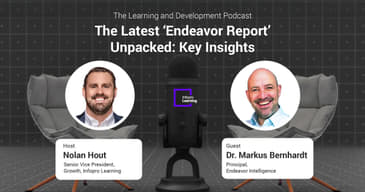
Unpack the latest Endeavor Report and discover key insights, emerging trends, and actionable takeaways for today’s evolving business landscape. Also Listen - The Latest ‘Endeavor Report’ Unpacked: Key Insights
Podcast Takeaways
• Markus’s unconventional journey from physics to L&D thought leader.
• The real story behind the Endeavor Report and its success.
• Why organizations must rely on client-led case studies over vendor hype.
• Hands-on examples of AI in learning and workforce solutions.
• Common misconceptions around AI as a “plug-and-play” fix.
• Why experts-in-the-loop remain critical for reliable outcomes.
• A balanced approach: Shiny innovation vs. solving real problems.
• The four-quadrant framework of the Workforce Solutions Navigator.
• Why the “golden middle” beats both cowboys and holdouts in AI adoption.
[00:00:08] - [Speaker 0]
Welcome to the learning and development podcast sponsored by InfoPro Learning. I'm your host, Nolan Hout. Today, we're joined by Marcus Bernhardt, founder of the Endeavor Intelligence and author of the Endeavor Report on the state of applied workforce solutions. Marcus is a recognized thought leader who specializes in helping organizations navigate the intersection of AI, emerging technologies, and the future of work. He brings unique perspective to the field combining a deep academic rigor with more pragmatic real world experiences from guiding a lot of global organizations through complex technological transformations.
[00:00:43] - [Speaker 0]
Today, we're gonna be talking with Marcus a lot about the Endeavor Report that he recently put out earlier this year. And we're gonna go through everything from just a brief overview of the report. We're gonna start. A lot of this is focused on AI, so you'll learn what AI can do, what I can't do. We're gonna talk about real world case studies, and then end on a a couple more, hands on learnings that we can take away from it.
[00:01:07] - [Speaker 0]
Without further ado, I wanna introduce you to our guest, Marcus Bernhardt. Welcome to the podcast.
[00:01:13] - [Speaker 1]
Thanks for having me, Lorna. Pleasure to be here. I'm really looking forward to this chat.
[00:01:18] - [Speaker 0]
Absolutely. Well, before we begin, we always start with just learning a little bit more about our guests. Obviously, you're very acclaimed in the learning development space. You're an author. You have a lot of, speaking events, keynotes, but that's not where you started.
[00:01:35] - [Speaker 0]
Well, maybe you were. Maybe you got really lucky and came right out of the gate just speaking at conferences. But we love to learn how you got into this field, what kind of kept you down this path, and and how how you landed at where you are today.
[00:01:50] - [Speaker 1]
Yeah. It's a it's a relatively long story, but I'll keep it I'll I'll I'll cut the corners. My my academic background is in theoretical physics. So I used to do a lot of programming and coding, and, I also used to have to do a lot of maths at the time. So equipped with that, and after a decade in, education mainly, running running education institutions in The UK, I thought to myself, let's have a look at this AI stuff, these neural networks.
[00:02:21] - [Speaker 1]
This is all this is all bubbling up. This looks like it's up and coming, but I wanna make my mind up, by myself. So I started coding some neural networks. I used some of the libraries available at the time. And, yeah, optimized my own backward propagation, looked at how many nodes you need and how many layers and what differences that makes and what gets your computer to crash and what gets it to do something in in a relatively short period of time and just played around with these tools.
[00:02:47] - [Speaker 1]
And at the time, also got to know a startup, for adaptive learning based out of Cambridge in The UK. And we got chatting, then I joined them as a chief evangelist. And that got me onto the stage and speaking at events. And at the time, they still always had the rule that when you come from a vendor, you're not allowed to speak. But at the time, a lot of, conferences made a huge exception for the weirdo that was me that wanted to talk about AI because they all probably thought, well, well, we can have one guy who's talking about it, And no no one else is doing that.
[00:03:19] - [Speaker 1]
We'll bring him in, and he can chat. And I think I I honored their trust by, serving up good information of what I thought was coming in the future and not selling the product, directly in the session. So I think that's they they honored that, and they kept inviting me back. And so for a couple of years, I was telling people about a natural language processing library called GPT two and how that was changing, how we were tagging content and working with words, that we were moving away from labels or keyword searches, but we could interpret text a little bit more intelligently. And I had half empty rooms, but really excited half empty rooms.
[00:03:59] - [Speaker 1]
Everyone else at the conference had decided to go to a proper talk. And then I did the same thing for another year with GPT three. And then the 3.5 moment came, and then many other conferences said, Marcus, you've been you've been doing this. We'll give you a bigger room. We won't give you the graveyard shift on a Thursday.
[00:04:20] - [Speaker 1]
And then and then let's see where we go. So it became the topic of interest, and I happened to be there. And so that was that was sort of how I ended up there. It's it was kind of, being in the in the place at the right time kind of a moment, but I enjoy it.
[00:04:37] - [Speaker 0]
So help me understand. When you mentioned you kind of, connected with this firm in Cambridge, Was that really your first foray into learning, like adult learning principles and corporate learning, or had some of the work you've been doing in the past focused on the development training arm?
[00:04:54] - [Speaker 1]
The the one thing that I've done throughout my entire career is is learning and training. So I started I started my my early career in the armed forces, and, there became an instructor. So, in in the in the late nineties, the armed forces was one of those places where you had to had to have proper learning objectives, and they had to be measurable, and they had to be precise. So the training was quite formal, but it was quite forward thinking at the time in terms of how learning objectives should be formulated and how one measures the impact of learning and training. So I started out with that, and then I spent most of my, career also in physics, lecturing and tutoring, things like statistics for biologists or or physics.
[00:05:45] - [Speaker 1]
And then, then after that, I went into into education, and I've also covered all age groups, including from 2.5 years old to 19. So not just university. So I've looked at a lot of different training and learning and human development, and that I was always interested in that, man. So that is the ongoing thread that goes through my entire entire career. And then when I saw that you could apply AI quite intelligently to that Yeah.
[00:06:10] - [Speaker 1]
That's when I got excited. I have to admit, though, one of my first conversations, at the time must have gone along the lines of, so you use AI to make GDPR training more interesting. So, yeah, I've I've always been relatively direct, and and and I voiced my concerns about whether something works or not. And I think that's also stood me in good stead because, I've I've not only once been called the not the silver bullet guy, which is a weird title and a very long title, but I I I I I'm very happy with that as well.
[00:06:43] - [Speaker 0]
Lovely. Lovely. Well, thanks for that background. It's really fascinating. You can definitely see you are the right person for exactly what you're doing.
[00:06:51] - [Speaker 0]
You have such a a history of keeping education as the center point, then obviously understanding this deep, deep technology before it became, you know, what it is today, which is the very commercial use of it, you know, building from the technical layer. You know, it it kinda reminds me of the the difference between, you know, you give a brand new hire, a tool like Claude, you know, marketing hire and say, go start writing blog posts on SEO. They're gonna be able to do it. You know, they'll they'll be able to do it, but they have no idea why they're doing it. They don't know whether it's good or not.
[00:07:27] - [Speaker 0]
They can't evaluate whether it's going to work. So you you definitely have kind of that root and origin, which brings us to, like, the the the this report, the Endeavor Report. As you mentioned, you know, it's it's it's very well known. But for those who haven't heard of the Endeavor Report before, would you mind talking a little bit more about it and and and and when, you know, when it came out, where people can get it, and and then we can dive into some of the details of it.
[00:07:54] - [Speaker 1]
Yeah. The inaugural Endeavor Report came out in June this year. And after several years of speaking and people often coming to me and saying, Marcus, we really like the use cases the best. Those are the those are the really good insights. You you tell us where people have found challenges that they've overcome.
[00:08:13] - [Speaker 1]
You tell us what's worked really well. And, and there's also that hint of, no. These these areas are still too far, and they're a bit hype, and here's why. Mhmm. So that kind of balance people love, and they love when it's connected to a use case, ideally one that came from a client and not directly from a vendor.
[00:08:30] - [Speaker 1]
Because the three hero slides, people struggle taking those, you know, fully seriously, and we know why. I'm not telling any anyone anything new here. So people want a real story, and they want to learn from a use case. They don't want to just know whether the vendor is absolutely amazing. So that's that's the story.
[00:08:50] - [Speaker 1]
And, I've always had good relationships with vendors across the board and and also clients, and I've seen myself a little bit of bridge between the two in my advisory work. And so at some point, I decided, yep. In in addition to mentioning them in my sessions and talks, I'm gonna put a report together. And so I went out, and I started telling people that I'd put a report together that is client led only and that not a single vendor would ever be mentioned in the report. And I had mixed reactions, you can imagine.
[00:09:19] - [Speaker 0]
Yeah.
[00:09:19] - [Speaker 1]
But amongst my vendor friends, a few also said, we get it. If if no one's listening, then it doesn't matter how loud we're shouting. So if we wanna get people to listen, then we can't put the vendor in, then we need a client led story, then they get really excited. And then at some point, they might ask who's the vendor. And then we have an inroad.
[00:09:38] - [Speaker 1]
Whereas if we have if we have a sponsored piece with several sponsored pieces that no one reads, then also all the sponsorship has gone out out of the window. And so had good reactions there. Also had good reactions from some clients. Some of my some of my use cases did not come through the vendor. The client said to the vendor, I'd like to do this with Marcus.
[00:09:56] - [Speaker 1]
So, yeah, that's how I got my first eight use cases together, and they were a nice little variation. And as I brought them together and told the story, which I do in the report for each of them across two pages, I started noticing some similarities, some differences, and I started exploring those more. And I I put a little bit of a framework together on how I see the use cases and what where they differ and and and where they are more similar. And so that's how it came about. The reception was absolutely amazing, better than I had hoped even.
[00:10:31] - [Speaker 1]
So, I'm very pleased with that. Following following the reception, people have also asked me to dive deeper in, you know, we'll talk about this in a moment, the the applied workforce solutions navigator. This this research piece that I did about those use cases where I started categorizing them a little bit, and putting the framework together. So I've published that since as well. And now I'm in the in the ropes of putting the next report together, which should be a q four this year mid q four this year, publication.
[00:11:01] - [Speaker 1]
So I'm looking forward to another good set of use cases, some of them completely new, and some of them stories that will continue from the last report. So a a a section will be called the endeavor continues, where we review some of the use cases that we already know, and we find out what's happened. Did they pivot? Did they did they scale? Did they do both?
[00:11:23] - [Speaker 1]
What what happened? What came out of it? So really, really, it's it's it's basically storytelling. People want to see what others are doing. People struggle to get information from vendors at at conferences.
[00:11:35] - [Speaker 1]
People can't speak to all vendors, and so people are looking for other ways to get on the front foot. And in such a fast moving field, you wanna hear from your peers, and you wanna learn with and from your peers. So this is a vehicle that kind of promotes that.
[00:11:49] - [Speaker 0]
Yeah. I mean, the the concept of who do you trust and where do you get these sources from be is becoming so important these days. That's actually how I started the podcast Mhmm. Was because I didn't have conferences to go to anymore to hear stories. And I loved hearing customer stories or, you know, not even customers, just just real life stories of what are the pains that you have?
[00:12:20] - [Speaker 0]
Like, what are the problems that that you know, you sit down in a Brandon Hall event in the morning, and you're just chatting about the world and what's going on and and being able to hear similarities was really valuable for me as a marketer. But then when COVID came, I didn't get those stories, you know, kinda like what you said. You know, you can talk to your sales team, and they're gonna give you a flavor of it. And then you're gonna talk to the, you know, delivery team, and they're gonna give you a flavor. You can sometimes talk to the customer, but sales wants to hold them close to their chest.
[00:12:54] - [Speaker 0]
So I I I I was like, you know, I'm hearing all these people that start these podcasts. They say the biggest benefit is they just get to have open conversations that they normally wouldn't get to do. So let me do that. And, you know, I I think that has been the value to the audience is really what you said. I mean, it it's it's putting literally, I guess, this case, a microphone to the case study to these people that you want to hear from.
[00:13:23] - [Speaker 0]
Now, obviously, you can still go to the events and you can still talk, but there's a lot of, you know, even an extrovert like myself, I have a hard time walking up and saying, you know, hey. I'm Nolan. How nice to meet you. Tell me about your AI challenge. It's not a real you know, you can't really dig deep into it.
[00:13:41] - [Speaker 0]
So I I can definitely understand why this report has gained so much attention. And and and and for those that that haven't heard, I mean, the the the majority of this is all talking about AI. I think I mean, I I read it, but correct me if I'm wrong, Marcus, but all these solutions, all eight of these case studies are all just talking about different ways that organizations have been leveraging AI within their workforce. Correct?
[00:14:10] - [Speaker 1]
99% correct. Yes. It I I talk about it more as a technology Correct. A little bit because I I think yeah. There are other technologies that play a role as well.
[00:14:23] - [Speaker 1]
And we have one use case, which is a tabletop, practice device for orthopedic surgeons where
[00:14:31] - [Speaker 0]
That's right.
[00:14:32] - [Speaker 1]
Aspects of AI will come in the next iteration. But in this first iteration in the use case, there was actually no AI in the solution. So it is I'm looking for a a variety of technological solutions that are interesting, where people learn, where people can practice, where people can get real time support or all of those ideally. And then also where we're measuring data along the way that helps refine what happens in the next loop in the next step. And so that for me is a workforce solution.
[00:15:05] - [Speaker 1]
If you're learning slash training, if you're getting also ideally some real time support, and if there's a data piece that combines those two and it becomes it becomes a continuous loop, that for me that for me would be a modern workforce solution where we now have the capability to bring these elements together. While we also realize that not everything has to be has to be tech solved, there are still workshops, there are still, mentoring and coaching and other good tools out there for people to improve and learn. And, yeah, the the the tabletop orthopedic surgeon that is used that is used in a workshop where they can practice. And because they can practice on this tabletop device, they can now practice without taking successively many X rays of the patient. Because previously, the way they could practice is they needed to see if they have the right alignment Mhmm.
[00:15:58] - [Speaker 1]
With the patient. And to see if you have that, you have to shoot an X-ray. If the X-ray machine was in the right place and you're fully aligned, then that picture is enough, and now you know you can move ahead. If the if the X-ray machine, you slightly placed it in the wrong place, then it doesn't even matter if you're aligned or not. You can't see if you're aligned.
[00:16:17] - [Speaker 1]
So now you have to readjust it and take a second X-ray. And if you then see you're slightly misaligned, then you have to adjust the tool and take a third. And so that is one of those really fabulous, great stories where a a really simple desktop solution with with some coding interprets the angles and interprets what a what a surgeon is doing, and you can practice, in in with real time feedback. And, I mean, these are already these are already fully qualified, well performing surgeons. They they even start competing against one another in the workshop in in one upmanship, to see to see who can take the the fewest X rays.
[00:16:56] - [Speaker 1]
And and even after the official workshop is done, there'll be quite a few tables still saying we'll do one more round because maybe we can crack the high score.
[00:17:05] - [Speaker 0]
I can't can't wait for the, Top Gun movie, equivalent of this to come out.
[00:17:10] - [Speaker 1]
I'm sure it will be everything.
[00:17:12] - [Speaker 0]
Well well, getting into the report a little bit, I thought what was really great is is, you know, I don't know if it's on the first page, but, you know, in in one a couple of the pages there, you talk about what AI can do and what it cannot do yet. And I I love that opening part of the report because I feel like it gave such a a really I don't know. It's such a good, like, context setting of, like, where are we today? Where are we not yet? Because it makes this report, you know, although you do you're gonna have multiple ones come out.
[00:17:46] - [Speaker 0]
It really does help you understand at a moment in time where were we. For those who haven't read it, what what is kind of the high level view of that? Where are we today with kind of the AI is doing these things really well? These things are not quite there yet.
[00:18:02] - [Speaker 1]
Yeah. That was, when I when I put the report together, I thought I also should have some useful other information in there. And I was very honored to be able to work with doctor Michael Allen and Steve Lee from Allen Interactions on this article, where we write about, what started out in a conversation between us as the misconceptions between buyer and vendor because there's a big mismatch between expectations. So for example, one of the things we talk about is that, the the the buyer side thinks well, everything is now plug and play. Everything is automatic.
[00:18:37] - [Speaker 1]
The AI does all the job. So Mhmm. I mean, clearly, I'm gonna have the solution within thirty six hours, and clearly, gonna cost me almost nothing because all you did is you threw AI at it, and you did your thing, and now it's ready. So the the plug and play element is something that is unbelievably overhyped. And, and one has to really say, no.
[00:18:58] - [Speaker 1]
If you're doing a curriculum mapping, that's not just having an AI that you tell do curriculum mapping. It goes far beyond that, and it's it you also need your experts in the loop. And I'm always very keen to say it's experts in the loop. We don't need we don't need a human. We don't need a human because they're there for their human elements.
[00:19:15] - [Speaker 1]
We don't in that moment, we don't need compassion, and we don't need understanding, of of of of feelings and and why maybe one thing is is better than another. What we need is factual knowledge evidence. So we need an expert in the loop who looks at the outputs and who guides the process. So plug and play expert in the loop and how much time that still takes to get it right, and also how much time it takes to continue to get that right. Because in a fast evolving world, the tool will change.
[00:19:46] - [Speaker 1]
Yes. The data will change. And it isn't just like, oh, throw more data in, it'll update itself. Anyone who's tried this, a great example is when you have a when you have your GPT type chatbot or your Gemini plug in chatbot, and you thought it would be really good to have your HR policies uploaded, then the first instance of that with all your policies uploaded works unbelievably well. But then if you have, new versions come out and you start uploading new versions, then you realize relatively quickly that the system is not able to distinguish between a new version and old version of timeline and what has replaced what.
[00:20:27] - [Speaker 1]
It becomes a myriad of a mixture of policies, and it becomes less useful. Whereas when we hear the benchmarking, we think, man, these things can really think. I mean, this is the easiest task ever. Right? Version eight is more recent than version seven.
[00:20:41] - [Speaker 1]
Duh. And if you can solve crazy maths problems, then, of course, you you know the difference between version seven and version eight. Turns out, if we look into the strengths and weaknesses of large language models in particular, that is not a strength, and there we fall down heavily immediately. And so it's it's about what what what aspects are plug and play and fast? What aspects need more thinking and understanding of why the model does what it does and has certain strengths and weaknesses?
[00:21:09] - [Speaker 1]
And the other one is, how do we how do we bring the expert in the loop and make sure that this continues to be good? The other thing that people often get wrong is that they assume that models just get better. Well, let me remind you of earlier this year when GPT Forge started throwing emojis at us all. And we went, And they had upgraded the system. This was apparently a better GPT four than the GPT four the week before.
[00:21:34] - [Speaker 1]
But for many of us users, it was absolutely not a better GPT four. Now if you have a plug in that works with that and imagine, you have that outward facing your company and suddenly emojis appear, then some sort of expert in the loop who checks the fact factualness, but who also generally checks the output would have maybe gone, oh, we need to pause this for a moment. Something here has changed. The upgrade was not automatically a better version. Yep.
[00:21:59] - [Speaker 1]
And and so those are those are those are the common misconceptions that we, look to educate people about and help them on their journey because, I mean, it isn't easy. It comes with a sense of trepidation. There's job insecurity out there. If you're running projects right now with AI, you think this could be a total winner, or maybe it might cost me my job. There are a lot of a lot of concerns in the market right now, and people need all the help they can get.
[00:22:24] - [Speaker 1]
So really, really cool to be part of that journey and give that support to people.
[00:22:29] - [Speaker 0]
Yeah. Interesting you bring up the, you know, the updating of data because it really is. It is one of the things that so far, at least, I haven't been able to get my models to work quite well at all. I think I mentioned, I put something I think you even commented on LinkedIn, but I was talking to to Claude, and I put it in an Excel file. And I said, you know, ignore the headers.
[00:22:54] - [Speaker 0]
I realized that these are the headers I want you to do. And it said, okay. And then it gave me the answer. I'm like, you didn't ignore the headers. They're like, you're right.
[00:23:02] - [Speaker 0]
I'm like, try again. They're like, okay. We fix it now. And I'm like, you didn't fix it. And I and I said, start from scratch.
[00:23:09] - [Speaker 0]
Erase everything. Go back to the beginning. They're like, okay, we'll do that. Did we fix it? No.
[00:23:14] - [Speaker 0]
I said, you're not hearing me. And I I caught myself. I was talking to this, you know, to Claude like I would talk to my, you know, my my kid when they're asked me 30,000 times why. And I just I I had to stop and just kind of laugh. But but that's a a fun, easy example.
[00:23:34] - [Speaker 0]
But when you talk about something like HR policies, they they get updated very frequently, or maybe you're even referencing an external source. Right? Yep. Referencing the state of California sexual harassment policy, and you're pulling in that. Well, when that gets updated, what's it doing on the back end?
[00:23:50] - [Speaker 0]
And so, very good point there. That is a a limitation.
[00:23:55] - [Speaker 1]
Yeah. And people always, when it comes to data and having clean, well structured data, they they often underestimate what that means. And if you're not doing your homework in that regard, when when people put data in the cloud, it needed to it needed to be be better structured to to do the cloud jobs. Then people started talking about data lakes in organizations. You you you can't just upload your file system and your SharePoint.
[00:24:19] - [Speaker 1]
That's not how the data lake works. And similar similar here, if you say, well, our chatbot just answers the frequently asked questions online, and we have we have all of them covered on a on a on a on a web page. And on on internal pages, we go even deeper. Like, we we're we're ready. Well, if you if you if you plug into an openly available model, and, it might have all the answers.
[00:24:42] - [Speaker 1]
What if what if one of the it's one of those models that has, after an update, tries to be unbelievably helpful, and you say, well, your your CEO gave me gave me this discount code and said, with this with this, I have to just rock up here, and I'll get the full refund. So the c a the CEO has promised me this. Tell me tell me where on your Internet it says that if someone makes up that story, then definitely it's a no. And if now your your model is, if you've been really explicit to your model that it should do everything to be helpful, Yeah. Then if if if a 100 people try that on, well, maybe a handful will suddenly end up with a full refund because they made up a story about having a code that they were promised would work.
[00:25:22] - [Speaker 1]
The system might apologize and say, oh, I'm I'm really sorry. This must be an error in my end, and here you go. Here's the refund. So, you know, in in those moments, we can laugh a little bit or like you explained, when it is acting like a like a bit of an like a bit of an idiot, the old rant at the computer has become a classic already. But but the yeah.
[00:25:42] - [Speaker 1]
At the end of the day, a company's reputation and brand is on the line, especially when it's external facing. So that's why that's why understanding the system a bit better and understanding what the limitations are is so key for everyone involved, even for those who are just using their cofounder to prompt themselves. If you understand the the use cases and what it does well and what it doesn't do so well better, and you've worked with it for a little bit and you've played around and you've practiced, your brain will adjust, and you will suddenly have really good ideas for where to use it. And you'll also know in which situations not to use it. And so and so it's it's less about prompting.
[00:26:23] - [Speaker 1]
It's more about if if you know why you're doing this piece with it and you know what evidence you've got and what you want as an output, well, you've just given yourself the prompt by by structuring the problem in a way that you think this works really well for an LLM. Now your prompt doesn't matter that much anymore because you've given it all the outlined parameters, and you think this is a problem that the LLM should get on really well with. So here we go. Boom. Then then the research also tells us the prompt makes very little difference.
[00:26:49] - [Speaker 0]
Yeah. I I just had this conversation actually with my my wife about it. I said, you know, it's it I I'm reminded of when people said stop sourcing Wikipedia. Like, Wikipedia is not the like, the Internet is not the answer for everything. When it first came out, we didn't know that.
[00:27:12] - [Speaker 0]
We just thought, hey, it's published. It must be right. Like, online. Therefore, it is fact. Because everything else we had seen in print was pretty much like you know, we're like, for the most part, if we see it written down, it's gotta be some type of fact.
[00:27:25] - [Speaker 0]
Right? And then we, over time, were able to realize what can we trust versus what can we not trust versus what's the gray area, so maybe we're not gonna do that. And, you know, I think as you use it more, like you said, you kind of be you you find that area of this, I'm gonna use it with high confidence that it's right. This, I'm gonna use it with very low confidence, but I just need something to kinda get me there. And and some, you you know, the more you know, you can say, you know, don't lie to me.
[00:27:53] - [Speaker 0]
You don't make up numbers, whatever it So so so those are a lot of the the the don'ts and some, you know, trepidation around the models. But in all these stories, the eight that you published, then I'm sure aside from the eight you published, I'm sure there's several other conversations and and things that didn't make the cut. Where are you seeing the top uses of AI today? You know, 09/16/2025. What are you seeing, the absolute dues of AI?
[00:28:21] - [Speaker 1]
That's a that's that's a really good question. That's also a bit of a trick question, because I I don't want to, I don't want to promote a certain sector or a certain application. So I'm gonna sidestep this one a little bit. Where I'm where I'm seeing the best use cases is where people from the start have have thought their use case through properly. Mhmm.
[00:28:47] - [Speaker 1]
And this isn't reinventing the wheel of thinking something through. These are just the basics. Yeah. It happens that with innovation, people often see the shiny tool and act upon the first reaction they have, which is more like that of a six year old in Toys R Us. Wow.
[00:29:03] - [Speaker 1]
Imagine what we could be doing here. And I always say, yeah, then and there's also the doubters. There's those that say start with the problem in mind, and they then look at the others who who have their Toys R Us approach and and say, see how much better we are. I stepped back from both, and I said, you need to do both. When it comes to when it comes to innovation, you need to approach a tool with the Toys R Us approach and go, oh my god.
[00:29:26] - [Speaker 1]
Imagine what's possible. Then you also sit down and jot down all your problems and and all the frictions you have or where or where you're underperforming. And then you start to think about what kind of a solution might work. But to be innovative, you have to think a bit blue sky, and you have to think a bit crazy. But that's not the hat with which you make your final decision.
[00:29:50] - [Speaker 1]
So I think if you have done both and you bring them together and you do your homework and you look at what's what's most reasonable, what's within budget, which timelines are good, and where can we measure ROI relatively quickly and see if it is doing what we want it to do, then you've done your homework. Then you're ready to run a use case. Second part of your homework would be looking at what the people transformation needs to be for those who are involved and who might use the tool or interact with it. That's a key thing to get right. The best tool that no one's using is not the best tool.
[00:30:20] - [Speaker 1]
The best tool is the one that the most people are using to the highest effect. That might only be a mediocre tool, but if your transformation is running really well, you'll get much better much better ROI, than if you bought the best tool and no one's using it. So that's part two of homework is the human transformation piece. And if you then also, do your research and you find the right vendors to partner with, and very often right now, these are partnerships. They aren't off the shelf SaaS style promises.
[00:30:53] - [Speaker 1]
These are co productions where you have a vision and, no, the features won't come off the shelf. And you see that in a lot of you the use cases in the report. And you partner in such a way with a with an external partner or with an internal team, and you were developing an in house, depending on what kind of organization you're at, then you're at the forefront, on September sixteenth in twenty twenty five. Then you've done your homework, and you've approached it in the right way. You haven't got you haven't got distracted by the shiny object syndrome.
[00:31:25] - [Speaker 1]
You haven't got distracted by the fear that you might, that an that an experiment might not work out. That's that's another one. When we look at sales and marketing for many years in sale and marketing, you have to run experiments, and you you you celebrate the winners. When when marketing has a smash hit home run campaign, no one asks, why did the five before not work? The whole point was to find the one that works and lean in on it.
[00:31:52] - [Speaker 1]
It could have been any of those six. Yeah. Yeah. Right? And that's normal in marketing.
[00:31:57] - [Speaker 1]
But especially when it comes to HR and learning and talent development, we are used to that projects need to work. They can't we can't test and see how good is this one and how good is that one. So this entrepreneurial mindset that we we run five and we we look at the that maybe one, if we're good, two are a real winner, and the other are learnings or normal progress. And maybe there's also one or two in there that didn't quite work out the way we thought. That's that's completely normal in other parts of the business, but in our our part of the business, that's still new thinking.
[00:32:29] - [Speaker 1]
So yeah, I can hear about that. Work, get right, the people transformation, also think about that it goes it goes into an experimental phase where it's not about winning winning every use case. It's about having a small portfolio and, and moving at a pace that allows you to pull the brakes and pivot or readjust or say that just didn't work the way we had hoped, but we tried.
[00:32:56] - [Speaker 0]
Yeah. I can I can definitely echo that? I I helped launch our our AI offering. It's not a product. It's just, you know, consulting services and and the like.
[00:33:10] - [Speaker 0]
And so I get brought in by the nature of that to most conversations with, you know, the, like, learning leaders and things like that. And after the call, usually my sales rep, the sales rep at the company will say something like, oh, this is great. You can tell they're really excited. They want, they want, like, a proposal tomorrow and then enact it the next week. And I tell every time every time I say, listen, it's the person who like, it's that that person who says, this is great.
[00:33:41] - [Speaker 0]
Show me a demo next week to my boss. We wanna get moving on this next month. A 100% of the time, they sign up zero times. Like, that is the absolute that person will never they will not buy from us at all. Contrast that to somebody I actually met with last year at this time.
[00:34:01] - [Speaker 0]
It's an exploratory conversation. They came back to me. They came back to us a month ago and said, hey, we're ready. You know? And and yeah.
[00:34:10] - [Speaker 0]
Then I was like, okay. Yeah. It'll take a month. But but but those those people who have almost, like, let it marinate, like, the idea of, okay, I saw the shiny thing. Now let me get a little bit of let me dig a couple layers deeper.
[00:34:26] - [Speaker 0]
Let me get everything lightly. Let me look at the human element. Let me look at who will use this. And now I'm ready to act. Now I'm ready to come in and, you know, know, okay, partner, come back in and work with me on this.
[00:34:38] - [Speaker 0]
I do I I I absolutely think you're spot on. And and those have gone really, really successful. The other ones, you know, usually they kind of sputter. They start a little bit awkward. Yeah.
[00:34:48] - [Speaker 0]
That's always the case. And then the other thing that I think, you know, you you really nailed is kind of that that partnership mentality. It really reminds me, I don't know if you did much work in in cloud computing when AWS and and became kind of really big. At that point, I was in the IT, world. And I remember
[00:35:07] - [Speaker 1]
be there.
[00:35:09] - [Speaker 0]
Clients would say, we'd have customers and they'd say, I, you know, I just really need an expert on cloud computing. I need somebody who's got ten years of experience on Amazon Web Services. And I would say, you realize Amazon Web Services is two years old. You know? And and I think with AI, I think that's the the if I understand you right, Mark, is I think when you mentioned partnerships, you're kind of saying, you know, you have to realize that these partners are building it with you.
[00:35:43] - [Speaker 0]
It's not gonna be, oh, cool. InfoPro is the expert. We'll have no problems. Like, there's you know, it will come in in AI and boom, we're done. We're you know, now we're an AI first company.
[00:35:55] - [Speaker 0]
No. It is a it is a a working alongside you, to kind of get to that promise land versus, oh, they got my AI strategy for me. I'm done. I don't need to invest my time.
[00:36:07] - [Speaker 1]
And that's also something that should, could, would come out in a proper conversation that a vendor would say, we've had we've had two similar use cases. Let me tell you about mistakes we made. Let me tell you about where the easy wins were. Let me tell you which parts of the project are gonna be more straightforward and why, and which parts of the project are gonna need a little bit more handholding, and and a little bit more trial and error and fidgeting to get it right and why. And then you go, now I'm listening to someone who's actually consulting me and who's helping me.
[00:36:41] - [Speaker 1]
That's the kind of partnership, and that's the kind of vendor I want to be working with. So there's a huge opportunity here. At conferences, we see a lot of potential buyers walk around just hoping that they'll meet someone like that, who will instead of just trying to get the the pipeline, scan the badge, get the meeting in the diary, will use the first five minutes to become a little bit of a a a source of really good information. About the product, of course, absolutely. That's their job, but also a little bit generally and also a little bit about other projects.
[00:37:17] - [Speaker 1]
And I'm not talking about hero slides. I'm really just talking about, yeah. Yeah. We're going through something similar, and it's it's not always as easy as you think it is. And have have you heard from others do this?
[00:37:26] - [Speaker 1]
But well, I can tell you a little bit what we're doing with our clients. You have you have those five minutes. You have all the trust. You'll have a far better conversation booked in. And I I still see a lot of vendors get that wrong.
[00:37:38] - [Speaker 1]
And the poor poor sales teams, the the expectation on them has also gone up. Right? Yeah. They they are not AI experts, and they are still figuring out what use cases the company is doing and how they're working. And, yeah, I I always I always smiled when in the first eighteen months, I went to vendors, and I said, so what plug in are you using in the background?
[00:38:02] - [Speaker 1]
And they say, we're building our own. You're not Salesforce. You're not building your own LLM in the background. No. No.
[00:38:09] - [Speaker 1]
You're not. This is an l m LLM plug in. Go and ask someone who can tell you which one you're plugging in. It's probably OpenAI. But but go and ask someone because I'd like to know how you're how you'd how how this is structured.
[00:38:22] - [Speaker 1]
And there were there was even the one or other who said, no. No. No. We're building our own. No.
[00:38:28] - [Speaker 1]
No. Uploading your information into someone else's tool is not building your own. That's not quite the same thing. But, yeah, there's we have to we have to appreciate. The challenge goes both ways.
[00:38:37] - [Speaker 1]
I I you know, I'm I'm I'm talking very, very flippantly here, but if you're if you're in a sales role at one of these organizations, there's a huge expectation that you suddenly can explain AI. You can explain large language models, and you can you can build that trust with the customer. Wow. What a job. But the opportunity is there because customers and the potential clients, they're out there looking for help.
[00:38:59] - [Speaker 1]
They're actively looking for help. And the best thing to do to get rid of them is to just ask them the three standard sales question where you think you're taking them down the funnel and you get them booked in in the diary, but you haven't had any conversation that has fostered any trust. Right? That's that's my view.
[00:39:15] - [Speaker 0]
Yeah. No. I I I absolutely agree. It's those that that you've allowed to to teach something, you know, has really helped out. So I I wanna one of the things we talked about was we were gonna evidence some case studies.
[00:39:29] - [Speaker 0]
There's eight wonderful case studies in the Endeavor Report. If you haven't downloaded, we'll have some links to download it so you can get it there. But go through those, read those. But at the bottom, once we get past the case studies, we we we have the applied workforce solution navigator that that is included in this report. I wanna make sure we cover this.
[00:39:49] - [Speaker 0]
Can you talk a little bit about what that navigator is and how people are leveraging that?
[00:39:54] - [Speaker 1]
Brilliant. Yes. So the navigator is just my interpretation of what kind of use cases I was coming across and how I, in my head, categorize them. That's it. You know, like any good framework, it's not the framework.
[00:40:07] - [Speaker 1]
It's not the best thing. It hasn't reinvented the wheel. It just helps you think things through and have a checkbox that you don't forget aspects. So that's the starting point. I saw two two pathways that people follow.
[00:40:19] - [Speaker 1]
One is, are we is is answering the question, are we enhancing operational excellence? Like, are we doing exactly what we're doing previously, but we're doing it better or faster or both?
[00:40:33] - [Speaker 0]
Mhmm.
[00:40:34] - [Speaker 1]
Or are we doing something that is completely new that wasn't there before with the technology? So that's those those give you one dimension to look at yourself. Is this is this faster, better, more revenue, or is this
[00:40:51] - [Speaker 0]
Did I make a better mousetrap, or did I make a new trap altogether?
[00:40:54] - [Speaker 1]
Correct. So that was one. And the other one is, are we are we putting a completely new solution together ourselves and some tech companies, do that? Or they cocreate with a vendor? Or is it more going out finding a vendor and integrating what's already there?
[00:41:13] - [Speaker 1]
And those two are very different because the view the the the timelines and the kind of the kind of, road map that you'd have to go through is very different. And once you once you map those two against one another, you you end up in four quadrants for where your use case might land. And the trick isn't that one quadrant is better than the other. No. They're all the same in terms of how good they are.
[00:41:35] - [Speaker 1]
It's just categorizing and helping your thinking. So if you're doing something if you're doing something that you've done previously, but you can do it more efficiently and better with technology, and you're working with an outside vendor who has the solution, then that is the quadrant that I call efficiency accelerators. Mhmm. And when you're putting an efficiency accelerator in place, that just means you have to ask yourself certain questions, and you have to you have to have a a certain you you have to do your homework in a slightly different way than if you're building something completely new that was never there before, and you're building that in house, and now you also have to convince your people that this new process and with a new tool is gonna be is is gonna be there. And so for each of those, that would be a capability creator.
[00:42:21] - [Speaker 1]
Each of those quadrants just gives you a different mindset to think about your use case and help you go through maybe a few tick boxes and and help you do your homework so that you can have a a successful one. That's that's, in a nutshell, the four quadrants where none is better than the other. You don't want to be in the top right, or you want to avoid being in the bottom left. That is not what this is about at all. In fact, good organizations will have a portfolio of use cases where there is a representation probably of one or two use cases in every quadrant because you would be missing out if you didn't have some efficiency accelerators of things you're already doing and you're accelerating them with technology.
[00:43:06] - [Speaker 1]
But you'd also be a miss in most sectors if you weren't building something that's completely new that wasn't there before. That might give you a real competitive edge over your competitors. So that's that's it in a nutshell. And if you look at the report, the eight use cases spread across those quadrants, and, we even have a couple of use cases that can't be exactly defined to be only in one of the quadrants, which again shows it's it's it's not it's not, science as in you you are either exactly there or exactly here. You can you can have an overlap of of maybe two quadrants, and that that story I tried to tell in the in the report, and we explained why we're thinking that way and why it helps to think about those use cases in this fashion.
[00:43:53] - [Speaker 0]
Yeah. And that's great that there's there's, and because I think what'd you call yourself the what was the title? The no silver bullet guy? What what was it?
[00:44:03] - [Speaker 1]
Not the not the silver bullet guy. Yeah. So
[00:44:08] - [Speaker 0]
so, you know, when I think about it, it's it's I think so many people are like, well, what is the AI approach or the tech, transformation approach or the whatever it is? But I think saying, you know, more than likely, it's gonna fit into one of these four buckets. And when it does, here are some things that you need to consider. I think it's helpful to break that down for people, especially in something like this that has so many interconnected parts. Being able to say, what is the goal of this program?
[00:44:40] - [Speaker 0]
Where does it fit? And then what questions do I need to ask? Is just so helpful. Because, you know, this is, especially in the field of of AI, that's the path you're going down. It's more than likely the first time that you're working on a solution like this.
[00:44:55] - [Speaker 0]
It's not like you have twenty years of experience, you know, enabling your organization to use AI or accelerating with AI. It's your first go round. And so having some roadmap is really, really helpful. And for those that again, that haven't looked at the Endeavor Report, really, you know, encourage you to check that out. It's free.
[00:45:16] - [Speaker 0]
You download it. We'll put a link for it as well. Marcus, before we head out, I'll give you a couple options here for for a takeaway. You can either leave people with this idea of, you know, if you're not using AI for this, this is where I'm seeing the most value, or this is the one thing I get I see most people get wrong in AI. So you can either choose, you know, a cautionary tale or or maybe a silver bullet if you want.
[00:45:49] - [Speaker 1]
I'll I'll position myself maybe a little bit in the middle. So here's here's the thought process. When when people start these projects and start thinking about these use cases, they always they always think that you have to be a certain personality, and you have to be in specific type of organization to do this. And they often they often have those leaning in in mind because that's what we're being told by social media. There's those heavily leaning in, and they're like cowboys shooting into the air like crazy, not not caring if they'll hit anyone by by accident.
[00:46:24] - [Speaker 1]
And then on the other side, we have the hesitators. They want everyone else to make the mistake, and they're not gonna move. And and and it it it we're told you have to almost be one of these two personalities, and you have to choose now. And that's all that's all complete nonsense. If I am if I work at a tech company in a totally unregulated space, so I'm not in pharma, I'm not in health care, you know, then then experimenting and leaning in is is gonna be the way forward because we're trying to get an edge across, other organizations who are doing something similar, regardless of in which department you sit.
[00:47:01] - [Speaker 1]
And the way we do that is by leaning in, and leaning in doesn't mean going nuts when it comes to use cases. Leaning in means means finding out as much as possible about what the tool can and can't do, and then thinking about, with the with the Toys R Us, but also with the problem hat, how how this might work for us. And guess what? The leaning in crowd, they also say no to four out of five use cases because they gathered all the information, put it on the table, and said, this isn't right. And even if you even if you're even if you're in an organization that that doesn't have many regulatory constraints, that's how it would end up.
[00:47:38] - [Speaker 1]
Of course, if you're in a highly regulated environment, then you might have to find seven or eight to find one that's okay. But guess how much you're learning along the way about compliance, about SOC two, about where the data is stored, about what kind of terms and conditions you're signing, and how they've changed in the last six months. All of that is a learning journey. None of that leads to the cowboys. Yes.
[00:48:00] - [Speaker 1]
Let's go. We're gonna go for every single use case out there. And the the other crowd, the hesitant crowd, they might be hesitant because they're highly regulated. They might be hesitant because the the company or the sector is, maybe even because of clients, risk averse and has to be. So they don't just choose their personality as a as a cowboy or as a hesitant.
[00:48:20] - [Speaker 1]
They they they might just be in that kind of a role. And there, I would also say they're probably also to a large degree, the better companies looking at possible use cases, exploring what are the limitations, what are the constraints, how we can how can we satisfy data privacy and and bias and other concerns in a way that we find we would be able to justify to our clients and our stakeholders. And then they might say no to a lot of things and come up with the one or other yes. So in any in any sector, if if you're if you're looking and exploring proactively, no one will force you to hit go, and you're gonna learn a lot along the way. And even in even in highly regulated areas such as pharma and health care as two typical examples, I I work with people who are leaning in heavily to try to find out what might work and when when the tools and when the regulations and when the market is ready.
[00:49:21] - [Speaker 1]
And they're also running use cases. They're just running slightly different use cases to to those that are less regulated. But don't let social media tell you that you're either or as a personality. As a as a professional who is looking to advance their team, their function, their company, depending on where you sit, you should be thinking about, what opportunities do we have amongst those opportunities which satisfy the rules and guidelines that we've given ourselves or others have given us. And within that playing field, where can we operate and where can we run a use case or two and learn from that even more to move forward?
[00:50:00] - [Speaker 1]
That is what the golden middle gets right. So you don't you don't have to be on either side of the spectrum. You should be someone who thinks these things through with their team diligently and has a good idea and also expects there to be some learnings along the way, both when it comes to theoretical research about a personal use case, as well as, like we said earlier, when you run it, there's gonna be friction. The came off the shelf and ran smoothly from day one has never existed anywhere in the world for any solution. So why would that have changed with AI?
[00:50:35] - [Speaker 1]
And that's where our sector, amongst other sectors, just also loves a good silver bullet story that this thing is gonna solve all our problems. We just have to sign the dotted line, and that has never worked. So position yourself in the middle. There is no there is no this is the thing you should be pursuing because it depends on where you sit, whether that's right for you and whether it satisfies the regulations, and and there is no certain personality with which to approach this with or whether you're innovative or anything like that. No.
[00:51:02] - [Speaker 1]
Just do your homework. Where are the opportunities? And to which ones do you have to say no, and you have a good reason that you're saying no? And to which ones will you say yes, and you probably have a really good reason why you can say yes. Not just because you're excited about the upside, but because you had did your homework and you think the risks are within the boundaries that you or others have prescribed.
[00:51:23] - [Speaker 0]
Yeah. So what I'm hearing is and and so cowboy was on one end of the spectrum. Was it holdouts? What was on the other end?
[00:51:30] - [Speaker 1]
Those holding back.
[00:51:32] - [Speaker 0]
Holding back. So I
[00:51:33] - [Speaker 1]
feel like holding back. It was hesitant. It's a
[00:51:34] - [Speaker 0]
new it's a new Likert scale. Cowboys holding back. The advice is answer a a two or four you know, slightly holding back, slightly a cowboy, or in the middle is where you wanna be. So so either be slightly cowboy, slightly holding back, or be neutral, but try to avoid being a cowboy or a hold back. So a very sound advice, Marcus.
[00:52:00] - [Speaker 0]
Thank you so much for joining us. Appreciate you spending some time with us, and I look forward to the opportunity to do it again soon.
[00:52:07] - [Speaker 1]
Yeah. Thank you very much for having me. Really enjoyed the conversation. And, who knows? Maybe looking forward to the next one as well, Nolan.
[00:52:14] - [Speaker 0]
Absolutely. Thank you. Bye.