Explore practical strategies for coaching, delegation, and virtual communication to strengthen leadership, improve collaboration, and navigate today’s evolving workplace. Also Listen - Navigating Work Today: Coaching, Delegation & Virtual Communication
Podcast Takeaways
Asking for advice leads to more specific and actionable input than requesting feedback.
Specific developmental input builds credibility and drives better improvement outcomes.
Delegating decisions can empower or burden employees depending on context and perceived expertise.
Eye contact through the camera significantly improves impressions in video calls.
Typos generally reduce perceived intelligence, though emotional urgency can mitigate the effect.
Voice alone often creates stronger impressions than text and can rival video in impact.
Professional or relatable backgrounds help build connections; poor lighting/backdrops can hurt impressions.
People overestimate how quickly colleagues expect replies; managers should set clear norms.
[00:00:08] - [Speaker 0]
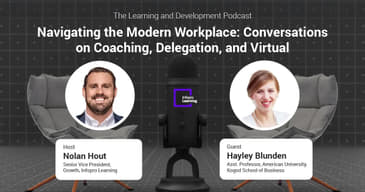
To the Learning and Development podcast sponsored by InfoPro Learning. As always, I'm your host, Nolan Hout. Joining me today, we have Professor Hayley Blunden, is an Assistant Professor of Management at the American University Kogod School of Business in Washington, DC. The first thing we'll have to have Professor Blunden tell me is how to say that name. Through her research and teachings, Professor Blunden seeks to improve people's ability to navigate workplace interactions.
[00:00:36] - [Speaker 0]
And gosh, those can be quite tricky sometimes. It's nice to have somebody who understands the science behind some of these, norms that we see. Today, we're going to be talking to Professor Blunden about a lot of different things, but really, workplace interactions and, and mentorship, coaching, delegating work, the list goes on and on. And here I am again, going on and on. So without further ado, let's welcome our guests to the podcast, Professor Haley Blendon.
[00:01:05] - [Speaker 0]
Thank you for joining us.
[00:01:06] - [Speaker 1]
Thank you so much for having me on on. It's just such a pleasure to connect with you about these topics because I came into this world with the same type of curiosity as you did. I came from industry thinking, wow, this is really challenging to navigate these interactions at times. And that really motivates a lot of my research. So I'm excited to get into it.
[00:01:28] - [Speaker 1]
I will help you out with the question you had. It is Kogod. That is how you pronounce our business school name. And we are very grateful to the Kogod family for all of the sponsorship that they have provided with our school, which helps me get to do this fantastic research. So it all comes together.
[00:01:48] - [Speaker 0]
Wonderful. Well, thank you. And I have to say before we get too far, big congratulations to you on being named Best 40 Under 40 Professors by Poets and Quants. Absolutely amazing accomplishment. Congratulations on that.
[00:02:02] - [Speaker 1]
Oh my gosh. Thank you so much. And it was such an honor because I care so much about my students. It was really, really encouraging and just exciting to be able to make an impact in that way.
[00:02:15] - [Speaker 0]
Yeah, phenomenal, phenomenal. Well, before we begin, you talked a little bit about, you know, how you got into it. That's how we start every podcast actually is just learning a little bit more about how you got into the spot you're in today. I mean, you obviously weren't always, you know, wake up and become the assistant professor. You had a long path to get there.
[00:02:36] - [Speaker 0]
We'd just love to learn a little bit about kind of what, what started maybe your interest into this field and kind of how it pulled you through where you are today.
[00:02:45] - [Speaker 1]
Yes, certainly. So, so you're right. It took me a little bit of a longer road than, than just waking up and, and, and pursuing, academia. But I started out in consulting and through that was really interested to get inside of an organization. So I actually worked at a medium sized and growing New York startup called The Ladders.
[00:03:08] - [Speaker 1]
It was a really great team there. And what I really observed in that role, I was on the finance and strategy team, was that workplace interactions have a really central role in driving organizations and their success and people's experiences of them. Right? So we spend so much of our time at work and so much of that is made up of these interactions. I actually went back to get my MBA in order to go back into industry and work on people strategy.
[00:03:39] - [Speaker 1]
So I wanted to influence some of these interactions, some of the processes from a people perspective coming out of that. But along the way, got really excited about management research and what I was seeing in the academic side of things. So I spoke with some of my professors there and everyone was extremely supportive and propelled me into getting my PhD, which is what led me to where I am today. And coming out of that, I came out of my PhD straight to Kogod. And here I was very excited to join this particular community because it is such a supportive community and you really can kind of see how a lot of this research I'm doing on workplace interactions and the positivity they can create, right, is reflected in my everyday interactions with the faculty and administration and staff.
[00:04:32] - [Speaker 0]
So something that I've always been fascinated about is, is what drives some people to say, gosh, I want to learn more about that. So let me learn about it, but let me kind of stick in my career versus actually I need to, I want to learn about this so much. I'm willing to invest so much time and maybe a little bit of money along the way, maybe a lot of time and a lot of money into becoming like an expert in this field. Do you think it's like, just, is that how you've always been? You've always been a really like curious person, really had to be very thorough, like get down to the bottom of it.
[00:05:10] - [Speaker 0]
What do you think drove you to dig so deep?
[00:05:13] - [Speaker 1]
Yeah. No. That's a great question. And what I don't think that I've had too often. So I will say to some extent, yes.
[00:05:20] - [Speaker 1]
There's an a curiosity that I have always kind of had, but wasn't as passionate about the topic until I discovered this particular field. But I will say a lot of it was honestly reading the studies that were being carried out and saying, want to do that. I want to go and get on the inside of organizations and collect data and test hypotheses and see if we can make improvements by, this through the scientific method.
[00:05:50] - [Speaker 0]
Yeah. Well, a great segue. You would have thought this this was your profession was doing hosting, talking into the one of the first research. One of the first topics we're going talk about today is your research on advice and mentorship and this kind of combination between giving advice, giving feedback. And you did a study on this that I think a couple of different things on this.
[00:06:16] - [Speaker 0]
So I'd love to just maybe you can set the stage a little bit about what your research was and how it's applied into the workplace.
[00:06:24] - [Speaker 1]
Yeah, absolutely. So, I came into this field with a really strong motivation to do work that is applicable to the workplace, because that's where I was driven, you know, from. That's where I was, first got excited about these phenomena. But I think so from a broad perspective, right? I view organizations as the sum of many different relationships and relationships as the sum of many different interactions.
[00:06:50] - [Speaker 1]
So you can kind of think of each of those interactions bubbling up and up and at the top of it, have an organization. Right? So I do most of my research is actually at the interaction level. So taking the kind of the integrative parts and pulling them apart and looking at that when people are interacting in these types of situations, how does that How can we make that more productive? So some of my research, as you alluded to, is on how to make developmental workplace interactions more productive, right?
[00:07:23] - [Speaker 1]
So, the other part is often on virtual interaction. I think we may have some time to get into that as well. But when we think about workplace development, right, I'm typically thinking of this as how can we improve, right? How can we get the information that we need to improve? And you know, historically, this may have been information that was provided by the task, right?
[00:07:47] - [Speaker 1]
You are in a on the shop floor maybe, and you know your production rate and you have some good kind of task feedback there. Many people now, that is not their experience at all. And the information that they're able to acquire on their performance really lies in the minds of their colleagues. And that's related to our performance being within the eyes of our colleagues. Right?
[00:08:09] - [Speaker 1]
Many of us have, roles that are more subjective. Even, you know, even some roles that will have a mixture of both, something like a sales role, you'll have a target, you'll know whether you hit it or not, but there's certainly elements of the role that are evaluated by our colleagues and our managers, right? So how do we get the insights that those around us have into how we can improve, right? Knowing that ultimately if we work towards that information, that's going to improve performance because it's subjective and it's in actually their particular eyes. So, I have several projects in this domain and I'm really excited about a recent one, which connects the concepts of advice and feedback, which I think you alluded to.
[00:08:54] - [Speaker 1]
So, my research team and I had kind of this really simple idea of, well, feedback often, right, we hear a lot of discussion of feedback as being unhelpful, Right? So it's often people say that's unhelpful because they don't actually know what to do after they get this feedback. You kind of have this conversation or receive written information. Might be kind of abstract. It might be challenging to kind of have that conversation.
[00:09:25] - [Speaker 1]
So, people might abstract up a level and not share the specific insights that help us know what to do, right? So, a huge kind of element of this was the observation that often feedback is not sufficiently specific and concrete to enable people to both know what they can do to improve, right? But also kind of understand that their colleague that's delivering this input was actually kind of paying attention. Yeah. You know, being more specific in your input can give you a certain Right?
[00:09:56] - [Speaker 1]
Level of I was attentive and understand what it is about your performance specifically that can be improved, right? So, what we're looking at here in this project, our main dependent variable is concreteness or the specificity of developmental input that people are providing. So, and why am I tripping around this developmental input word when most of us often will just call us this feedback, right? What we find is most organizations when they solicit this, they're asking for feedback. Well, it's because the intervention that we put out into these processes was to actually reframe that input as advice.
[00:10:39] - [Speaker 1]
So, really simple, really simple way that we were able to get people to be more specific rather than asking them to give feedback, we asked them to give advice. Right? And we found that actually across, you know, several different studies, this propelled people to think more about the future and that future focused thinking really helped them be more concrete in their delivery.
[00:11:04] - [Speaker 0]
That's fascinating. So, this, and I guess I'm, I'm part of the, you know, that could be part of the test cases. When I just stop and think for a second, if somebody said, can you give me some feedback on my performance? I would say what they have done, what they, you know, versus they said, hey, can you give me some advice on how I can perform better? I would, I would really just be looking at what are those opportunities that these people have versus like, what are the weaknesses that, that, that I'm just trying to kind of pinpoint or call out in a thing.
[00:11:39] - [Speaker 0]
And if I look out which one I would prefer, I definitely would prefer the advice over the feedback.
[00:11:45] - [Speaker 1]
Yeah, no, and you're, you're completely right. And I think we do find that, you know, subsequently people who look at this input do rate it as more useful, right? So an independent set of raters did, did say this was going to be more useful. It was rated as more actionable. So we do find, you know, there are these likely benefits to having this future focused orientation.
[00:12:05] - [Speaker 1]
In another part of this study, we actually did consider future focused feedback and that actually didn't move the needle as much as asking for advice. So there's something about that really pulling you really into the future, as you mentioned, that makes people be more specific and yield developmental input that's ultimately probably more useful.
[00:12:27] - [Speaker 0]
So, if it wasn't the idea of it being in the future, do you think it's more just a connotation of the word? When I hear advice, I think a mentor would give that to me, a coach, my parents, you know, somebody who I trust versus if I hear the word feedback, I think more like just my boss, more callous, like I don't have an emotional connection to that. Like, is there anything about just like how our minds, they read the word advice versus they read the word feedback, it elicits a different part of their brain or some type of emotional response?
[00:13:03] - [Speaker 1]
Yeah, I think that's such an interesting question. And it was something that certainly I had been thinking about when we first ran this kind of study. You know, we studied this with an organization of over 50,000 employees. We've also studied it with several follow-up experiments. And in those, I did try to investigate some type of emotional role and we didn't find that that was the mechanism by which this was particularly operating, but that doesn't mean that it's not there, right?
[00:13:34] - [Speaker 1]
Just because, you know, what we we found consistently is this future focus is what is kind of ultimately helping people be more concrete. But there is a possibility that just the way we examined it didn't reveal part of that, you know, emotional because it does feel like it would be there. Right. That's part of why we examined it.
[00:13:55] - [Speaker 0]
Yeah. And so how does that mean, you know, how does that apply when when I'm sure at the organization you're working at, maybe they did, maybe they don't. You know, you even have it in the word like these three sixty degree feedbacks, feedback assessment, feedback, feedback. How what was your I don't know. It seemed like you were more studying them, but like if you were to put your consulting hat back on, what what is how does that change how organizations try to implement some of these programs that are designed to either capture, you know, feedback or give advice or whatever it is?
[00:14:32] - [Speaker 1]
Yeah. So, we you know, I mentioned we tested future focused feedback. We also tested, input. We just asked people for input and we again found that that was not as effective as asking for advice. So, I think that, you know, that's kind of the beauty of, there's some interventions that us as researchers will do that are a little bit more, take a little bit more effort and a little bit more This from the employer is not one of those.
[00:15:00] - [Speaker 1]
Is a readily implementable, relatively, you know, low, low, low cost intervention that we have found can actually help people receive input that is likelier to be more specific.
[00:15:15] - [Speaker 0]
So So is it really just like a simple flop the word, just like you use feedback? It by.
[00:15:24] - [Speaker 1]
I think this is real easy your word. And that's exactly what we did in our field experiment. Was that was the change that we made. And it was, you know, is it going to have an enormous effect? I would say, you know, I wouldn't expect something enormous, but over many, many people, over many, many comments, this can add up to helping our employees, which is ultimately what we want to be doing.
[00:15:44] - [Speaker 0]
Yeah. I mean, especially a lot of the people that we have on the podcast and probably, you know, a lot of listeners are in larger organizations as well, where we know like moving the needle a small percentage across so many touch points, you know, 50,000 person organization like you're in makes a really big difference. And as you it's rare that we have these in corporate training and, you know, in the corporate world where there is a low hanging fruit that also has very little to zero costs associated to it. You know, those quick wins don't really present themselves too quickly. So that's a really fascinating thing.
[00:16:22] - [Speaker 1]
Yeah. And, you know, even beyond that, some of my coauthors, Ariella Cristal and Mike Yeomans have, we have posted our code so you can actually run this within your own organization and see, right? You can test this yourself.
[00:16:37] - [Speaker 0]
Awesome. We'll put some links to that for those that want to get that and run it and see kind of the topic on that. Another topic which we wanted to talk about on the podcast that was really fascinating is this role of delegation. I was reading a little bit of your research on delegation and specifically like its impact on the interpersonal connection when you ask people to help you with decisions and then just all other components of that. A lot of us these days are in, I don't know, I find delegation hard my entire life, I guess.
[00:17:17] - [Speaker 0]
I think we all have a hard time of understanding, you know, what do I give away? What do I keep? So, think we could all take away quite a bit from just learning a little bit more about delegation. Tell us a little bit about what your research has been into and kind of what some of the fascinating takeaways have been of that.
[00:17:35] - [Speaker 1]
Yes, certainly. So, so some of my research in this space is focusing on interpersonal consequences. So we have these interactions that may be actually asking for advice. It may be trying to delegate, right? And we care about kind of that ultimate decision and whether it's correct, but we also care about the effects of the relationship afterward.
[00:18:01] - [Speaker 1]
That's the particular orientation of this particular body of work. So I worked with Mary Stoeppel, who's a fantastic researcher in the decision space. And so, this project is really focused on delegating decisions, right? So, when we think about delegating kind of just work without the decision, well, we're not really giving up control. We're just kind of giving up effort.
[00:18:24] - [Speaker 1]
Right? So maybe maybe we wouldn't expect, people to to welcome that as much. When we're delegating a decision, right? Often this can be framed as something that's really empowering.
[00:18:36] - [Speaker 0]
Yeah.
[00:18:36] - [Speaker 1]
Right? We're going to empower our colleagues- Absolutely. Do this role. Come
[00:18:41] - [Speaker 0]
with me on this. Yeah.
[00:18:43] - [Speaker 1]
Yes. So what some of Mary's work finds is that that can actually be very burdensome
[00:18:50] - [Speaker 0]
for people.
[00:18:51] - [Speaker 1]
People are often reluctant to take on the these kind of decisions. And what our work looks at is, okay, well, when we are delegating these decisions, well, what are the interpersonal outcomes of those? So specifically, we look at whether people would want to, work with them in the future, right? Which is kind of a main a main goal that you may have when you are working with your colleagues, right? Kind of maintaining this positive relationship.
[00:19:18] - [Speaker 1]
And what we find is that in certain contexts, delegating decisions is actually gonna be more positive, and in other contexts, it's gonna feel more burdensome. And that feeling, right, that this is kind of empowering or kind of something that I should be taking on versus you're shifting that burden onto me and you're shirking your responsibilities, that can, you know, lead to subsequent perceptions that this is gonna be a positive relationship, right, that I wanna continue or or not. So those particular situations, we find that when you are delegating a decision, it may be valuable to do so when that per that person you're delegating it to has some type of expertise in that arena.
[00:20:03] - [Speaker 0]
Okay.
[00:20:04] - [Speaker 1]
That's one situation in which it can feel kind of less burdensome. And, you know, this could be a a simple matter of either giving them insight into that so they have expertise, right, prior to delegating it, or, you know, framing it in that way. That could it could be, you know, valuable to as you're delegating that decision to share that this is related to your perception that they have expertise in that area.
[00:20:32] - [Speaker 0]
Okay. Yeah. So whether it's perceived expertise or real expertise, but so, so if it doesn't, though, if we start with like the negative, right? You know, if I came to you and I said, Professor Blunden, I really want to open up a plumbing business in North Idaho. I'm on the fence.
[00:20:51] - [Speaker 0]
What do you think? From what I understand, you're saying that that would create a negative instead of you being like, Oh, let's talk through this. Actually feel it would somehow erode our relationship. Is that what I'm understanding?
[00:21:04] - [Speaker 1]
Well, almost except that you wouldn't say, what do you think? You would say, I would like you to make this decision for me. And that is the decision delegation when no longer are you making the decision, right? You're receiving responsibility for the decision.
[00:21:19] - [Speaker 0]
Oh, so this is purely, this is not a, you know, bring, let me bring you along with me on this. Let's decide together. Let me get some input before I decide. It's here's my input. You make the call.
[00:21:31] - [Speaker 1]
That's right. We know, you know, that can be really valuable when you're a manager giving that type of control to your employees. We talk about employee participation. This is something we know is often valued by employees, being able to be empowered like that and being able to make those decisions. But you're right.
[00:21:48] - [Speaker 1]
You're right. In that particular case, I would feel burdened Yeah. Making some
[00:21:54] - [Speaker 0]
Cause then you would go out and try to research everything about plumbing when you're like, God damn it. I don't know about plumbing. Why did you even ask me about this? But it's funny that when I look back, I have to admit that I feel like sometimes I have given the burden of decisioning to somebody. I have to admit, probably because I was too lazy to do the work required to make the call myself.
[00:22:18] - [Speaker 0]
And I'm like, Hey, it's easy and I can understand. Like, people are seeing through that. I can kind of see how that would create it when you're just passing it off. So remind me then what is the right way to seek that decision from somebody else to make them feel it's empowered? Remind me that.
[00:22:37] - [Speaker 1]
Yeah. So I think it's going to be contextual, right? So we're going to, we're going to start off by, you know, a huge piece of this is who does the decision affect? If it primarily affects the decision maker, well, we see that that's that's a a really valuable time to to delegate a decision. So if you are a manager and you are trying to determine what people's schedules are gonna be to return to the office, I know many managers are in this situation right now, You know, we find that it's much more valuable to delegate that decision when it's going to primarily affect the employee than when it's primarily going to affect the rest of the team or other employees.
[00:23:17] - [Speaker 0]
Yeah. Yeah. Yeah. Fascinating enough. I just today had a colleague who, of a friend who, who got displaced for the, you know, return to work.
[00:23:27] - [Speaker 0]
She just said, I don't, I don't really care to go back to work. So, I don't care to go into the office, I should say, which makes total sense, which, have you done any research? This is a complete side topic and we haven't kind of putting you on the spot here. Have you done any research or anything about the, the, you know, return to work mandate, the return to work, you know, whatever you want to call it, mandate movement, whatever.
[00:23:52] - [Speaker 1]
Yeah, it's certainly a really interesting topic that touches on a lot of what I'm doing. I think that so some of the work that I have done that would kind of speak to that, it would be work on virtual work, right? Because I, you know, you hear that people are returning to the office. So what was the alternative? Right?
[00:24:11] - [Speaker 1]
What's the counterfactual? Working virtually, right? So it's looking at, you know, how do we do that effectively? Can we do it effectively? Do we need to be in the office?
[00:24:20] - [Speaker 1]
I don't, I think that there's, you know, conflicting perspectives on that certainly, and you'll hear them reflected in managers' discussions. But you know, back to, back to the delegation piece, right? So, if we have, if we are a manager and we are required to do this, right?
[00:24:37] - [Speaker 0]
Well, perhaps,
[00:24:38] - [Speaker 1]
and this is going a little bit beyond my work, but it wouldn't be, I think, too much of a stretch to think that we may be able to empower our employees with that scheduling decision that may, you know, be a little bit of a, make the load a little bit lighter.
[00:24:56] - [Speaker 0]
Yeah. Well, it's interesting, you know, you talk about the virtual world that we work in and that is something that you have an insight into. And that's obviously top of mind for many of us that are working virtually, including myself. I'd love to just unpack a little bit more into the virtual working. You know, one of the things that I was reading that you had put out with this virtual impression management, a couple of areas that you talked on there was like typos, which I know I am so guilty of.
[00:25:30] - [Speaker 0]
So I would love to understand the role of typo. We had this debate internally recently on when are typos okay? You know, is it Okay in an email? If it's short, is it Okay over Microsoft Teams? If I'm just chatting with one other person?
[00:25:45] - [Speaker 0]
If I've got 10 other people, is it Okay? So, you know, these are all just conversations from a bunch of people that have no research into it. So, I'm so excited to have somebody who has done a little bit more, a lot more digging into it to get, you know, maybe some better answers to those things. So, tell us a little bit about kind of your work in this area, then maybe I can guide you down some of these areas that I selfishly have an interest in.
[00:26:11] - [Speaker 1]
No, definitely. Yes. So, so I have actually long been interested in virtual work. I was, I like to say I was interested in virtual work before it was cool. But, but so, you know, in the wake of the pandemic, it was really, you know, wonderful time to get into this space more because all of a sudden everyone was doing this.
[00:26:29] - [Speaker 1]
So this most recent paper, actually it's coauthored with my fabulous author, Andrew Brodsky, who I have his book here, Ping.
[00:26:37] - [Speaker 0]
Let's see it.
[00:26:38] - [Speaker 1]
So if you're interested in more, you know, The Secrets of Successful Virtual Communication. Ping, wonderful. Fun book, but also really, really science backed. But basically, what we're looking at is we are more and more, even if we are back in the office, interacting via virtual means. So this isn't this isn't only looking at working remotely.
[00:27:01] - [Speaker 1]
Right? This is looking at interactions like you and I are having now over video, over email, which we've been having for a long time, over text, right? And looking at what are the findings, kind of when we look at across research, that can help us make a good impression and create, start to create some of those positive that, you know, I mentioned are kind of the basis of organizations. So, so looking across those and having some kind of insights that we can glean across the research. So, you mentioned the role of typos, right?
[00:27:32] - [Speaker 1]
And actually do have a separate paper that is specifically on typos.
[00:27:35] - [Speaker 0]
No way.
[00:27:37] - [Speaker 1]
So, so the, the bad news, for you and your colleagues is that I haven't seen a study where typos don't decrease perceptions of intelligence. You're kind of, you're kind of always going to take a little bit of a confidence Wait a minute. Time out.
[00:27:52] - [Speaker 0]
Time out. Maybe you don't. Okay. Now maybe, maybe it still doesn't help, but did you research? I would call them intentional typos.
[00:28:05] - [Speaker 0]
When I'm saying, I need you to call me, but need only has one, one E and to call is one word instead of separated because I'm just like typing clacking away. So it wasn't, I wrote this email and I didn't recognize that I used, you know, to TO versus TOO or TWO. It was just by the nature of typing so quickly, I didn't care to spell check.
[00:28:36] - [Speaker 1]
Yes. So in my particular paper, right, I think, think this could fall under what we study, which is when you are perceiving that the author of the message is emotional. If I'm perceiving this message and I'm thinking, oh my gosh, you're terrified of something. Right? Or you're very afraid.
[00:28:57] - [Speaker 1]
Right? Because that's why you're writing maybe your manager asked you for something and you need to ask for some data from me. So, you're writing this so fast. And we do find that when in emotional contexts, there is less of a competence penalty. Take a life, there's still an effect, But it is mitigated than when you're not in an emotional context.
[00:29:20] - [Speaker 1]
I will say, you know, a lot of this too is we're looking at impressions over time, right? If you're interacting with the same people over time, that can mitigate some of this. Right? For example, you you know this person, you've worked with them, they've created many presentations. I don't think you, with your very, you know, excellent colleague are going to think that because they've written you a typo that they're, you know, less intelligent.
[00:29:44] - [Speaker 1]
We're more looking at contexts that are in the, in the form impression formation stages Then
[00:29:49] - [Speaker 0]
that Yeah, type of no, I, there's definitely something to like the, you know, I would expect to the, to the history of, of communication between two people because, yeah, if I see somebody on, you know, Instagram or Facebook said, you know, I seen the movie last week. I'm like, I feel like I know who this person versus, you know, somebody, my colleague said it, I'm like, yeah, that's just kind of quirky thing they do. That definitely plays into it. So what are these other fascinating bits of the virtual communication or virtual impression that are obviously so important to us? Like we talked about typos.
[00:30:28] - [Speaker 0]
Don't be like me. Check your work. Don't hurry. Don't rush.
[00:30:32] - [Speaker 1]
Yes. So, one, one effect that I think was, you know, surprisingly consistent across many, many contexts was the role of making eye contact or being seen to be making eye contact. And I'll explain that in a minute in video communications. Okay. Across virtual teaching interactions, video interviews, people's interactions with their psychologists virtually, across all of these different contexts, people perceived those who were making eye contact, more positively.
[00:31:11] - [Speaker 1]
Right? But interestingly, right, to make eye contact in video means you're by definition not making eye contact because it means you're looking at the camera. So, you know, and I, I'm kind of going back and forth now as I'm looking at you and not just testing this out.
[00:31:28] - [Speaker 0]
Read this. I read that before I came here and I, so I've been like, I'm just staring right in the center and I have a weird setup. So you're actually in the middle of two screens. So I have half your face on one side and half on the other. So I, I read it and I also am like, I need to look at her eyes, but now I can't look at what she's showing, especially when, like somebody's presenting a slide.
[00:31:52] - [Speaker 0]
It's well, where do Yeah. I
[00:31:54] - [Speaker 1]
mean, this is not gonna, you know, I'm not saying you can never look away because, know, we know that it's not normative to maintain eye contact for more than like five seconds anyway. But I think it is interesting that that that did come across across many different contexts that there, there was value in that. So, you know what I tell my students who are often preparing for video interviews, because I think for most organizations, the first round is virtual at this point, or if not recorded. Let's put our notes near our camera. Let's move our video of the other person so it's close to the camera so that we can at least try to get that benefit, get that impression management benefit.
[00:32:34] - [Speaker 1]
Maybe that might be a little piece that puts you over the edge.
[00:32:37] - [Speaker 0]
Did you do any research in that? Because I know a lot of virtual facilitation has become really, really important and that skill with COVID became even more important. Now we're seeing, you know, in our side, we are seeing some work move back into the classroom. But when you're did you do any work or study on when you're, you know, facilitating to a classroom or to a large audience? Like what are some of the things that you can do to to make a bigger impact on those crowds?
[00:33:05] - [Speaker 0]
Did you do any research into that?
[00:33:06] - [Speaker 1]
Yes. So, I think my research has not focused specifically on that, but my experiences as faculty member certainly, right, can speak to this, right? So, I think it was really interesting when everyone did need to teach virtually. So, all of my colleagues, all of a sudden, some with very short timelines, right, adapted all of their teaching to a virtual world and did stay there and kind of were able to grow into that role as time went on. And I think, you know, there are certain ways that we can try to keep our audience engaged, right?
[00:33:43] - [Speaker 1]
So I think increasing the level of engagement is really valuable. If there's things that, you know, we can click into, I would, you know, use a lot of communal whiteboards that we could all go into and take on and try to be communal that way. I've seen, really interesting exercises where you, you use the, the screen to try to have people kind of touch the outsides of their, of their video and try to kind of clap hands that way.
[00:34:10] - [Speaker 0]
Okay. Okay.
[00:34:12] - [Speaker 1]
So creative ways to make people kind of more engaged, because it's very easy to check out when you are on video. Something that might, that I kind of try to implement that may, you know, that may have a research basis is this idea of audio. So I think that when we look across the findings virtual work and working via electronic means, I think that I perceive kind of an undervalued role of audio. So some research by Professor Juliana Schroeder, one of my coauthors, really looks at and breaks down the role of audio versus video versus text. So for example, in one of her studies, she will have people, MBA students pitch make a a pitch as for themselves as a job candidate.
[00:35:04] - [Speaker 0]
Yeah.
[00:35:04] - [Speaker 1]
And in one condition, recruiters will read it. In one condition, they'll see the video. And in one condition, they'll just hear the audio. And what they found was that perceptions of people really were boosted between that text and audio condition. When people heard that pitch versus just read it, it was a huge it had a huge impact on people's impressions of the hireability of this candidate.
[00:35:26] - [Speaker 1]
Yeah.
[00:35:27] - [Speaker 0]
For sure.
[00:35:27] - [Speaker 1]
But it was actually not that much extra from video. So audio voice was doing a whole lot here to communicate people's confidence. And they actually tie that back to perceptions that that person speaking is human. Because when we speak, we have vocal variation and we have pauses and we have, these kind of non these kind of verbal cues, right? That make us seem like we're a thinking sentient being.
[00:35:53] - [Speaker 1]
So I think that that's really fascinating and leads me to want to use audio more than I maybe would have otherwise.
[00:35:59] - [Speaker 0]
Yeah, I so this mic I got, I think maybe six, seven months ago because I had I just I realized when I was listening to other kind of podcasts, it was just capturing the depth in a little bit of a different way. And so, switched to this microphone. I mean, it was a and it was a minor adjustment, right? It was $100 like nothing big and it didn't take anything to set up, really just set it up. But instantly the engagement like went up and people commented actually.
[00:36:33] - [Speaker 0]
Like, it's interesting you say that, like, people pick up on it because I get I get feedback all the time like, Oh, that audio is phenomenal. Or a lot of people say you have a radio voice. And I say, Well, that's kind of a distant me because you're seeing me face to face. Like when you say somebody's got, you know, a face for radio, it's not a compliment. It's not the compliment you think you're giving somebody.
[00:36:57] - [Speaker 0]
But I definitely agree that I and I don't I never really know. I try to kind of remove my bias because I realize, especially in a virtual world, so much of your audio is actually the quality of the equipment you have and the visual as well, right? Like I'm shooting this on a Canon DSLR. The video is because I switched away from my webcam because I thought it wasn't good. I have a lighting system set up.
[00:37:26] - [Speaker 0]
I've got this mic. So, I am overengineered to come off virtually. I don't know, whatever you'd want to call it. But just because somebody doesn't have it doesn't mean they're any less than it's just that's probably not part of their job. Did you do anything about like, you seen anything about the bias that people have when it's like a fuzzier video or a grainy video or slow bandwidth or things like that?
[00:37:51] - [Speaker 0]
Like, I can't help it seek into my bias, I'm sure, but I realize it's there.
[00:37:56] - [Speaker 1]
No, that's so interesting. And you know, that now that you're mentioning this, your mic looks very professional too. So from a visual perspective, you're getting the double plus there. But I, so in terms of video quality, right? So we do see, there's one study looking at backlighting and so you talk about lighting, you got it right, you know, and that's the right thing to do, right?
[00:38:19] - [Speaker 1]
When you have backlighting that can lead to worse impressions, right? Another couple of studies have looked at backgrounds too. So you've got, you've got a nice professional looking background. I've got my, my books right there, my co author's book. Great.
[00:38:39] - [Speaker 1]
But what this research really, I think I can sum it up in saying that as long as it's not too out there,
[00:38:46] - [Speaker 0]
pretty much everything
[00:38:48] - [Speaker 1]
was okay. Yeah. So they, you know, they tested like a background of a living room that was blurred. They tested something like a set up, like a a bookshelf. Yeah.
[00:38:57] - [Speaker 1]
I mean, these are specific conditions because I'm only I'm not gonna go beyond the beyond the study because I don't know what other things would
[00:39:03] - [Speaker 0]
have Right. Right.
[00:39:04] - [Speaker 1]
Would have done. But the only thing that performed worse was a picture of, I'm trying to, I think it was a narwhal. It was a picture of an Arctic animal.
[00:39:16] - [Speaker 0]
Yeah. And
[00:39:16] - [Speaker 1]
that somehow didn't perform as well. However, other studies do show that there's value in generating similarity with your, with your colleague when you're, when you're speaking. So if you know that your colleague is a neural enthusiast, perhaps that background could actually generate some, some positive impression I
[00:39:35] - [Speaker 0]
from can tell you firsthand, that is a big, big component. There is so much when I so you can't that's the downside of the DSLR is I'm focused on my face, which isn't the biggest downside you would think it is. But the biggest downside is you can't see my artwork or anything behind me. So behind me, have artwork and then I have a turntable and some records and things like that. And just a 100 year old typewriter, like all these things that I used to always just get comments on like some, because somebody would, somebody would, and it wasn't intentional, but I feel like somebody could connect with something there, right?
[00:40:15] - [Speaker 0]
Like it was either like, oh, is that typewriter work? Or, oh, you're, you like vinyl or that's interesting artwork. Like, where did you? And so, yeah, it's interesting you say that that it really does, that background can create like a conversation point that you would get to help create that, you know, icebreaker, if you would, like as a virtual icebreaker.
[00:40:36] - [Speaker 1]
Yeah. I think that's a, that's a great element. I mean, I think it's, so the research that's out there is not looking at that necessarily, but there is kind of this role of similarity. I'm sorry that I, now I think I shook my back on a little bit. Hopefully we won't be too concerned about the visual there, but I think that, I think that you're right.
[00:40:57] - [Speaker 1]
I mean, I think that other, other just research in the area suggests that the more that you can connect and disclose about yourself, the more you're able to create that interpersonal connection with someone else that can be really valuable, especially on like a new team.
[00:41:11] - [Speaker 0]
Yeah. So, and I know we have to hop out, but there's one thing in particular that I wanted to talk about in this virtual impression. I didn't read the entire study, so maybe it didn't cover this, but, but one of the areas that I saw that there was some research done that I think you participated on was this idea of like flexibility. And I think for me, when I look at virtual, like that's it's this weird thing. And I, there was a book either it was either like Sapien or Brief History of Nearly Everything.
[00:41:39] - [Speaker 0]
It was one of these really popular, you know, books. And it talked about how we have this tendency to invent these things that to make our lives easier. And it makes our lives harder. Like the idea of you don't have to handwrite an email or a note, pay to put a stamp on it, go to the post office and deliver it, and then wait seven days to get a response back when the person does the same thing. We thought, Oh my gosh, we can do it digitally for free and it's instant email?
[00:42:11] - [Speaker 0]
This is going to make, or I'm going to save so much time. I'm going to save so much money. And then the next thing we know, we're getting emails from our boss on a Sunday night that are like, what's going on? And you're like, Oh my gosh, I wish I could just ignore it. Like, I wish I could just pretend it didn't happen, whatever it was.
[00:42:27] - [Speaker 0]
And now we have like text messages and we've got so like we've surrounded ourselves with this stuff that that allows us to be flexible, allows us to work remote, but also, I don't know, like has the downside of always on. Did you, did you look into that? Because I saw flexibility as kind of like one of the keywords, but I wasn't sure if you dug much into that.
[00:42:48] - [Speaker 1]
Yeah. So there's some really great work on this arena and it's actually, it's not even that new. Right? So I think some there was a really great article that came out in 2013, which is, you know, when people had BlackBerrys and everything, but it wasn't we weren't in post pandemic. Everyone's worked virtually world.
[00:43:07] - [Speaker 1]
Right? Really, you know, that, that having this kind of always on can be both a burden, but can also be, act in the opposite way, right? Making us feel more comfortable that things are taken care of and that we are reachable. So I remembered when, when I entered the workforce, it was during that period of time where like all the senior people would have BlackBerrys, but none of the junior people did.
[00:43:31] - [Speaker 0]
Right.
[00:43:31] - [Speaker 1]
But they would still email us asking for things, you know, at all hours. So I remember going to, like, into a store to try to log on to see if I had any emails in the evening to see if I need to do anything before going out. And, like, that was a real burden. Right? I mean, you could it was it was the worst of both worlds.
[00:43:50] - [Speaker 1]
You you can't you know, you both are expected to kinda be always on, but you don't actually have the tools to do so. So I was definitely very happy when I, well, I I don't even think I think that was the end. That was the last of the corporate sponsored devices era. Yeah. And then it was kind of you're on your own.
[00:44:09] - [Speaker 1]
But I was grateful for that possibility. So, I think it does cut both ways, but there is some recent research by Laura Gurge and Vanessa Bonds, really great paper looking at response time expectations.
[00:44:22] - [Speaker 0]
Yes. That's And what I want to
[00:44:23] - [Speaker 1]
what I is that people are overestimating how fast others are expecting them to get back. Right? So people will receive an email and they'll think, oh my goodness, I had to reply to this right away. This, I just received this from, you know, someone senior, my manager, I need to get back to them right away. Not maybe thinking, oh, well, that's one of 50 emails that that person is going send, and they're not even going to read your response for a while.
[00:44:51] - [Speaker 1]
Right? So people do overestimate the extent to which they need to reply quickly. That being said, you know, I do think that response time expectations are a real norm that managers should work to set with their employees to both relieve them of this burden of being concerned that's something, you know, that they're going need to reply right away. But also just because, you know, maybe there are instances when you do actually need to reply right away. So I don't want to give people, you know, carte blanche to pause all of those responses.
[00:45:19] - [Speaker 1]
But I think it's in a conversation that needs to be had more.
[00:45:23] - [Speaker 0]
Yeah. Especially, I mean, I'm, I am really bad. I don't do it as bad at work, but somebody texts me like while I'm in the middle of this pod, right before the podcast, if somebody sent me a text and I read it, but then I was like, oh shoot, podcast time. I probably will never respond to that person again unless they text me or I go to text them something. You know what I mean?
[00:45:43] - [Speaker 0]
And I see it kind of creeping into my work life as well, where I'm so inundated with engagement that the ability to like think back, Oh my gosh, somebody wrote something to me and they're now asking again, but I haven't even answered the first thing. So like I do, I agree that I think it is, it is something that a manager needs to be aware of and help their team decide what you, you know, what is the bar that you're shooting for? Because I think it's, it's almost impossible to kind of please everyone at that.
[00:46:13] - [Speaker 1]
Right. What's your urgency calculus? And then similarly, you know, it does lead us into some really valuable research by Todd Rogers and one of his colleagues on how to get people to reply. And basically what they find is there's just enormous value in being brief. Enormous value.
[00:46:32] - [Speaker 1]
They ran a series of studies on this, you know, even some of their studies, they would cut out whole paragraphs so that the email didn't even necessarily make as much sense anymore, but still found that the shorter email got more responses.
[00:46:46] - [Speaker 0]
Yeah. I just reviewed an email from somebody yesterday and they said, Hey, can you take a look at this? And I said, You know what I love about this email is it doesn't look like somebody else, like somebody else wouldn't look at that email and said, that's a great email. It looks like somebody just was like, I've got ten minutes. I'm just giving you the important stuff and I'm sending it.
[00:47:08] - [Speaker 0]
And I think there, so there is something to the brevity of it. And also, like, I feel like for me, when I read it, I'm like, okay, the person took the time to just cut the crap and give me exactly what they need. Right? There's like famous quote from somebody, I didn't have time to write you a short note, so I wrote you a long one.
[00:47:26] - [Speaker 1]
I Oh yeah, think that
[00:47:27] - [Speaker 0]
is so true. It is so true.
[00:47:30] - [Speaker 1]
And like, this is maybe where this is way beyond the research. I've never tested anything like this, but does does AI play a role in helping us do this? I wonder.
[00:47:40] - [Speaker 0]
Yeah. I mean, I have to admit, I took your research articles that have abstracts, right? It's not like it wasn't written, but I went into Claude and I said, Hey, summarize this for me because it was, it knows how I want it summarized. So like I'm summarizing a summary, leveraging AI and like its ability to condense even somebody's condensed version is pretty astounding, like to me. So I think absolutely, if you find yourself being too verbose, plug it in.
[00:48:13] - [Speaker 0]
I will say, have to admit, though, I've tried this like so many times. It isn't. I don't think it's great at it yet because I think I think it does just take so much Like, I don't know. An intangible thing to say instead of 200 words, you know, instead of like four bullet points, one sentence, you need to know what is so important to put in that one sentence.
[00:48:42] - [Speaker 1]
That's true. The prioritization can matter.
[00:48:45] - [Speaker 0]
You need to know the person enough to know what they're going to find value in. So that's where I found that mismatch. It did create a one sentence summary, but it wasn't capturing the thing that I thought would resound to my audience. So that's where I think it probably has a little bit of work to be done.
[00:49:02] - [Speaker 1]
Yeah. Trust but verify.
[00:49:04] - [Speaker 0]
Absolutely. Well, Professor Blunden, thank you so much. We're completely well out of time, way past time. Thank you so much for giving us so much of it. It has been such an eye opening experience.
[00:49:16] - [Speaker 0]
You've talked a lot of things that I know now I probably need to go correct in my own management and even our performance management system, you know, changing some words around there. So thank you for investing so much of your time with us today.
[00:49:30] - [Speaker 1]
It was great to have this conversation.
[00:49:32] - [Speaker 0]
Yeah, likewise. We'll talk again soon. Thank you.
[00:49:35] - [Speaker 1]
Thanks.