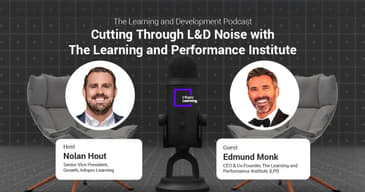
Cut through L&D noise with insights from The Learning and Performance Institute to drive smarter learning, performance, and workforce development. Also Listen - Cutting Through L&D Noise with The Learning and Performance Institute
Podcast Takeaways
LPI is a global, non-profit organization focused on raising learning standards and linking learning to measurable business impact.
Accreditation ensures trust and helps organizations select reliable learning partners.
Building a strong learning culture is the #1 challenge for L&D leaders worldwide.
Convenience does not equal impact—long-form, meaningful learning experiences are still highly valued.
User-generated content drives higher engagement than professionally produced content.
AI can enhance learning by repurposing and amplifying existing content rather than just creating more.
Multi-format content helps engage all learners regardless of preferences.
[00:00:08] - [Speaker 0]
Hello everyone, and welcome to the Learning and Development Podcast sponsored by InfoPro Learning. As always, I'm your host, Nolan Haupt. Joining me today, have Ed Monk, CEO and co founder of the Learning Performance Institute, also known as the LPI, which is what we'll be calling it mostly on the podcast here. Ed will tell you more about what the LPI does, but in short, Ed founded the LPI with the mission of raising the global standards of the L and D industry by providing measurable, innovative learning solutions that align with trends in tech and in business. Today, we're going to be talking with Ed a bit more about the mission and how organizations can leverage the LPI and what they've done to help them cut through a lot of the noise in corporate learning to really narrow down on what is making the largest impact on business today.
[00:00:54] - [Speaker 0]
Especially now there is a lot of noise. So I'm really appreciative of the work that the LPI does to kind of help align us on what is important. Speaking of aligning on what is more important, definitely more important than me. Let's get to our guest, Ed Monk. Welcome to the podcast.
[00:01:13] - [Speaker 1]
Hey Nolan, really good to talk to you. I don't know whether I'm more important than you. Can we be equal?
[00:01:21] - [Speaker 0]
I made the, I made the commitment when I started the podcast that my main goal was to whoever was on it to be the, you know, all about them. And it's really been nice for me. I tell people that, I started it kind of with this more of a self interest of how do I get people, how do I talk to people during COVID that I normally wouldn't get the chance to, just have like a long dialogue, you know, like those conversations over breakfast or lunch or whatever at your big conferences you're at. And so I started just to have those because I was missing them. But then I realized what I loved the most was actually like, I dunno, helping people, helping their businesses, helping connect others.
[00:02:03] - [Speaker 0]
So, in that regard, you're definitely pushing your agenda.
[00:02:07] - [Speaker 1]
Still going to argue that we're equal then because we, we seem to have the same purpose, don't we? So maybe we just sit in silence for the next fifty minutes and just look at each other and admire each other.
[00:02:18] - [Speaker 0]
Not too bad either. I'm sure we'd get a couple, couple of follows for that. Well, Ed, before we start, the thing that we always do with is just learning a little bit more about our guests and particularly about how you got to this position. Obviously, you were doing quite a bit before you founded, the Learning Performance Institute. Tell us a little bit about kind of your origin story of how you got to where you are today.
[00:02:43] - [Speaker 1]
Yeah. Thank well, you, Nolan, and hi, everyone. I'm, very grateful for this opportunity to talk to you all. Very briefly, I really wanted to be a journalist, first of all. So I had that passion to kind of, explore authentic stories, expose bad practices somehow in in places.
[00:03:03] - [Speaker 1]
And I literally applied for a job in a publishing organization, as a journalist, And they ended up giving me a job selling advertising in the publication instead. So I I learned about the commercial side because I needed the money. I learned about the commercial side first. That led to the creation of two or three magazines, in partnership with another publisher. And one of those magazines was actually IT Training magazine, which went on to be super successful.
[00:03:34] - [Speaker 1]
The second biggest publisher in The UK bought that title. And it was that money really that that kind of founded what was originally the Institute of IT Training. So through the kind of late nineties, early two thousands, it was very much focused on information technology training. So every time Microsoft had a roll out of the latest software, you know, '95, the institute would do really well, and a whole lot of people would wanna work with us. But it became pretty obvious that, actually, the people that were joining us as members were using IT, not necessarily teaching other people about IT.
[00:04:13] - [Speaker 1]
So it was a medium rather than the content. As such, the whole l and d space opened up for us. And since that point, we now are, you know, one of the most, I guess, powerful organizations in corporate learning and development worldwide. I think the association for talent development is the lead body in terms of amount of members, but we're second to that. And it's European focused primarily Yeah.
[00:04:40] - [Speaker 1]
But increasingly in Asia Pac, The Middle East, and obviously The US as well. We're finding that we're having members and accredited organizations there. So I think you need a bit of luck along the way, Nolan. Obviously, some things have happened that have really helped, not least. You know, we created we created a course which taught people how to teach in the virtual classroom environment when it was Webex and Adobe Connect Pro.
[00:05:06] - [Speaker 1]
Yeah. I'll be honest with you. Nobody cared. When we did that in 2010, nobody was interested. And we were really fighting for this.
[00:05:16] - [Speaker 1]
And then, obviously, Microsoft entered into that space, became quite interested in it, and a whole load of people went through that program. And then when COVID hit, it was crazy. Obviously, we had the number one ranked program in how to deliver virtual classroom training. So it's been a it's been an interesting thirty years. It will be thirty years next month Oh, wow.
[00:05:38] - [Speaker 1]
For the institution. So yeah.
[00:05:40] - [Speaker 0]
And so help me understand. So for those that, that aren't familiar with the Learning Performance Institute, would you mind talking a little bit about kind of what the goal of the Institute is, how you're providing value, you know, to others. I, I, you know, I'm, I'm in The States and United States. It's not as prevalent, I would say here as it is, you know, a lot of our, our company in Europe, we're attending your conference this week or an LPI accredited partner. So we, we understand the value, but I don't see you as much here.
[00:06:09] - [Speaker 0]
So if you wouldn't mind giving us a little overview of what you do, what's the value, for our listeners.
[00:06:16] - [Speaker 1]
Yeah, of course. I guess the most important thing, Nolan, is we're not for profit. So if I start with that, and it's been that way for thirty years. So Yeah. We exist literally for the l and d community, and that's the most important thing.
[00:06:31] - [Speaker 1]
What we what we want to do is make learning work. So we're all about efficacy. Too much of what we were seeing in the mid nineties was I mean, it it didn't have any impact. People were quite happy to go away for five days to, you know, a great house in the country and do a team building course, and nothing happened. Nothing changed.
[00:06:53] - [Speaker 1]
So, you know, we felt pretty strongly that it could be better. Yeah. Learning was getting a bit of a bad bad rap as well, I think. It was, you know, it's always the first thing to go in a financial crisis along with marketing, and it just felt like it could be better. And we knew from the magazine days that a lot of people who worked in the sector were really great people, really passionate about making a difference, but they weren't being associated with business improvement.
[00:07:20] - [Speaker 1]
So Yeah. We wanted to close the gap between business performance and learning impact. You know, let try and link the two things. And we're still doing that. So how do how do we do it?
[00:07:33] - [Speaker 1]
Obviously, it's a membership body. We have thousands and thousands of members all over the world. That's our community, and they help each other. But we also upskill learning professionals. They can self assess through diagnostic tools that we have and find out how good they are compared to worldwide averages.
[00:07:50] - [Speaker 1]
We upskill them in performance consultancy is a huge thing now. That's all. Yes. The course is flying off the shelves. And, obviously, AI for learning professionals is massive at the moment, whole host of other courses.
[00:08:04] - [Speaker 1]
We accredit training companies, learning companies, learning tech companies, learning departments. We also provide a whole host of different consultancy offerings. So bespoke, building effective learning teams, benchmarking skills, matrixes matrices. Sorry. So there's all sorts of interesting things happening there across our network of consultants.
[00:08:30] - [Speaker 1]
But also, you know, we we happen to just create these events that really took off. So biggest awards event in learning worldwide is the learning awards, which we started a long time ago. And now I think 47 countries entered those awards last year. So it's a yeah. It'll be the thirtieth anniversary in February at Grosvenor House Park Lane Mayfair.
[00:08:55] - [Speaker 1]
And we have LearningLive, which, your organization is at this week, just for chief learning officers and heads of learning. And now LearningLive AI is a spin off just focusing on that that arena, if you like. So it's the typical institute set of services, really. But increasingly, we're providing tech solutions. So you've got the learning and performance accelerator where people can, for free if you work for a learning department right now, go in, answer a lot of questions, and get feedback from the institute as to how your department is doing, and it costs absolutely nothing to do that.
[00:09:34] - [Speaker 1]
And what we're getting, obviously, is amazing data. So at some point, because the institute is not for profit, if one of the large companies in the world comes along and buys the LPI because I won't live forever, then it will be for that data, I think, that they'll be wanting to buy it because we have millions of data points on corporate learning and development.
[00:09:55] - [Speaker 0]
Right. So, you know, one of the interesting things, so if I look at, you know, so InfoPro learning is, is, is a member accredited member of yours. And it's interesting because when I look at the other, you know, partners out there that are more trade partners, you know, like your Fosway Group, trainingindustry.com, elearning networks, things like that. They have like lists, you know, the top 20 of this list or the top 20 companies to work with here and this, that and the other. But you took a different path, more like an accredited learner.
[00:10:33] - [Speaker 0]
If you don't mind digging into a little bit about, cause that was kind of a yin versus a yang, at least in our market, most of that market is more like, we're going to create a list of the top companies to work with versus you, you know, your org is really more focused on let me certify credit them. Tell me a little bit about the thought process between those, you know, why you went with that one. I'm sure you don't know why they decided to go the other way, but why is that accreditation become kind of so key to you?
[00:11:02] - [Speaker 1]
Well, we're vendor agnostic is the short answer. So we're everything that we do is driven from the point of view of the learner. Right. So if a learner were to contact the institute as they do regularly and say, can you recommend a provider that does this? We will not recommend one provider.
[00:11:22] - [Speaker 1]
We will say, those 27 providers are accredited by the LPI. Now if you want us to do some work for you to identify which is the best one for you out of those 27, we can. But our first answer is always, they've achieved accreditation, which gives the learner a lot of reassurance that certain things are in place, you know, their money's going to be well spent if they're buying something from them. And that's a principle that we've been committed to since the very beginning. Yeah.
[00:11:52] - [Speaker 1]
What I would say, maybe more controversially, is in the last five to ten years, there's been a plethora of, you know, top tens, top twenties with varying levels of scrutiny, I think. So I'm not gonna say which ones
[00:12:09] - [Speaker 0]
Right.
[00:12:10] - [Speaker 1]
Are the ones to follow, which ones are, but there are so many. I mean, there are Jane Hart's top 50 tools. Fantastic. That's that that's her scrutinizing those, and that's a really interesting set of information just on the individual pieces of software, which one's the best to use. Like you say, training industry, Fosway is a research organization.
[00:12:33] - [Speaker 1]
Craig Veiss produces a list of software as well. Right. Yep. So you can go to lots of different places and find that, not least, obviously, generative AI tools now, which will scrape the content from all of those lists and and identify what it's it would think is the top five. The only way we differentiate between those are accredited and those that aren't is within the awards.
[00:13:00] - [Speaker 1]
So you don't actually have to be accredited as a company to enter the learning awards.
[00:13:06] - [Speaker 0]
Right.
[00:13:07] - [Speaker 1]
If you if your submission because independently judged, the LPI is not involved in the judging. It's a whole load of experts. And then on the day, you know, anything can happen. But no. I think it's, it's very easy.
[00:13:19] - [Speaker 1]
The I mean, there are some pay per play lists as well. None of those that I've mentioned are, but you can find top 10 lists where people are paying to be the number one in there. Yeah. So I think there's an element of, skepticism and cynicism around some of them now. But we just wanna make sure there's a clear playing field, you know?
[00:13:38] - [Speaker 0]
Yeah. I think what you're, to summarize, I think you're saying that if InfoPro is on the list, that must be a good list and trust that. If InfoPro isn't on the list, you definitely need to understand what's going on here.
[00:13:51] - [Speaker 1]
Well, yeah. I mean, you're saying that. I would say Yeah. If Infopro wasn't accredited, it doesn't mean that it isn't a great organization. Correct.
[00:14:01] - [Speaker 1]
Now that now that Infopro is accredited, it's so easy to know, well, they must be great then because they've achieved that. So it takes that conversation away straight away because they've achieved that.
[00:14:13] - [Speaker 0]
Yeah. So And you know, I I have to really say it and and and, you know, those who are listening in already knew everything about the LPI promise that we're not pretty much the end of learning it, but I wanted to make sure that everybody had an understanding of what it is, but I think we, I did an event recently and there was so much, I feel organizations are looking to outsource more work these days. I feel like they're becoming a little bit more mature in how they plan to leverage their vendors, become really more partners than just a pure like, Hey, take this content and make it, you know, video or whatever it is. And one of the big things that always kind of stands in that way is risk, right? If I'm partner, if I, if I choose to align to the wrong partner, there's a lot of risk associated to that.
[00:15:04] - [Speaker 0]
A lot of, you know, save the tech companies, right? When you, when you buy a tech product, you know, for better or worse, you kind of know what you're going to get because you can see the product, you can touch it, you can feel it. It's a little bit more tangible. But when you work for a large consulting agency and you're looking to, you know, I don't know, outsource a learning project, there's a lot of ambiguity in there and it's hard to measure the value of one versus the other versus the other because the pricing is not homogeneous. And so, so much rely on, you know, the, the, the, the word-of-mouth really is a big one.
[00:15:40] - [Speaker 0]
I've been at so many conferences where somebody has stood up and talked about a great learning program that they worked on with vendor, you know, or with XYZ. And the first question from the crowd is always like, how did you find this vendor? How did you find them reputable? So I think that that information, you know, if you're one of those people out there that maybe you, maybe you don't have a large network yourself of, of experts to go talk to, to say like, Oh, is that company really like reliable? Like, do I feel confident selecting them?
[00:16:10] - [Speaker 0]
You know, I encourage you to look at organizations like the LPI, the Learning Performance Institute, or, that, that, that really have made a name for themselves of not being these pay for play because it's a great way to get some external validation. Not necessarily start with the list, maybe, maybe identify a couple and see if they're on the list. But, I definitely feel that that values there. I mean, I'm assuming, you know, Ed, you've, you must have seen a surge as well, a request from, from others and traffic saying, who are these people that I can rely on?
[00:16:41] - [Speaker 1]
Yeah. I, we could probably philosophize about this for the next hour, Nolan, but I, I do believe we are in I've posted about this recently, actually. We're in an age where trust is a premium currency. So Yeah. Who who do we believe anymore?
[00:16:57] - [Speaker 1]
What's a reliable source of information? Even kind of those organizations or maybe, you know, media outlets that we would have trusted ten years ago are now in question from a lot of people. So where do you go to get information that you can trust? Being totally transparent, you know, when the institute was founded, it was kind of pre mass consumption of the Internet. Right.
[00:17:21] - [Speaker 1]
And the then you are the kind of ivory tower, I'm gonna get my information from the institute. Then everything is democratized because, well, I just downloaded it from the Internet, so I don't need to join your institute anymore.
[00:17:34] - [Speaker 0]
Yeah.
[00:17:34] - [Speaker 1]
But then and then it goes kind of full circle. Even with generative AI providing everything it provides, people still want to combine those answers with, hey, Ed, I'm getting this from here. Would you say would you agree with that actually? Because you've, you know, you've been doing this for a while. Mhmm.
[00:17:50] - [Speaker 1]
And that is invaluable now. Now if there's a voluntary benchmark for organizations, it just gives that, as you say, risk mitigation to people. I think they're desperate for that. And I actually think my one of my predictions when I was asked by a global publication the other day, I I think over the next few years, two or three years, we're gonna see a huge, huge surge in the reliance on local community for people. They'll want to know what their neighbors are doing and thinking to get beyond this crazy environment that's online.
[00:18:26] - [Speaker 1]
So if you translate that back into the L and D workplace, people aren't necessarily gonna believe everything that they're reading anymore. They're going to want to to see it validated by an organization they trust. And if we accredit, you know, Microsoft all the way down to a local council somewhere in The United Kingdom, we must be doing something right. You know, why are they renewing every year? That would be my view.
[00:18:50] - [Speaker 1]
Yeah.
[00:18:51] - [Speaker 0]
Yeah. I didn't really connect the dots of that, but I do think you're probably right. There is probably a big, you know, when the sentiment of trust goes down, the reliance of those partners really go up. So, you know, you mentioned that you talk with a lot of different organizations, you know, data points go lower. Let's talk a little bit about where those data points are headed.
[00:19:15] - [Speaker 0]
And maybe we can just start with a really simple one, or maybe not so simple, but when people are coming to the LPI, either online, you know, or in person, where does the majority of your traffic headed to today? Like what is the problem that people are saying, you know, this is the bucket in which I'm looking for the most help.
[00:19:35] - [Speaker 1]
So I can give you a straight answer on that one because I was literally talking about it this morning. And bearing in mind, I was talking about millions of data points with the conference happening on Wednesday. So this is I I don't know when you're gonna put this out, but we don't reveal the top five challenges until the annual
[00:19:51] - [Speaker 0]
conference meeting. Come out until the, middle of October.
[00:19:55] - [Speaker 1]
Right. So right now, we've just uncovered after a year of looking at it, what is the number one challenge for chief learning officers slash heads of learning around the world? Right? And the first one is quite philosophical one. It's building a learning culture.
[00:20:12] - [Speaker 1]
So everybody would have said it's AI. Everybody. It's not. It's the human side of AI implementation.
[00:20:19] - [Speaker 0]
Yeah.
[00:20:20] - [Speaker 1]
So I'll give you an example of a real a real world example of why learning culture is the number one challenge because we've asked people to back their assertion up with date with real real world examples. And the top one is, well, we spent a lot of money here at whatever the company is Right. On a learning experience platform, and nobody's using it. So that's nothing to do with how good the technology is. Could be the number one on all the lists around the world produced.
[00:20:50] - [Speaker 1]
Right? But nobody's using it. Why? Because you didn't have an employee engagement strategy because you don't actually empower people to learn when they're at work. People are actually scared to take time out of their working day to do some learning to develop themselves.
[00:21:04] - [Speaker 1]
There's no time to do learning anymore because it's so busy at work. And that is the number one challenge that heads of learning face right now. Number two is the use of artificial intelligence and technology. But I think it's really interesting that not having a strong culture of learning in companies is their biggest challenge. It's a human problem.
[00:21:28] - [Speaker 1]
Do
[00:21:29] - [Speaker 0]
you think it's how much of that is is a culture of like do you think that it's external or more like internal, like internally, we're not able to, the L and D department does not have the right culture to drive whatever we need or is it more, we haven't been able to impart it externally or is it more like outward, like pressure putting down? We, we know the, the, the org I'm in does not have a culture. Where do you, or it's probably a little bit of everything, but like where are you seeing some of those things come through?
[00:22:03] - [Speaker 1]
There's a few root causes, Nolan Mhmm. Which I can take you through. I mean, learning is seen as a task
[00:22:10] - [Speaker 0]
Yeah.
[00:22:11] - [Speaker 1]
Culturally. Managers within companies are unsure how to coach or how to protect time. So that's a big one. You've got communications being broadcast with little recognition Yeah. Or participation within the company.
[00:22:31] - [Speaker 1]
Communities of practices are drifting. Nobody's really engaging with them because they're they're engaged with ones outside. So, you know, they're not gonna use the internal community of practice. There's no clear purpose, no facilitation of that. And then you've got no real visible link between how a learner or employee is going to engage with the learning for themselves.
[00:22:54] - [Speaker 1]
What I know you want me to do it, but what am I getting out of it? And I'm afraid, again, to philosophize a little bit. We live, we live in a very increasingly selfish world where people are going to say, what's in it for me? What are gonna do for me?
[00:23:09] - [Speaker 0]
Yeah. Yeah. I was just doing podcast recently with Carl Kopp. I don't know if you know him, you know, like the And founder of game based learning he just put out a book called Action First Learning and it was really remarkable. And this kind of what's in it for me conversation came up and he said, he's like, you know, we kind of have looked to that to be the number one thing that everybody wants, like, which is like, which is true.
[00:23:39] - [Speaker 0]
But the way that we've told people that sometimes is a bit outdated, right? Like take this training and you'll become the world's best salesperson or kind of thing. And you know, he's like, if you, if you're able to find a way to get them to engage and help them discover why it's valuable, then it, then it really becomes an impact. And so I thought that was a really interesting way to kind of tail into it because he's like, you know, everybody has kind of started with this rote memory, tell you what I'm going to tell you, then I'll tell you again, then I'll ask you what you learned. And it isn't really working anymore.
[00:24:15] - [Speaker 0]
It's interesting that, you know, one of the things, big things you talked about, and I think it's pervasive, this idea of like a constrained, I feel a lot of it's connected to this idea of a constrained time limit, that everybody has in their, their, their work. And, you know, I can definitely say I haven't tracked as much in Europe, but definitely here in The States, you know, recently big, big layoffs over the past two, three years, would say, right? Massive. But never have I seen the massive hiring PRs to come after that. But yet I see their stock prices, I see their revenue they're doing and it stayed exactly the same.
[00:24:56] - [Speaker 0]
And so I think, you know, we've got a significant time pressure which, which forces a lot of this kind of idea of, Oh, I don't have time. I'm a manager. How am supposed to manage? How am I supposed to communicate? So I think some of these are really, just the, like the idea of being stretched so thin, I think people just get into, let's just get something out.
[00:25:17] - [Speaker 0]
Like you mentioned, let's put out this big LXP, but we'll spend five minutes on a communication strategy we spent all of our time building the LXP itself. But then how do we like, as you, you know, and, and so therefore I feel like with AI, with the second challenge you mentioned, it exasperates the problem of point one is because now you're just putting more and more and more and more out there without a central theme of what is the, what is this culture going to be at learning? Yes, AI is going to support us doing it, but like, how do, are we going to be a team that puts out a billion pieces of content every day? Or are we the team that's going to put out one piece of content and then tell you about it a billion times so you consume it? I feel like there's such an overlap between those first two points.
[00:26:09] - [Speaker 1]
Yeah. I think you're absolutely correct. And I one of the first things that within the accreditation program we look at when we're looking at culture is actually what what are your values as a company? And it's amazing how many, learning leaders within companies are not linking any any of the learning experiences with the values of the company. When actually, if you that's probably the bridge between learning experiences and culture is the company's values.
[00:26:37] - [Speaker 1]
Right? Yeah. So you've got that as a quite a trite, but, know, simplistic solution where you maybe start there, you know, Maybe you'll get the engagement because that's why people came to work for this company. Those values, that is your culture. You can't create a culture.
[00:26:54] - [Speaker 1]
I think people like to think, you know, we can we're gonna create a culture. Culture comes from within. Yeah. And one of, obviously, ChatGPT's favorite verbs is foster, isn't it? Everything's fostered on ChatGPT, but you can engender a learning culture.
[00:27:09] - [Speaker 1]
So, you know, you can build the right kind of framework for a culture to propagate, if you will. Right? And we see a lot of impact with the accreditation program on that side of things, with just hints and tips as to how you can really make that land. The other part, I would say, in answer to your assertion is there is no getting away from anymore that we live in a convenience culture in everything that we do in every part of our life. So it it seems that if something can be done more quickly, that's seen as a good thing.
[00:27:43] - [Speaker 1]
Ironically, that gives us more time back, which we don't do anything with because average screen time in Europe is seven and a half hours a day, which is insane. Right? So we we we are giving people time back because we're making it convenience driven, but it's in no way efficacious. So the whole reason for having learning experiences was to try and drive impact. It's why it's the Learning and Performance Institute, not the Learning and Development Institute.
[00:28:14] - [Speaker 1]
What is the impact of what you're trying to do as a learning professional? Are you trying to make it easier for people to access content? It's pretty easy anyway. Why have you paid for the twenty seventh learning experience platform in the last ten years? Do you really think this is the one?
[00:28:30] - [Speaker 1]
Because the issue is a human issue. Right? And that there's a real world example I'm talking about there, which I can't say the name of the company, but unbelievably, you know, buying the twenty seventh and thinking this is the one. So I think we need to move away from convenience being the main driver for learning experiences and look at what is impactful. What we did find as a kind of microtrend is that one of the things that made people engage more with the learning experience was if the content was created by an fellow employee.
[00:29:04] - [Speaker 1]
Mhmm. So user generated content, even a rubbish video on a mobile phone badly produced Yeah. Gets far more consumption than a beautifully created piece of elearning, you know, that's cost £50,000 to create. People don't need it. They've got content coming out of their ears right now.
[00:29:26] - [Speaker 1]
They it doesn't they can't make make any difference between what's broadcast production and what's been made by Dave in finance. Yeah. It's just content.
[00:29:37] - [Speaker 0]
Yeah. It's interesting. I had a person message me about a business idea or something. They wanted to start selling some content and they know nothing about learning or development. And they said, you know, is it even, he said, is it even worth putting out content if it's not like Hollywood grade?
[00:30:00] - [Speaker 0]
And I said, you would be surprised if the content is great, people don't care. I feel like it's a very cheap answer of all the content didn't look good, so people don't engage. The answer really is, you know, like, because I mean, newspapers existed for a really long time and they're not picture books, right? It's like the content is the king. Like it is there.
[00:30:25] - [Speaker 0]
That is what they want. That is how they want that information. If you have information that's valuable, people will find it and they will take it. It doesn't have to be through these vehicles. Now that's where I think, you know, I think where some of these strategies can, can help, you know, some of these technologies can help like AI can help is Dave in finance.
[00:30:48] - [Speaker 0]
I think you said, you know, maybe Dave in finance takes a raw video. Well, some people love video, but some people hate video, right? So throw that into NotebookLM and say, turn this into a podcast, right? Okay. Now listen to it on your way to work.
[00:31:01] - [Speaker 0]
Great. Make a video with Colossian, you know, make a PowerPoint or something with Colossian, make it a little bit more, graphically enhanced. Fine. Turn it into text, use AI and translate it with Eleven Labs into 50 different languages if you want. I think that's really where, you know, when I, when I speak on AI and things like that, that's where I try to get people is like, it's not, it's not just an engine to just put out more and more and more.
[00:31:30] - [Speaker 0]
It's a way to engage deeper with what you have and like do more with those resources that are already available versus just, Oh, now I can put out 50,000 e learnings when last week I could only put out 20,000 because as you said, you know, gosh, LinkedIn learning only has 50,000 courses available. If they had 50,002, gosh, then
[00:31:55] - [Speaker 1]
I would pay for that license, you know? Well, exactly. I think, I remember Vine. You just remember Vine software? Seven second videos.
[00:32:05] - [Speaker 1]
Right? And that kind
[00:32:06] - [Speaker 0]
of took off. Gosh. Remember Vine because our CEO, he has this proclivity like Vine and Periscope. I don't if you ever joined Periscope.
[00:32:15] - [Speaker 1]
Remember Periscope?
[00:32:16] - [Speaker 0]
But you know, he always is, you gotta start putting some marketing content out here. So I remember Vine for that reason.
[00:32:24] - [Speaker 1]
But then you look at TikTok. Right? Yeah. So to further to your point and to our point, I think, that which is easy is not necessarily impactful. If anybody takes anything away from our chat today, please take away that.
[00:32:39] - [Speaker 1]
Because if you look at what would probably be I think most people would agree that that maybe the most difficult to engage with long form content model for 13 to 20 year olds would be a book Yep. In the modern age. Right? That takes a lot of effort, doesn't it? I mean, I mean, I can just watch this.
[00:32:59] - [Speaker 1]
Yeah. There's a thirty second video where somebody's given me a summary of what happens in Pride and Prejudice, so I'm not gonna read the book. I've watched the video, and that's fine. What we did find as a trend, not just our organization, but every every research company in the world, I think the second or third most popular hashtag on TikTok for a three year period was booktok, which is where you had teenagers reviewing books that they were reading so that other people could watch TikTok video following the hashtag and go, oh, that sounds like a good book. And then they bought the book.
[00:33:39] - [Speaker 1]
Right? Yeah. So if the content's good enough and it resonates with people, even if it's gonna take twelve hours to consume in quite a laborious way, and you can't do anything else while you're doing it, people will engage with it. So I I just think we need to be more almost resilient and proud of what we do in L and D. Let's just stop going for the thing which makes everything easy and actually just produce more meaningful experiences that make a difference.
[00:34:07] - [Speaker 1]
It's as simple as that.
[00:34:09] - [Speaker 0]
Yeah. I was just having this internal dialogue. So I'm a really big, don't judge me. I'm a really big Dan Brown book guy. I just love that.
[00:34:19] - [Speaker 0]
Just I'll pick it up. I'll read it in a day and then I just love it. I'll read it, you know, two years later and I just love it again. Really simple read, quick moving. He just came out with a book, Secret of Secrets last week and I was thinking, I had stopped reading for a while, like pervasively reading, you know, but I picked it up this year as a resolution.
[00:34:40] - [Speaker 0]
And I've realized that I feel like my brain got rewired to like books again, or that type of media, even audio books or reading whichever way, because so much content has become cheap, quick, give it to me in a second. But I want long term enjoyment. If I can read a book, that takes me like, so really the, there's a, movie coming out called Project Hail Mary, by the same guy that did The Martian.
[00:35:14] - [Speaker 1]
Oh yeah.
[00:35:15] - [Speaker 0]
Amazing book, Project Hail Mary. And I thought to myself, I am so fortunate that I read that because that's like a fifteen hour movie. You know, I spent fifteen, twenty hours reading this. Why would I want to condense it to two hours? So I, and I thought about it from a learning lens.
[00:35:32] - [Speaker 0]
I was just like, yeah, you know, I think that is, that's what makes L and D I think the toughest marketing job in the world. Yeah. You look at marketers, what's the hardest thing for them to do? It's a Super Bowl ad. It costs the most money and has to appeal to the widest audience because people watch the Super Bowl that don't know a thing about football.
[00:35:53] - [Speaker 0]
They're just at a party for the, you know, they're there for the hang and they're watching football. So how do you, you know, so they're like, oh, how do I create an ad that appeals to everybody and gets my mission across? And that's what L and D does, right? Like not only do you have differences in generations, but then those generations evolve over time. Right?
[00:36:12] - [Speaker 0]
And like, yeah, maybe they wanted the TikTok, but now they don't like they're inundated with it. They actually want to sit down and learn something of value. So it's so fascinating. You bring up like this TikTok thing because I feel like so much of it is like this. Oh yeah, they all want this just like three minute, but I don't, I think, I think as you dig deeper, there is much more to it than just the surface level.
[00:36:37] - [Speaker 0]
We got to make all learning shorter. That's the only way to get engagement. Just make it shorter.
[00:36:41] - [Speaker 1]
The evidence suggests we want everything. It's like, you know, the
[00:36:45] - [Speaker 0]
old think ultimate point. Yeah.
[00:36:46] - [Speaker 1]
Yeah. We want we don't actually want everything to be quicker, you know? So here in The UK, there's there's kind of an explosion of, these old market towns are kind of re reinventing their market, the part the market part of the town into these artisan stalls. So you can go and sit on benches and round there are little kind of boutique bakeries and pizza sourdough pizzas. And Yeah.
[00:37:15] - [Speaker 1]
I mean, they're amazing. But that's what it was 300 years ago. I mean, it makes me laugh. Know, this is a great idea doing this. It's what it was built for, you know, all those years ago.
[00:37:27] - [Speaker 1]
So I don't agree with trying to make everything, you know, quicker is is gonna make people buy your learning experience platform. Actually, there's the people are crying out for long form content. What they're crying out for, as you, really astutely pointed out right at beginning of this call, I think, they want partners Yeah. When they're talking to companies. They're not looking for vendors.
[00:37:51] - [Speaker 1]
They want a partnership. They want to feel that this is or this resonates with how we do things here. And I think, actually, it's a bit like the ultimate meme in learning and development is the learning styles one. You know, anybody posts about learning styles on LinkedIn is is basically gonna get a kicking very quickly from all of the kind of, you know, learning impresarios around the world who will all say the same thing. Do you know?
[00:38:17] - [Speaker 1]
There's no such thing. No no empirical evidence for learning styles. And then they'll feel really good about themselves for having told somebody that that's the way it is. Right? So we now know that because that's been happening for about fifteen years that everybody's been saying that.
[00:38:31] - [Speaker 1]
But what do we do with that information? So if somebody isn't an auditory, right, or they're not, you know, driven by visuals, okay, that's fine. But actually, everybody is driven by everything is the conclusion we can draw. So to your point, if you've got a great piece of content, replicate it in multi form so that everybody can engage with it. Don't concentrate on making it the quickest and easiest to access.
[00:38:54] - [Speaker 1]
Just make it in every form, and people will engage with it.
[00:38:57] - [Speaker 0]
And I think when I, so when blended learning became the Vogue word, you know, not Vogue, but it was the word, right? Everything was blended. I'm sure LPI had a big thing on it. Everybody did. And at that time it was really like, how do you, you know, gel?
[00:39:13] - [Speaker 0]
A lot of it was like digital within person and stuff like that. And I was doing this podcast with the ATD president of a local chapter in Philly. And we rehashed some of these terms like seventy, twenty, 10, blended learning, things like that, that have all gone the wayside because AI has taken, you know, 99% of the share. And I was saying, really, you know, really, I feel like it is the true blended learning. Like that is what it really is, is, as you said, you open up these avenues for people to consume the content in the way that they learn best.
[00:39:49] - [Speaker 0]
And that's, that's really a great mission statement for AI of like, you know, doing the more with the, doing the more, doing more with the same, creating that true blend to allow a learner to put themselves in the path that they want best. And then the other thing that I, you know, the, the kind of partner thing, I feel there's what we, we've seen a big surge for more in person kind of classroom training. And I feel AI is a great way to free up money to do more of that because people do crave community right now. They absolutely crave community. You just, I mean, mentioned exactly what it is.
[00:40:30] - [Speaker 0]
Like they want to sit on the park. They want to talk to people that they know. Want to
[00:40:34] - [Speaker 1]
see their
[00:40:35] - [Speaker 0]
boss. Want that physical interaction. And so I think that component is one that I really feel has an amazing way to be brought more back into the fold, not necessarily even in the traditional sense of like, let's bring everybody to the Marriott for seven hours to learn about communication training. But gosh, I mean, if you just put, you know, 20 people in a room and say, we're going to review this latest, you know, everybody take twenty minutes and look at this program that we put out on the latest, you know, I don't know, consumer spend report and how marketing needs to adapt. They're just going to, they're going to spend thirty minutes catching up with each other and then thirty minutes talking about the problem.
[00:41:19] - [Speaker 0]
But those employees are going to walk away engaged, right? And they're going to have that culture. And now you have helped create that culture of learning because it all came around this idea of, of learning. And so I think, when I, when, when you were talking about like ability to consume that, that I remember that thought of this blended learning and kind of the, you know, what's old is new again kind of thing.
[00:41:44] - [Speaker 1]
Yeah, it's true. I think, I think they're in Mexico at the moment, but they've been in The States for the last two or three weeks, a band that's from near where I live, Oasis. Right? Oh, yeah. Why are people, if it's all about convenience, quite happy to part with thousands of pounds worth of thousands of dollars to stand in a stadium, maybe in the rain, and watch a band for two hours Yeah.
[00:42:10] - [Speaker 1]
When they could, you know, maybe livestream one of the concerts in the future, watch a whole lot of YouTubes of the best of Oasis live in their cinema cinema room at home. I mean, that's probably a more luxurious experience.
[00:42:23] - [Speaker 0]
Oh, yeah.
[00:42:23] - [Speaker 1]
Why are they there?
[00:42:24] - [Speaker 0]
Paying $20 a beer?
[00:42:26] - [Speaker 1]
Right. You know, why I mean, why are they doing it? And I I know I'm, you know, being a little bit facetious, but why why are people paying the same amount of money for a Taylor Swift concert when there's millions of videos of Yeah. Why when you go there, is everybody recording the thing on the phone when they've just paid $2,000 to be at the event? So all of these things are really interesting evolutions of humanity.
[00:42:52] - [Speaker 1]
And what I think they tell us when we relate that back to learning is that people will pay.
[00:42:57] - [Speaker 0]
Yeah.
[00:42:58] - [Speaker 1]
People people will see that as a as a core memory unlocked. It's a valuable experience. You know, I was out of that concert in Manchester with my kids who don't remember Oasis the first time around. I mean, what a memory for me. I'm sorry, but that is a lot better than putting the big TV on in the cinema room, sitting down and saying, look how good this band is.
[00:43:18] - [Speaker 1]
Kids, you'll love this. They couldn't care less, but it's a great experience. And I I think we need to really remember that in learning and development, that if you build something really great and meaningful, they will they will do it. You know? People will pay here.
[00:43:35] - [Speaker 1]
I don't know what the equivalent would be there, but at the aforementioned markets, you can be paying a ridiculous price for a loaf of sourdough bread because it's art it's artisan, Nolan.
[00:43:47] - [Speaker 0]
Artisan.
[00:43:48] - [Speaker 1]
Yeah. It's artisan. So this is special bread. But people buy, and they're not buying it because of the bread. They're buying it because they've had the lovely experience going to the market, talking to the guy who makes the bread.
[00:44:01] - [Speaker 1]
This feels really great and organic, and then they're gonna go home with that bread. And when they eat it, it it tastes better than any other bread they've ever had. Why? Because it was 15 pounds or $15. That's why they paid a lot of money for us.
[00:44:15] - [Speaker 1]
So they convinced themselves of the value. Again, if you relate that back to learning and you make something a premium product, like you were saying, by the way, we're seeing face to face experiences explode over here. Absolutely explode. You know, you had the pandemic, obviously, wipe it out. Right.
[00:44:34] - [Speaker 1]
And it took time for it to come back, but when it came back, it's bigger than ever. So I combining convenience with, I would suggest, difficult experiences, but that are more challenging, you know, the reading a book Yeah. Side of the spectrum compared to watching the thirty second overview of the book. Both are perfectly reasonable. They're learning experiences.
[00:45:00] - [Speaker 0]
As you said, people will pay. I mean, and that's, we talk, you know, kind of bringing full circle. I talked to, you know, how we are so short on time and you know, some of us are short on money with inflation and all these certain things. People are going to continue to pay where they see value and learners and employees pay with their time. Like that's the, you know, most organizations aren't paying internally with something, some do, but some don't, but really you're seeking time and, and your ability, you know, you can be bold with, with your ask as long as you feel confident that you've put something out there to, to, to draw them in.
[00:45:38] - [Speaker 0]
And I do think the demand is there. I mean, we've talked about it. The demand is there. You've got the data points in the back and I'm more talking about what we've seen, but the demand is there for that type of stuff. This has been great, Ed.
[00:45:49] - [Speaker 0]
Thank you so much for joining us. This is the week of one of your biggest or the biggest maybe conference for you of the year. Yeah. So I really appreciate you taking some time out of, out of your busy week to meet with us here. We're excited for the conference.
[00:46:04] - [Speaker 0]
And I'm sure we'll talk again in the near future.
[00:46:07] - [Speaker 1]
Thanks, Nolan. Really appreciate it.
[00:46:10] - [Speaker 0]
Yep. Great. Thank you.