
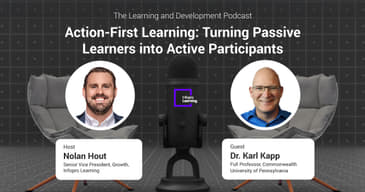
Discover how action-first learning transforms passive learners into active participants through practical experiences, engagement and real-world application. Also Listen - Action-First Learning: Turning Passive Learners into Active Participants
Podcast Takeaways :
• Karl Kapp’s origin story and career in instructional design.
• Why lecture-driven training disengages adult learners.
• The core principle of action-first learning.
• How immediate activity creates curiosity and openness to learning.
• Distinguishing meaningful activities from irrelevant icebreakers.
• Practical examples: card sorting, board games, escape rooms, branching scenarios.
• Using storytelling with SMEs to design impactful experiences.
• How AI enhances SME interviews and scenario-building.
• Roadblocks to action-first learning and strategies to overcome them.
[00:00:09] - [Speaker 0]
Everyone to the Learning and Development podcast sponsored by InfoPro Learning. As always, I'm your host, Nolan Hout. Joining me today, we have a very special guest with us, Doctor. Karl Kopp. I was telling him before we started, this is actually somebody who was probably my first reference ever.
[00:00:27] - [Speaker 0]
When I started in marketing, I was writing an article, I referenced Doctor. Karl Kopp's work on game based learning. I'm super excited to have him here. Over twenty seven years now, Karl's written award winning books, spoken at probably too many conferences that he could even count, consulted several organizations on gamification, interactive learning, e learning. He's also the founder of Learning and Development Mentor Academy, where he provides a lot of seasoned LND pros with access to libraries of on demand content, self paced workshops, monthly live sessions, and just a community of other like minded folks for a lot of the people probably on this podcast would love to go and check that out.
[00:01:06] - [Speaker 0]
There's so much more that Doctor. Karl Kopp has done way too long to put into a podcast intro or else you would never actually meet him. So let's kind of get to it. Today we're going to be talking with Doctor. Kopp about his book he published back in April 2025 called Action First Learning, and it's been gaining quite a bit of a following, on how we're, because of its ability to turn passive learners into more active participants.
[00:01:33] - [Speaker 0]
So we're really going to unpack a lot of components of that book. And as a gift to the community, we're going to give away a copy of that book for free at the end. So you still have to go get the book. We're not going to give you everything. You do have to get the book, but we will, purchase a book and FauxPro will purchase a book for the listeners.
[00:01:53] - [Speaker 0]
And we'll have some details on that afterwards. But without further ado, love to get into our podcast. Doctor. Karl Kopp, welcome to the podcast. Thank you for joining.
[00:02:02] - [Speaker 1]
Nolan, thanks. Thanks for having me. Very excited to be here. Very, very excited to be one of your earlier references. So I appreciate that.
[00:02:08] - [Speaker 1]
And please call me Karl for our conversation. Yeah. Fantastic.
[00:02:12] - [Speaker 0]
Wonderful. Thank you, Carl. Before we begin, how we always start with all of these, you know, podcasts is, is just learning a little bit more about how everybody came to be. I mean, you've had a long storied career, but we'd love to learn your origin story if you would. How did you break into this field in the first place?
[00:02:31] - [Speaker 0]
Why did you break into this field? Did that field even exist when you started?
[00:02:36] - [Speaker 1]
We'd love to learn more. It was quite a strange, so it, this origin story goes way back to sixth grade. When I was in the sixth grade, yes, a woman named a girl at that time named Kitty Neal, who I thought was very attractive, joined something called Little Theater where, you know, you're learning to act and everything. I'm like, wow, that's okay. I don't know what that is, but I'll do it.
[00:03:01] - [Speaker 1]
So I joined Little Theater. And then one of the projects we did was this video called Willie Whistle, which this stuffed puppet, which was a whistle taught kids how to cross the street. So they got us and we were like crossing the street and stuff. Okay. And so that was what we were doing.
[00:03:21] - [Speaker 1]
Fast forward to graduated from college. I am I'm I'm I'm like, okay, I need to get an internship somewhere. Where am I going get an internship? And they're like, well, remember that company that you did that video with long time ago? Well, they do something with learning or development or something.
[00:03:39] - [Speaker 1]
You might want to, you know, check them out. I'm like, okay. And so I went for the interview and asked them and they said, I said, I've worked here before. And they're like, what do you mean? And I said, well, I was in the Willie Whistle videos.
[00:03:52] - [Speaker 1]
And then, so the woman, Laurie, actually, was there, it's like, Yeah, I try it out. So I got in there, didn't exactly know what they did, like something with English and education, something. And so I said, What do you guys do here? And they're like, Oh, it's instructional design. I'm like, Man, this is really cool.
[00:04:10] - [Speaker 1]
It's a combination of technology, the combination of figuring out how people learn. I was studying to become a teacher and had done my student teaching with middle school kids, which just about killed me. So I'm like, there's got to be a better way to do it. There's got to be another way to do this. That's corporate.
[00:04:29] - [Speaker 1]
I didn't even know there was such a thing as corporate training till I got there, found out what it was. I was actually already planning to go to grad school. I changed my entire grad major to instructional design and technology and never looked back.
[00:04:42] - [Speaker 0]
Wow, wonderful. That's really fascinating. And what is it that you think that, like, what is it that attracts you and has kept your attention in this field for so long?
[00:04:52] - [Speaker 1]
Yeah. So I think it's really interesting to determine what the right way to present the information and the content to people so that they want to learn what you're teaching them. So there's a lot of stuff that we have to learn all the time. And, you know, you know, in school, they just kind of throw information at you and that kind of stuff. I was more interested in because I almost minored in psychology and I was really interested in like, motivates people?
[00:05:21] - [Speaker 1]
What do they do? But also not just motivate in general, but motivate for an outcome. And so then I started thinking about, okay, well what are some ways that you can help people solve that problem or organization? So to me, it's almost, it's a little bit like being a detective, right? Here's the type of information you want to learn.
[00:05:39] - [Speaker 1]
Here's the you want people to learn. Here's the behavior you want them to do, here's some instructional strategies. How do you put all these together to maximize the output and the performance on the other side satisfying both the organization but also the individual, right? You can't just make training that the organization loves. If people hate it, they don't take it and it doesn't help.
[00:06:02] - [Speaker 1]
So it's a lot of moving puzzle pieces. To me, that's kind of interesting.
[00:06:06] - [Speaker 0]
That's fascinating because I, so my degree is in marketing and I, I had wanted to pursue a minor in psychology because I wanted to, I did, I am fascinated with how people think and why people think the way that they do. And I, and in marketing that was like, you know, the, the, the thing that attracted me most was the ability to try to move those levers. And I've always attested that, that the role of a marketer is really similar to the role of an L and D. We're both seeking engagement or both seeking people to change behavior, do something that we're trying to have them do. Now, maybe the means are a little bit different.
[00:06:47] - [Speaker 0]
You know, I think people would assume L and D is a little more altruistic than marketing, you know, capitalist buy my toilet paper or whatever it is. But it is that component of how do you get people to do something and how, how is it the way that their brains are wired, make them do that or help them to come to that conclusion faster. So wonderful. Really good. So I want to get into this most recent book that came out in April, which was titled Action First Learning.
[00:07:16] - [Speaker 0]
And I want to unpack a little bit, Carl, on really what is action first learning and how is that different than any other type of instructional design that we know?
[00:07:29] - [Speaker 1]
Yeah, that's a great question. So the book is a little bit, so it's a little bit of a like a journey, but also a little bit of like epiphany and also backlash. A lot of training starts out with today you will learn, right? And we lecture people, whether it's e learning lecture or it's online lecture or it's whatever. And in my years of experience, I found that the most engaged students I have are students that I engage with right away.
[00:07:58] - [Speaker 1]
So if I am doing a workshop, let's say, and I lecture for like half an hour to forty five minutes and they say, okay, now I want everybody to get into groups and do an exercise. You get like, oh, come on. Like right, I was just enjoying being passive. But if I start out construction saying, hey, here's a problem that I want you to spend fifteen minutes trying to solve. People are active and engaged right away.
[00:08:22] - [Speaker 1]
And that seems to go throughout the whole training. So I'm like, okay, there's something about this active first learning. There's something about being active first. And so then you look at the research and there's a lot of research that says that people learn best when they're engaged and in a meaningful task. So I'm like, okay, well, let's put these concepts together.
[00:08:42] - [Speaker 1]
And so the idea of action first learning came about where making the learner do something right away because what it does is it helps the learner understand what they don't know. So a lot of problems with adult learners is you go, hey, I'm going to teach you five ways to close a sale. An adult learner goes, I know six. It's like a waste of my time. Right?
[00:09:04] - [Speaker 1]
And you're like, okay, well.
[00:09:06] - [Speaker 0]
The old adage of I always want to learn, but I never want to be taught.
[00:09:11] - [Speaker 1]
Right. Exactly. Exactly. But, but what if you said to that same salesperson, do know the number one way sales are closed in our organization? Now you've got my, we've got their curiosity.
[00:09:22] - [Speaker 1]
So that's kind of the idea behind the action first learning. If we can peak the curiosity and then they're like, oh, the way they close sales is, you know, it's the hard close. And then you find out, no, no, it's the soft close. They're like, oh, really? Oh, so now they're more open to learning.
[00:09:38] - [Speaker 1]
So Malcolm Knowles, an adult learning theorist said adult learners learn best when they know they don't know something. And so I think our job a little bit as developers of instruction is to point out to adult learners, hey, you don't know this.
[00:09:52] - [Speaker 0]
That's so fascinating because I was year ago, I interviewed a lady who created a simulation. They had a simulation created for them to the, the, the, the design of the game was to remove unconscious bias. Like that was the whole goal. And I said, what I love so much about it is that I don't know how you raise your hand or attend unconscious bias training without bias, you know, like for the exact same thing, which is such a meta thing to think about of we're going to teach people on how to remove bias that they don't know exists in the first second that you shine light on it, it goes away because now they're like you. Oh, I know sick.
[00:10:34] - [Speaker 1]
So, yeah, exactly. I'm not biased at someone else.
[00:10:38] - [Speaker 0]
Really interesting. Yeah. Fascinating.
[00:10:40] - [Speaker 1]
So if you can kind of stealthily do that, you can get to that outcome. So, you know, you know, in that case, wouldn't call it unbiased training, right?
[00:10:50] - [Speaker 0]
Yeah. I would call
[00:10:51] - [Speaker 1]
it something else. And then, by the way, guess what we just learned? You know, that kind
[00:10:54] - [Speaker 0]
of Yeah. That's really fascinating. And so what was the moment that you realized that was the trigger point, right? Cause there's a lot of different avenues that, was it in your lecture series that you're like, Oh, well gosh, if I just applied this or was there something else that, that led you to, this is what it is? Like it is this this action versus that moment?
[00:11:15] - [Speaker 1]
So I think a lot of what it did was, you know, I'd done a lot of work in games and gamification and that kind of learning. And I would I would consult a lot and look at people developing games and, you know, people would say, okay, I'm going to develop this game. First, you got to go through these 10 screens that tell you how to play the game.
[00:11:32] - [Speaker 0]
Oh my God. I hate those. Yes.
[00:11:37] - [Speaker 1]
Yeah. I mean, nobody who you know, the game becomes how fast can I click next to get to start the game? Right? So that's the game. So I'm like, you know, this isn't worth you know, so I know people are understanding games and gamification, but they're not, like, getting it.
[00:11:49] - [Speaker 1]
Like, you gotta do it first. And so I'm like, how can I convince people or shortcut this? Right? Because we know that sound bites can get people moving and give people action. So I'm like, yeah, okay, today's gonna be action first.
[00:12:04] - [Speaker 1]
And as soon as I said that one time in a training class or a classroom, like people said, okay, what are we doing? Right. They immediately knew that we're going to do something. And I think that is an important way to move forward.
[00:12:18] - [Speaker 0]
So, so what are some of these action items? Like, what does that look like in practice? I'm like, I'm starting to think like, well, some, some seem pretty obvious, you know, but like, how do you take this concept from? Start with an action to like, okay, what, like, what are you seeing in practice? What are some things that people are doing?
[00:12:43] - [Speaker 1]
So, so, so the book actually outlines nine action first learning approaches, but I don't for a moment think that's the whole universe of action first learning. There's a lot of different ways to do it. One of the nines is using cards as a tool. So for example, let's say you're teaching insurance agents to assess damage to a car, right? So you could immediately start out with, okay, I have pictures of damaged cards.
[00:13:10] - [Speaker 1]
I want you to sort them into front end, side or rear crashes. Like which way do you so immediately they're doing something and then you can say, okay, well, why did you classify that as a front end crash? Okay, well, because it was on the headlight and stuff like that. Well, actually, if you look at the angle, that was a side collision, you know, so you can kind of get them right away thinking about that. Totally.
[00:13:31] - [Speaker 1]
Another thing that we do often is we do board games. So a board game would be, okay, we're going to start everybody. This is your role. This is your role. Your goal is to make the company profitable.
[00:13:45] - [Speaker 1]
Go. Right. And so you figure out the rules and you kind of go to there and you go, yeah, well, I'm not going to invest anything in cybersecurity because I waste all my money. You know, three, three turns later you get a cyber attack and you're wiped out. Maybe you should have invested some money, right?
[00:13:59] - [Speaker 1]
So you have those kinds of conversations. Another way to do it is with an escape room type environment. Like here's a problem that you have to solve. You're an auditor and you have to audit this particular manufacturing company because there's an oddity on the books. Then you go, okay, well, what do I need to do?
[00:14:16] - [Speaker 1]
I need to look at a spreadsheet. Okay. So then you start doing spreadsheet calculations. The problem is oftentimes we say, okay, we're going to teach you how to how spreadsheet works. Like nobody in real life needs to do use a spreadsheet.
[00:14:29] - [Speaker 1]
They need to do a budget. They need to sort data. Exactly. Yeah. So so the so teaching somebody how to use spreadsheet is like so abstract.
[00:14:39] - [Speaker 1]
Teaching Teach them how to do a budget. Now that makes sense, right? Teaching them how to forecast, teach them how to read a P and L, all that kind of stuff. So the idea is to not focus on the kind of the software or the object around it, but the task that needs to be performed, like the task of sorting out crash items or the task of investing today so that you prevent disaster tomorrow, task of knowing how to budget. So the book goes through a bunch of different ways to do that.
[00:15:05] - [Speaker 1]
Like in the classroom, audience response systems have been around forever. One of the things that that's disappointing about the use of them is people just ask question and response, question and response. Okay, that's great. But what if you actually created a case study and you had a question and you said, okay, in this case, what would you say to the healthcare provider? You would have it on the phone and they make their choice and then you could say, that's the wrong choice.
[00:15:31] - [Speaker 1]
Now you can debrief everybody. But in that moment, you force that learner to commit to an answer. And when you commit to that answer, you either feel like you're, yeah, I got it or I'm not sure. And now you're more open to learning. And so those are the kinds of opportunities I think that really lead to the learning outcomes that we're trying to accomplish.
[00:15:53] - [Speaker 0]
Yeah. You know, something and I was something you'd said in the book that kind of caught my attention a little bit was this idea of, of activity for activity sake. And, you know, cause it's not a new concept necessarily, you know, you start and a we've all seen them facilitator packs, right? There's like a squishy cube. You throw it at someone and it says, tell me the first the worst date you've ever been on, you know, that kind of stuff.
[00:16:19] - [Speaker 0]
So like what's the difference between those kinds of kitschy kind of game? I don't know how you would describe those versus the what you're talking about here.
[00:16:29] - [Speaker 1]
Right. So so the difference to me is like when you have to say, you know, your worst first date, that has nothing to do with learning how to identify damage on a car for insurance salesperson. Right. Or insurance adjuster. Right.
[00:16:44] - [Speaker 1]
Nothing to do with that at all. So the idea behind this is that the activities that we do are related to our learning outcomes. So instead of just doing an activity for the sake of an activity, we do an activity to lead to an outcome, which is better understanding, you know, adjustments when looking at collisions or better perform better or creating a faster, more efficient budget or being able to read the P and L statement. So, you you could do an activity. You could say, okay, here is the P and L and the cash flow statement for company X.
[00:17:20] - [Speaker 1]
Are they would you invest in this company? Right? And if you're teaching about investments and P and Ls and that kind of stuff, now it's an activity that makes sense. If you're just saying, okay, we're gonna throw around this beach ball and anybody that catches it has to tell me what their favorite candy is, right? That has nothing to do with budgeting.
[00:17:38] - [Speaker 1]
And when you have an adult learner in the room, their time is very precious. They don't have a lot of time. So the more we can be focused on that, the more they're going to appreciate it, the less they're going to push back and the more they're going to get value out of that instruction. And even online learning, like a lot of people just go through online learning as fast as they can because they just want to get it over with. So rather than starting with, okay, here's your objectives, here's the terminology, here's what we're going to do.
[00:18:05] - [Speaker 1]
Just say, okay, your boss has just accused your coworker of embezzling $10,000 What do you do? Right. Okay. Now I got to make a decision right away. I got something to do.
[00:18:17] - [Speaker 1]
And that piques my attention that I think I know what to do. I think I but I'm not sure maybe. And so now I'm more motivated to go through the instruction. So that's that's the difference is when you tie it to a meaningful behavioral outcome or performance based outcome, then the action makes sense and people buy into the action. If you tie it to something that they can't see the relationship, that's when you get pushback.
[00:18:43] - [Speaker 1]
That's when you get people going, this is boring. This doesn't make sense to me. This is a waste of my time. All those kinds of reactions, which, which put up a wall to learning.
[00:18:53] - [Speaker 0]
Yeah. And that is interesting because I, as I reflect on some of those, you know, things that, that, that the typical activity, you know, beach ball kind of stuff. I do find myself sometimes I'm that type of person. So I know not everybody feels that way, but I definitely am that type of type of person that is like, are you've got me here in this room. I want to do something like, and like, yeah, I'm happy to get to know my people, but if you give me the opportunity, this sounds very vain, but it's true.
[00:19:23] - [Speaker 0]
If you give me an opportunity to show how smart I am while also getting to know somebody, I would love that. I would love to give it in a context. So it really makes sense to me, but I feel like that I would assume that creates a barrier as well to getting this because to know, to be able to create an activity, an action first learning experience, you have to know it deep enough, right? To create something like that. You need to know the topic or the idea or whatever.
[00:19:54] - [Speaker 0]
How do, you know, and specifically in the corporate world where you're having to train on or educate people on a thousand different things, you know, one day it's P and L, the other day it's sexual harassment, then the third day it's marketing principles. How do you get to that? How do you kind of weave that story in when maybe you don't know so much about it? Is there like Yeah,
[00:20:17] - [Speaker 1]
that's a great question. So as I said, the book is kind of a culmination. So in each chapter of the book, talk about step by step, what do do for step one, step two, step three to make this happen. So following that can be helpful. If you don't know, if you're not like, if you're more of a subject matter expert and not a structural designer, you can follow that.
[00:20:36] - [Speaker 1]
But if you're an instructional designer, the thing I always say is become a story connoisseur. What I mean by that is ask the subject matter expert, the person that knows about it, about what happened. So what would happen? What's the worst, most spectacular failure that ever happened on this job, right? Or what was the most spectacular success or what mistake does everybody make?
[00:20:59] - [Speaker 1]
And you're like, you're gonna make this mistake, right? So if you gather those stories, then you can start developing action around them. So if everybody makes, like, let's say everybody makes a mistake of, let's do a dumb example, like going in door A and store door B, then you set it up. So, hey, where do want to go? Door A or B?
[00:21:17] - [Speaker 1]
And everybody goes to A and there's your learning moment right there. But you've got that from talking to the subject matter expert and asking them to tell you stories about the behaviors that you want. Tell me a story about the best salesperson ever. Tell me a story about the most effective marketing campaign ever. Okay, so now let's give people bits and pieces of, here's six things you can do in a marketing campaign, which one would be the most effective?
[00:21:42] - [Speaker 1]
And they're like, I don't know, okay? But the subject matter expert knows and they're gonna tell you this is the most important and this is why. So you kind of set up as the trainer or developer, e learning designer, experience designer, whatever phrase we use today is you set up the framework, you set up the schema and then have the subject matter experts fill in the knowledge or information.
[00:22:04] - [Speaker 0]
We're leveraging at InfoPro in regards to AI is kind of this reduction on SME time because we all know that that becomes a huge roadblock traditionally in developing our training programs is access to these subject matter experts. And so now, you know, we're, we're, we're, we're loading in as much subject matter expertise as we can into these models to pull from. I wonder, it sounds like, I don't know if you've seen much of this, you know, in practice, Carl, but I feel like if, if somebody came to me and asked me to, you know, be this me on, I don't know, podcasting as an example, I'd be kind of bored. I'd give them what they want, but I wouldn't make time for it. But if somebody came to me and actually said something like that, like, Hey, tell me some funny stories about the worst things that have ever happened.
[00:22:57] - [Speaker 0]
I feel like I would be more receptive because it would also be more entertaining for me. Are you seeing this? I was like, it's better for the learner, but you're also getting richer information from a SME because it's what they probably care to talk about.
[00:23:11] - [Speaker 1]
Right. You are. And, and the interesting thing is like most SMEs, like they're doing 10,000,000 things, right? So to try to get time from them is very difficult. I've had SMEs like when I say, Hey, I want you to tell me stories.
[00:23:24] - [Speaker 1]
I want you to me a story about this, this and this. Like I'll get emails like 02:00 in the morning like, Hey Carl, I couldn't sleep. I just thought of this really cool story that we, this one time. So now they're not only giving me information, you know, when I asked for it, now I'm like, Stop, I have enough information. So, and you have to ask it structured.
[00:23:40] - [Speaker 1]
Like you can't just leave it too wide open, But I have a structured process. But if you go through that process, it can be really helpful. And the other thing that I'm seeing with AI now is that you can set up like an AI chatbot to engage in this conversation with the subject matter expert. Like, hey, I want you to tell me a story. Who are the characters?
[00:24:00] - [Speaker 1]
What were the characters doing? What was the tension that was in the room or in the environment that So you can actually now instead of having because sometimes sitting down for an interview with subject matter experts, I don't have time to do that, but I do have time on my phone to like speak in a story or something So like you can capture stories all kinds of different ways, have AI parse out the data or the contents. And now that you can use it that way, you can also, once you have a story and you have kind of the parameters, you can also use AI to say, Hey, wait a minute. Can you give me a similar story to this? That's realistic.
[00:24:35] - [Speaker 1]
And then you can give it back to the subject matter expert and say, would this be a real story? And they're like, Oh yeah. And that's great. And what if we added this? Oh, okay.
[00:24:42] - [Speaker 1]
That's fantastic. And now you've got this sense of content and what, so I was talking to somebody the other day and they were talking about their sales for insurance. And they said, yeah, when a push comes to shove, what we need to do in our insurance sales is have people overcome objections. Like, that's what we need to do. I said, okay, that's great.
[00:25:01] - [Speaker 1]
So it's like a two week training. I said, okay, when do you first start introducing these objects? You know, is there a list of objections? No. I'm like, oh, what do you mean there's not a list of objections?
[00:25:12] - [Speaker 1]
Isn't that what they have to do? Well, yeah, but it just because it kind of comes out in the instruction as I'm like, no, you can't just come out. It just can't surface. So I said, you know, tell me stories about overcoming, the biggest objection. And then they gave me a story and then I said, okay, now next biggest.
[00:25:29] - [Speaker 1]
And then now all of a sudden you've got this content and this ideas of how to do that. And I said, okay, let's sprinkle the instruction with these stories about how people have overcome instruction objection. And by the way, let's start with a branching scenario. You're a salesperson, you walk into this client and this is what they ask you and maybe you can answer correctly and overcome it, but maybe you can't. And now let's keep track of that And then let's give feedback and let's do it again in a couple of days and see if you've gotten any better and kind of go through that process.
[00:26:02] - [Speaker 0]
Yeah, that's phenomenal. And one of the things you touched on, I want just kind of double click into for some of the listeners is this idea of kind of creating an agent that can interview your SME. It's just a phenomenal, like one of the biggest things that we found in learning, but then I also happen to a big part of our portion of our business is placing talent, like L and D talent, instructional designers, things like that for people. And one of our biggest barriers in that, the recruitment side is finding time to talk to people. It's like the whole like, you know, everybody always stretches their head.
[00:26:39] - [Speaker 0]
Like, why do bank hours line up? And actually, these days they're like, it's 10:10 a. M. To four p. M.
[00:26:46] - [Speaker 0]
And it's like, well, who is this serving? Like, you know, nobody worked. Everybody's working during that time. When are they coming into the bank? And so the same kind of thing happens is when people are looking for jobs, they're at their job nine to five and that's when the recruiters are at their job nine to five.
[00:27:05] - [Speaker 0]
And so, they actually created an agent that just sent a text message to the people and said, listen, we have this job that we want you to apply for. Click a button. When you click that button, it will start the interview process. At any point you can pause it and come back to it. But that component of capturing it, whenever it worked for them, You don't have to do the, okay, now I'm ready or, you know, check my calendar.
[00:27:31] - [Speaker 0]
And as you mentioned with SMEs, gosh, they're, you know, I don't know, they'll think of excuses to get out of that meeting. If they don't already have one. So I love that idea of, you know, kind of have an agent ready, queued up for this. You start a new training program to say, Hey, whenever you get, you know, fifteen minutes, talk to this person, they'll figure it out. So that's, that's really cool.
[00:27:54] - [Speaker 0]
One of the things that, that, that I've been kind of curious about as we're talking through this and I, I have some ideas in my mind, but when you have the expert, why share my ideas? How does this all associate back to a lot of what you've talked about, which is game based learning simulations, things like that? Like where there's obviously a heavy overlap, but like help me draw that connection and how people are leveraging that to see even better results.
[00:28:28] - [Speaker 1]
Yeah. So the other day I was talking to somebody, you know how you always say, well, I'm no expert and we're talking about learning and development. I'm like, I'm no expert. He started laughing because, well, Ben, who is if you're not? Nine times out of 10, I'm not whatever I'm talking about.
[00:28:44] - [Speaker 1]
This is that lane. The other thing that just come back to AI. So one of the things I did in this book, like every time you write a book, like first book I wrote it, people like this is a great book, but there's not enough case studies. So second book, I put case studies in it. It's a great book, lots of case studies, but not enough how to.
[00:29:02] - [Speaker 1]
So I put how to in, and then the next book is like a great how to in case studies, but there's not enough, you know, whatever. So one of the things I did this book is I put some prompts in there for prompting. So if you're gonna want to do an escape room, like how would you prompt that? If you want to do an AI coach, there's even a chapter on doing an AI chatbot as we talked about. So a lot of people think those aren't accessible, but they really are accessible.
[00:29:25] - [Speaker 1]
And then the overlap of activity based learning and games gamification is gamification is about doing something definitely. The problem that this overcomes is that there was too much preamble, I think in a lot of cases. And games are really great for critical thinking because you gotta maybe think ahead of what an opponent might do or what the environment's all about. Games are great for manipulating ideas and concepts, classifying ideas and concepts. Action first learning is around concepts.
[00:29:57] - [Speaker 1]
Games are great for bringing people together. And a lot of times, Action First Learning allows people to come together to work together. A lot of social learning going back to So Bandor's social learning there's a of those overlaps. And action first learning uses a lot of games like card games, board games, video games, you know, video game concepts like branching scenarios, escape rooms, you know, all those kinds of thoughts and activities. The problem is a lot of people, especially when you can get content with A.
[00:30:33] - [Speaker 1]
I. From like all over the world, then it's not a content game anymore. Right? It's a performance game. It's what it's a behavior game.
[00:30:41] - [Speaker 1]
Right? It's not content game anymore. So how are you get people to exhibit behaviors? And I think it's Aristotle or somebody was once quoted and I think misquoted as saying, you know, I spent an hour playing a game with someone, which is better than having a lifetime conversations with them to understand who they really are. Right.
[00:31:02] - [Speaker 1]
And you can you can understand a lot from person how they play a game, like do they suddenly become, you flip the Monopoly board or do they, you know, sweep the Stratego board or whatever they happen to do. So you can learn a lot about people's interactions and how they interact through doing something. There's you talked about before, like getting to know people is important part of social learning. But there's no better way to like, if you're both working on a problem, you really get to know somebody, you know, and that is part of action first learning. So those are where I see the overlaps.
[00:31:36] - [Speaker 1]
I'd be curious as to where you saw the overlaps and if we're aligned or something.
[00:31:40] - [Speaker 0]
Yeah, I mean, I definitely felt like it brings out, I mean, this is me because I've been I don't it's hard to describe, I guess, nobody would probably classify themselves as overly competitive, maybe, you know, so I would like to say I'm not overly competitive because I see some of my brothers and my brother and his wife, every family reunion, they do not talk to each other for an hour after the family charades game. I mean, there's nothing on the line. It's, it's, it's boys versus girls. Maybe that's, but they just do not talk to each other for an hour afterwards. So I'm like, okay, well, I'm not them, but once there's a game at play, oh, I'm in.
[00:32:24] - [Speaker 0]
I just have to, I love it. I just love competing. So to me that instantly would trigger like you, you, even if it's a game against myself, you know, like arrange these in these cards, arrange this in this cards, I'm now competing with myself at this. Like, it, to me, I would classify it a lot like the Wordle, you know, crossword puzzle. Like a crossword puzzle is, is really a game against yourself.
[00:32:49] - [Speaker 0]
But now with, you know, the apps and stuff, you can compete with your friends of who completed it fast enough. So I saw a ton of components of, of how you do game based learning, but it actually, it seems to me, action first learning seemed much more approachable and feasible in kind of today's environment of, as you mentioned, like where content is going. It just seems really widely applicable. Especially with, with what and what with what AI will have a hard time doing. AI would have a hard time capturing that.
[00:33:24] - [Speaker 0]
And so, I think people can also discern in their minds. This is absolutely I have no facts to back this up. This is just a conversation that I've had with my brother before of when I learn something, if I can easily Google the answer, I never retain it. But if I'm hearing something that I know, like this is the one shot I have, I retain it a lot more. So I think a lot of those things are at play that all tie into this game based simulation based learning that also just seems again, so like readily available and actually easily accessible.
[00:33:58] - [Speaker 1]
Yeah, absolutely. I mean, to me, the really interesting thing about the future of learning is not so much knowing something like content, it's knowing connection. It's like how does this fit in with that? And how do these two things relate or not relate? And I think that's really important and valuable.
[00:34:15] - [Speaker 1]
And so, yeah, we only have so much brain capacity. So if we could Google something, why in the heck do we have to memorize it? Like people say like, what's your such and such as phone number? Like, I don't know. Why don't you know?
[00:34:26] - [Speaker 1]
Well, because it's in my phone. Like why? There's no reason to know this number. Like, why would I ever know that? But when I was younger, we memorized all our friends' phone numbers, right?
[00:34:34] - [Speaker 1]
And I still have that. So we're very efficient about what we learn and what we don't learn. And so what we now need to focus on are the human elements of critical thinking, predictive thinking, connections, juxtapositions. Like I always say creativity is a juxtaposition of two things that don't go together. That's what, and AI is gonna put things that go together.
[00:34:58] - [Speaker 1]
I mean, that's what it does, right? This naturally follows this, they have to go together. And so now humans were like, it doesn't have to go together. You could do this, you could do that. So that's really, I think where we've got an advantage and where as designers of instruction, making those experiences of applying those kinds of skills and making people do that is pretty important.
[00:35:19] - [Speaker 1]
I always find it fascinating to me, especially with training, like you'll talk to, let's pick sales for example, like, Hey, you know, I know you've been a salesperson for fifteen years. Do you want to go to sales training? And they're like, No. Why in the world would I go to sales training? You go, Hey, Brady, you're the best quarterback in the world.
[00:35:36] - [Speaker 1]
Going to practice today? I'll be early and I'll be staying
[00:35:40] - [Speaker 0]
late. See
[00:35:41] - [Speaker 1]
you then. Right? If it's good enough for Tom Brady who knows everything about football plus to practice every single day, why do you as a salesperson feel like you've got nothing left to learn? Like that doesn't make any sense to me. None.
[00:35:55] - [Speaker 1]
So the idea of action first learning is where you're going to practice those sales skills. Someone said to me one time, you could have ten years of experience or you could have one year of experience 10 times. And I think a lot of people in the corporate environment have that one year of experience 10 times because they feel that there's not anything to learn. Now, in their defense, a lot of the learning was so bad that of course they knew it all, right? Because you dummy it down.
[00:36:24] - [Speaker 1]
Like the tradition is, you know, you start really simple and you get more complex. Well with action versus learning, it's kind of flipped, right? Okay, here's the It's complex, you figure it out. And now you've got their attention. Now they're learning something rather than being like baby stepped along.
[00:36:40] - [Speaker 0]
Yeah, it's funny because I, we have a, an agent that helps create instructional design blueprints and frameworks. And we, when you put something and you ask the agent to give you an answer, it always ends, most always ends with, you know, the practical application of whatever this is that you use. And so it is kind of interesting to hear how maybe we need to flip that around to instantly kind of, you know, it's like the, I'm a huge Christopher Nolan movie buff guy. All of his movies, you know, in this element of like, start at the middle, we come back to the beginning and end at the end. Like it's kind of, to me, it's giving me shades of this like inception based, you know, thought of storytelling, which is really, really interesting.
[00:37:22] - [Speaker 0]
So, what is, you know, I mentioned one of the potential barriers was going to be subject matter expertise and kind of getting these stories. And, you know, when I, as I was thinking about traditional game based learning, I was looking at the intersection. I was like, well, gosh, I feel like there's always so many barriers to game based learning that like people put on themselves or that some are very real. What are the roadblocks that you see in action first learning that people maybe just need to be aware of that they exist?
[00:37:56] - [Speaker 1]
Right. So, so I think one of the ones, especially if you're doing it face to face and even online is the initial confusion. So so people have been trained for, you know, all through high school and college that you come into a room and people talk to you and that's how you learn. And in fact, it's one of the worst ways to learn. But anyway, that's what we believe.
[00:38:17] - [Speaker 1]
Right. So when you come into a classroom and you say, hey, I want you people to do something or, the very first e learning screen is making a decision. People are like, there's a lot of confusion, chaos and frustration. Like, I don't know this material. Why are you making me answer a question right now?
[00:38:34] - [Speaker 1]
Like, I don't even know it. Right. So understanding that there will be confusion and that there will be some pushback. But I always say it's kind of like, you know, going to a doctor, right? You broke your arm and you're like the doctor says, I got to set this and you're like, it's going to hurt.
[00:38:52] - [Speaker 1]
And I don't want you to set it because it's going to hurt too much. Right. Doctors like, I got to set it. Otherwise, long term, it's not going to work, right? So you don't want to do it, the doctor knows better.
[00:39:02] - [Speaker 1]
So the doctor says, we're going to set your arm. So same thing with this e learning, like, hey, I don't want to be active right away. Well, I know it's good for you. So you do it right away and get that. So that's one of the obstacles.
[00:39:14] - [Speaker 1]
The other obstacle is we're not used to develop like I when I talk to instructors all the time, I say, don't start out with objectives. In fact, I call them objections. And, you know, that example I gave you, you know, five, I know six. So who cares? And they're like, oh, my God, like, we're not telling the learners what they need to learn.
[00:39:33] - [Speaker 0]
They're going to learn.
[00:39:34] - [Speaker 1]
Right. What do brain explodes. Right. You don't tell them right away. You can tell them this is what you learned.
[00:39:42] - [Speaker 1]
You definitely need to have reflection. So this is what the experience you had. This is how it translates into what you need to do in the job. This is why we did this, right? You're gonna tell them, but you don't have to tell them right away.
[00:39:54] - [Speaker 1]
And there's some research that people even tune out objectives. So it's not even worth the ink they're printed with. So that's another thing is that the learners aren't prepared for learning like that. So you kind of have to say, hey, trust the process, know that this is going to work, know that the outcome is going to be there. And then I think you had mentioned before, if we're not used to developing like that, it does take a little bit of work and effort to, I mean, it's really easy to go to AI, put in a topic, get some screen, boom, here it is.
[00:40:30] - [Speaker 1]
It's a little bit harder to say, okay, well, how do I get the learner involved right away with a difficult question? And then what type of feedback do I have to give them and then how do I move them to the next situation? So it's much more critical to do that but on the other hand, if we don't do that, we're also competing with like look at the entertainment industry and how they've kind of flipped stories on their head and they take tropes like I wrote something about the Wolverine and Deadpool movie, right? So some critics were panning out like, there's no plot in this movie. There's nothing happening in this movie.
[00:41:05] - [Speaker 1]
Nothing's going on. And the fans are like, Oh my God, I loved seeing, you know, Blade. I couldn't believe Blade showed up in the movie. Right. Right.
[00:41:12] - [Speaker 1]
I can't believe. So that sense of character, the sense of breaking trope, like we you know, you think of Johnny Storm, right? Like like, oh, that's that's that's Thor. I'm sorry. That's Captain America.
[00:41:28] - [Speaker 1]
And then all of sudden, no, it's it's not. It's Johnny Storm. It's it's the the human flame. And it's not part of the movie because you have to know that that actor played that part before and you have to put it together, but it's almost kind of being meta, like above the movie. Yeah.
[00:41:45] - [Speaker 1]
Like, oh, okay. And I think training needs to be that a little bit. I think a lot of times we treat the learner like they're not very intelligent and they're not very smart, but they know that they're in compliance training or they know they're in. And so it's kind of a waste of their time. They don't see the link to real life.
[00:42:04] - [Speaker 1]
So I think if we can develop that way, we can overcome some of those obstacles. We can make it more enjoyable for them. For us, I think that's going to be like, it's kind of like you get a bunch of actors together and you're like, wow, it looks like they really had fun making that movie. Right. And it comes through on the screen.
[00:42:21] - [Speaker 1]
Well, if you're drudging through the creation of training, it comes through the screen.
[00:42:26] - [Speaker 0]
Yeah. You know, you bring up a couple points there like that. The first one being you mentioned, you know, so this is a marketing principle of these days when, when you read the same thing over and over and over again, your mind erases it, not in, you don't intentionally do it. And so in America at least, and there's a big difference between how Americans market versus Europeans versus Asians. Americans have become so saturated with adjectives that they remove an adjective when they read ad copy.
[00:42:58] - [Speaker 0]
You know, world's best learning company. They read learning company. They might read world. If they're a global company, maybe they'll read world because that pertains to them. But a lot of they just filter out the adjectives.
[00:43:11] - [Speaker 0]
So because they they've seen it so many times. There's and then there's also there was this guy, very random, who had said, you know, when you have a gun pointed at your face, like you can perform an action that offsets the other person's mental like focus and that will cause them to miss the shot. Like if you have no other option, you know, bark like a dog, do the most ludicrous thing you can do because it's going to get them out of this mindset that they're in. And I think a lot of what you're talking about is kind of shaking that up right from the beginning of, Oh, I thought it was, I thought, I thought this learning was going to start with teaching me what I was going to like telling me what I was going to tell them in the beginning. Okay, we're starting with this game.
[00:44:02] - [Speaker 0]
What's this all about? You know, so there's something I think that really, you know, seeds, seeds a lot of, of, of, interest. I can see a little bit of the, you know, the pushback because there are going to be some people who are like experts. You know, if we if we if we go back to the game based thing, like they're going to think like, Oh, shoot, I don't know this at all. Like, my action is leading to a bad consequence and oh, if I'm going to be judged based off of my ability to do this.
[00:44:32] - [Speaker 0]
So I understand, you know, yeah, maybe some, some of those roadblocks exist. But I just love it as a way to prime people. I think the trade off is well worth it considering the alternative is they just don't take it, which is what people do most of the time anyways. That really Well,
[00:44:49] - [Speaker 1]
they'll zone out as they're taking it like that. Don't want them to zone out either. We want them to be engaged. We want them to learn to see the value of it. And, you know, I also want them to have a little bit of fun in the learning.
[00:45:01] - [Speaker 1]
Like, why not have fun? Like, what if it's all drudgery, then why do it? Like, it's not worth it.
[00:45:10] - [Speaker 0]
And do you think, have you seen this work in every type of, you know, training kind of program that you've seen, whether it's, you know, ILT, VILT, async e learning? Are you able to weave this?
[00:45:22] - [Speaker 1]
Yeah, I think any delivery methodology can be open for action first learning. I don't think that there, I don't think that there's any kind of learning that you don't want to do. And also I think, you know, people will say, well, know, we're too serious. Right? We're our topic is way too serious.
[00:45:39] - [Speaker 1]
Right? Well, but I think back, think of the military, like what do they do? They don't do war lectures. They do war games. And what's a war game?
[00:45:49] - [Speaker 1]
Well, okay, I want you to go and try to capture their flag, right? Well, yeah, but I don't know. That's okay. We're gonna talk tactics later. You figure out, oh, okay, you got massacred?
[00:45:57] - [Speaker 1]
Okay, now why did that happen? Action after action review, right? And they talk about it and they figure it out Next time you go, do it again. Okay. But a little bit better.
[00:46:05] - [Speaker 1]
Right. So that's kind of the whole idea. You know, even think of the first Maverick movie where, you know, he flew out, first of all, and got shot. Everybody's getting shot down day one, like right away. Right.
[00:46:16] - [Speaker 1]
So that nothing's more serious than killing fellow humans. Right. So if it's serious enough for military action, certainly it can work for your insurance sales for your you know, that kind of like like so. So you're too serious, your bank training, oh, too serious to, you know, to do action first. Well, no, because and in a bank you have to do action, like maybe you have to open a new account.
[00:46:39] - [Speaker 1]
Okay, how do you do that? Okay, you have to secure a big loan. How do you do that? Like those are challenges that you have to overcome in the actual job. But wouldn't it be great to practice that?
[00:46:51] - [Speaker 1]
Overcoming that in a safe environment where you can get feedback, you can get coaching and you can then, you know, go to the top gun for banking or whatever.
[00:46:58] - [Speaker 0]
Yeah. Wonderful. Well, thank you so much for investing your time with us. And this has been a phenomenal podcast, tons of great insight. The book is available.
[00:47:11] - [Speaker 0]
I'm guessing Amazon is the best place for people to get it. I mean, that's I've seen it. Again, it's action first learning. It's on Amazon and I'm sure every other place. If you don't know where to buy books these days, I don't know what to tell you.
[00:47:23] - [Speaker 0]
You probably aren't listening to a podcast.
[00:47:26] - [Speaker 1]
As phrase goes, it's available where better books are sold. I also think where some not so good books are sold too. It's probably available there as well.
[00:47:36] - [Speaker 0]
So definitely check that out. How do you like people to engage with you? What other ways, Doctor. Kauti, if you want people to engage you?
[00:47:44] - [Speaker 1]
Yeah. So LinkedIn is probably the best place. And I have a LinkedIn newsletter called L and D Easter Eggs, where I talk about, you know, kind of interesting and unique things in the learning and development industry. And if you go to there and if you go to my page and scroll down, I actually have action first learning curriculum of like all kinds of course. Like I've done a bunch of LinkedIn learning courses.
[00:48:06] - [Speaker 1]
So I say, oh, this LinkedIn learning courses match this. This LinkedIn learning course matches this. So you can kind of go down and see that and some articles and things like that. Then I'm on YouTube. So I have a really fun series called The Unofficial Unauthorized History of Learning Games, which sometimes it's the unofficial unauthorized, but I look at like Oregon Trail.
[00:48:29] - [Speaker 1]
What can we learn from Oregon Trail and stuff like that? So I got a lot of kind of stuff on there. So those are the places where if you want to engage more, those would be great places.
[00:48:38] - [Speaker 0]
Lovely. And for those that are just listening, Karl Kaup, it's K A R L K A P P. So not phonetic on the last name and Karl with a K. Well, you so much, Karl, joining us. We've appreciated it and look forward to possibly talking again in the near future.
[00:48:55] - [Speaker 1]
Sounds good. Thanks for having me, Nolan. I really appreciate it.